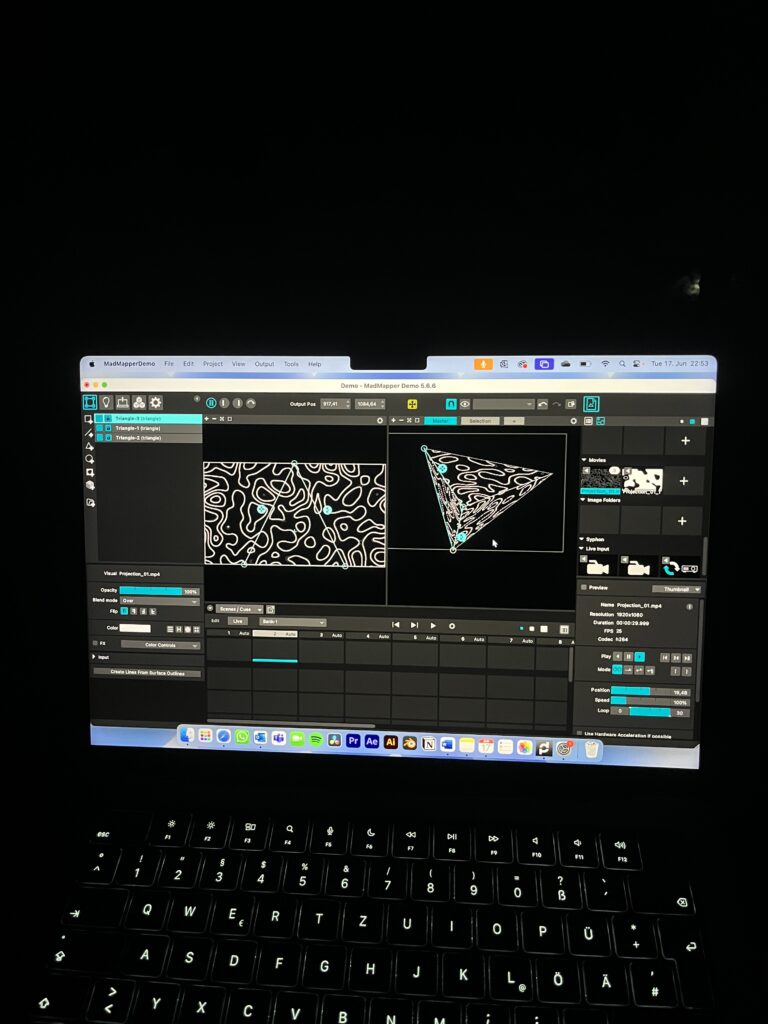
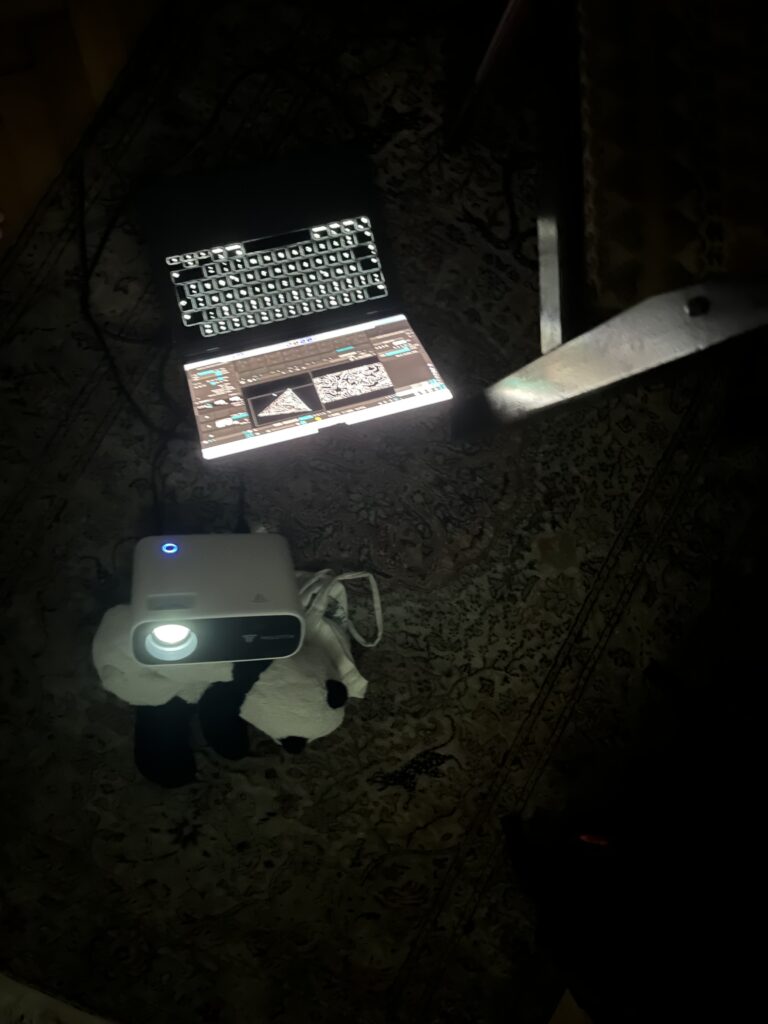
After all the tests on flowers and organic forms, I wanted to see how projection mapping works when the surface isn’t soft or round – but sharp, structured, or even broken up by corners. So I started experimenting with projecting onto walls, especially corners and edges, to see how that would change the way the animations behave. Corners introduce a physical break in space, which in turn changes how moving images behave when projected. What interested me most was the possibility of creating a three-dimensional effect relying purely on the existing geometry of the room and the way light reacts to it. I again used a the same looping animation with abstract line structures, resembling topographic patterns or fluid motion. These visuals were mapped in MadMapper onto three triangular shapes that met in the center of the corner, forming a pyramid-like projection. The projector was placed at an angle, ensuring both walls and the corner edge were evenly lit. Aligning the shapes precisely was essential. The corner created a sharp visual interruption, which affected the animation in subtle ways. The flowing lines changed their rhythm at the edge, appearing to bend, break, or stretch depending on the viewer’s position in the room. From certain perspectives, the shape seemed to float, detached from the architecture. From others, it flattened completely.
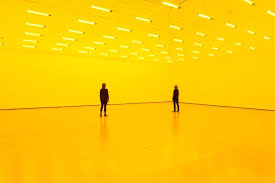
Thinking about this approach it led me to consider artists who also integrate space into their visual work. For example an artisit I have been reading about a lot, James Turrell’s installations, he often uses light to define architectural features or even erase them altogether. In works such as Raemar Pink White (1969), walls and corners dissolve, and the viewer is left with an experience of light as form. Turrell’s work highlights how light can transform a neutral space into something immersive and perceptually complex. Another great artist, Olafur Eliasson takes a similar approach, using reflection, refraction, and color to change how space is understood. In Room for One Colour (1997), he shifts the viewer’s experience of an ordinary room by bathing it in monochromatic light, revealing how easily our perception adapts to manipulated environments. Both of these artists treat space not as a container for content but as an active component of the visual experience.
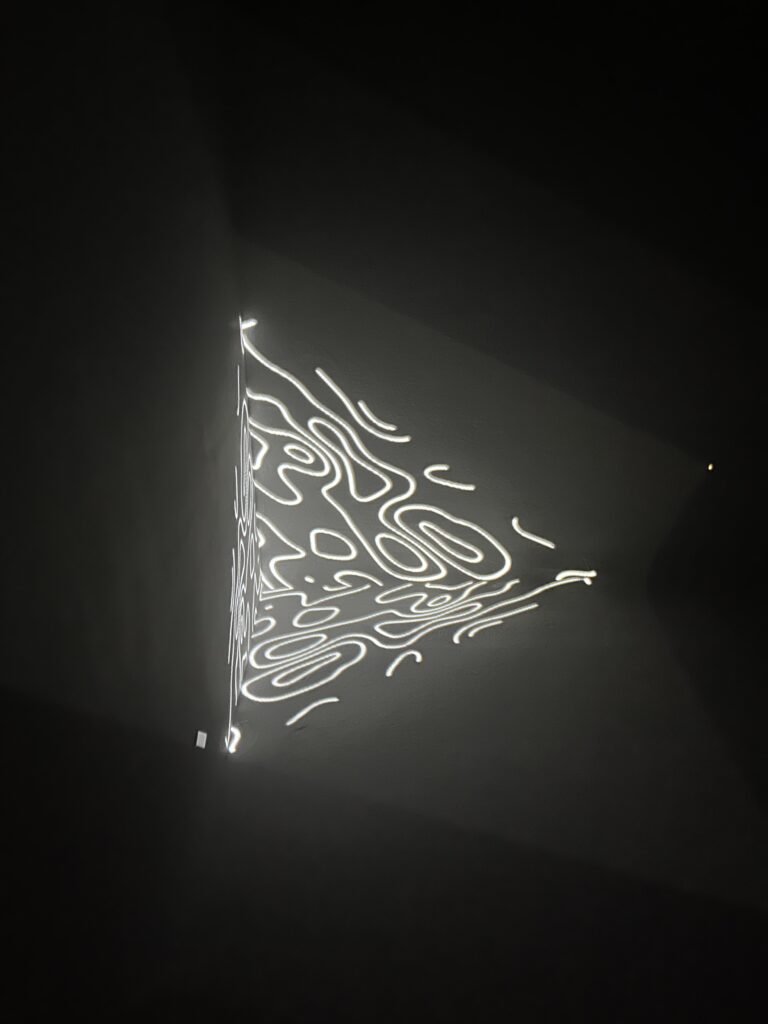
Working with a corner also brought up some new questions. The same animation looked different depending on where I stood. From the front, it formed a clean shape. From the side, the lines stretched or collapsed. That made the projection feel less like an image and more like something connected to the room. The movement was influenced by the space, not just by the animation itself. Comparing it to previous tests on flat surfaces, this setup felt more spatial. The projection wasn’t just placed on a one surface. The edge of the corner changed how the visuals behaved.
