Recently, we had a workshop at the University of the Arts London with Ella, the Course Leader of the MA Design for Social Innovation and Sustainable Futures at London College of Communication. The workshop is part of a larger task for this semester: creating a future newspaper set in the year 2046. Each of us has to develop our own project that exists within this imagined future, while also working with a local community. It sounds simple at first, but the question behind it feels much bigger: how will the future look, and how do we position ourselves within it as designers?
I’ve noticed that thinking about the future makes me slightly uncomfortable. The future feels abstract, uncertain, and difficult to hold onto. I realised that I often find more comfort in looking at the past, in personal stories, cultural references, and existing memories. At first, I thought this might be a limitation. But Ella’s talk shifted my perspective.
One thing she said that stayed with me was: “Joy is radical.” In a time where so much of the future is discussed through crisis, climate change, political instability and uncertainty, choosing to focus on joy can itself become a form of resistance. It made me realise that future-oriented design doesn’t always have to come from fear or urgency. It can also come from care and hope.
Ella showed us several projects from her students, and one in particular stayed with me. It was created by an international student from South Korea, who asked the question: What if South Korea had never been colonised? She explored this question through deeply personal and visual methods. She rearranged photographs in her grandmother’s home, imagining how her family might have dressed or lived under different historical conditions. Through this process, she connected speculative thinking about the future with reflections on the past. What I found especially interesting was how this exploration eventually led her to something completely different: kimchi and sustainability. She created her own kimchi brand, using food waste from restaurants to imagine more sustainable production systems. I was fascinated by how a thesis that began with history and identity could evolve into something so tangible.
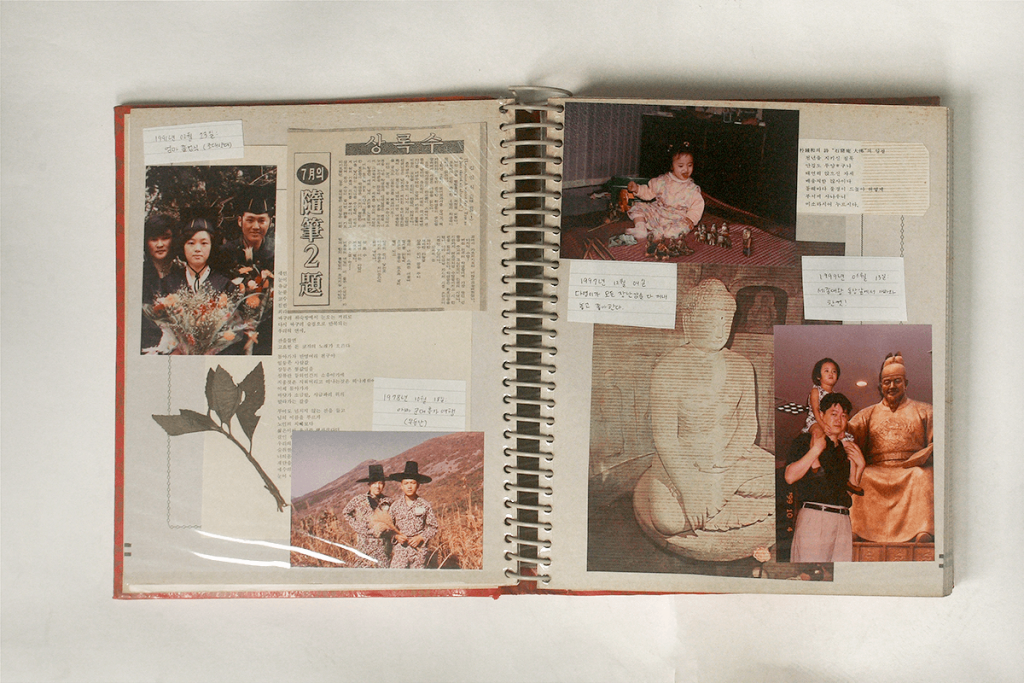
This project also reassured me on a personal level. It showed me that working with the past doesn’t mean you’re stuck there. The past can become a tool to imagine alternative futures. As someone who is interested in cultural memory and my own background, this approach felt very close to how I want to work.
Another moment during the workshop that stayed with me was when one of my classmates presented her idea that chocolate might no longer exist in the future due to climate change and resource scarcity. One suggestion I particularly loved was the idea to make people write letters and give them chocolate-flavoured stamps, allowing people to value it while we still have it.
Links:
https://read.followingthefootprints.com/p/the-check-out-20-theferm
https://madsisf.myblog.arts.ac.uk/2020/06/11/rebecca/
https://www.arts.ac.uk/colleges/london-college-of-communication/people/ella-britton
