I already played with the thought of including a statue or something “live” in the exhibition before, but I never knew what exactly. I kept thinking about my celery experiment. I could place one right in front of the entrance, or hide it somewhere in the space like a tiny secret for the people who actually pay attention.
But this week I got inspired again by the KING Paulus Goerden. He had the brilliant idea to capture his everyday installations but not through a photograph. He actually REBUILT THEM IN MINIATURE VERSIONS.
And I have to say: this is genius.
Because it adds a whole new layer to the act of documenting. A photograph is still a translation, but it’s a very common one. Everyone takes photos. Everyone documents. Especially in the age of Instagram, photographing something “interesting” is almost the default reaction. It’s quick, it’s effortless, and it often stays on the surface.
Rebuilding an installation is different. It’s slower. It forces you to make decisions. You suddenly have to look at the scene like a designer, not just like a photographer. What exactly makes the arrangement work? Is it the proportions? The materials? The awkward tension between objects? The exact angle of something leaning? The fact that it looks accidental but somehow perfectly balanced?
I immediately noticed things I would normally overlook. For example: it’s not just “two palettes leaning somewhere.” It’s the surface underneath, the texture of the street, the way the metal barrier frames it, the little gap between the objects, and the fact that the whole thing looks like it could collapse at any second.
A reconstruction turns the installation into something you can’t just consume visually. You have to understand it structurally.
And it also shifts the question of authorship in a really interesting way. When I photograph an everyday installation, I’m still only the observer. I didn’t create it, I “just” framed it. But when I rebuild it, I’m suddenly much closer to becoming part of it. I’m recreating something that originally had no artist. I’m taking a random street moment and turning it into an object with intention.
Which feels slightly illegal. Oopsie
I also like the idea because it makes the exhibition more physical. Photography exhibitions can sometimes feel distant. But if there are small reconstructed installations in the space, the whole thing becomes more immersive. It could make people slow down. It could make them compare. It could make them question what’s “real” and what’s “recreated.”
So right now I’m seriously considering building a mini version myself. Like: the photograph shows the found moment, and the miniature shows the act of re-seeing it.
Because in the end, this thesis isn’t only about what is out there in the city. It’s also about what happens when I decide that something is worth noticing.
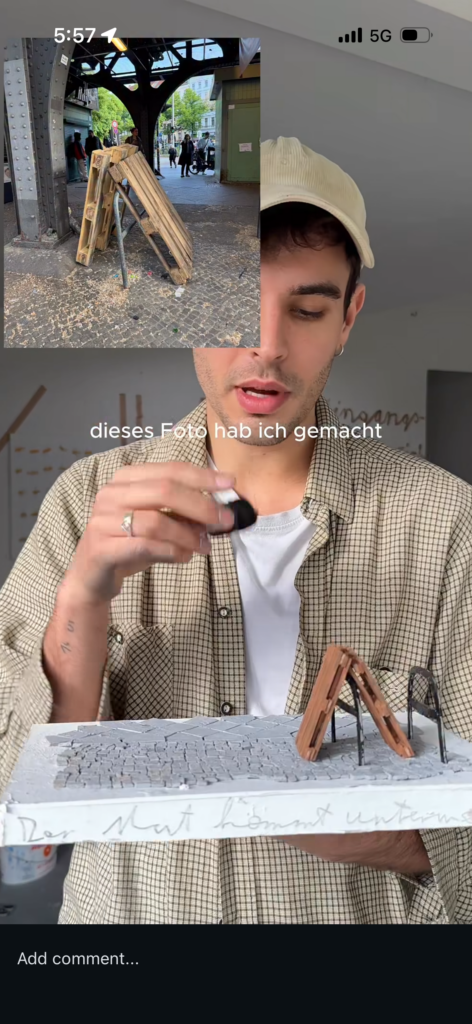
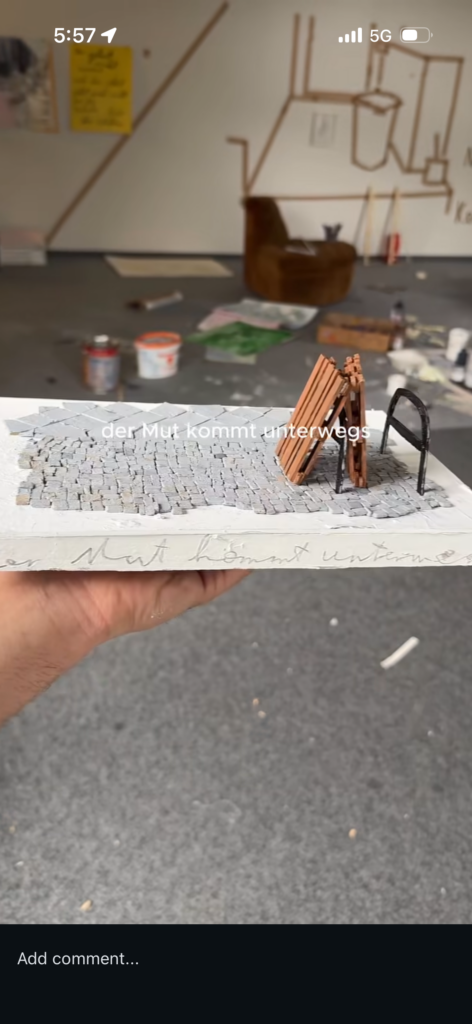
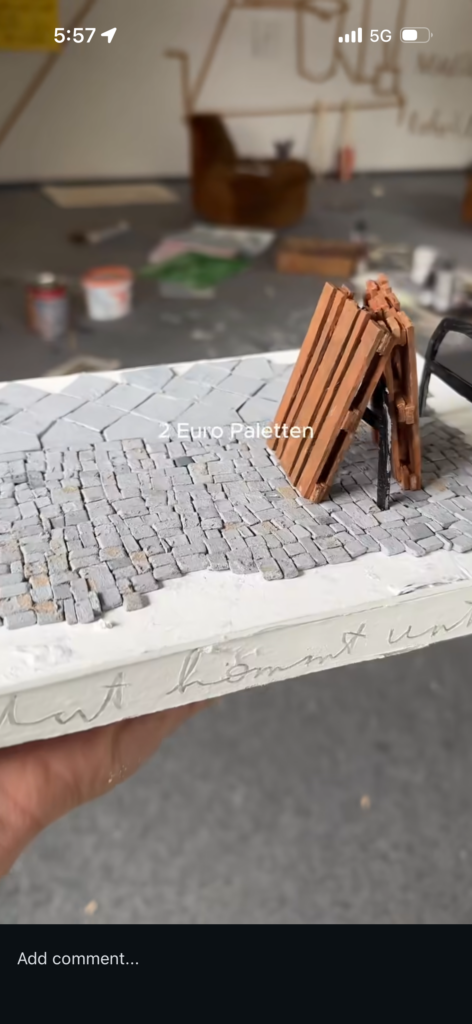
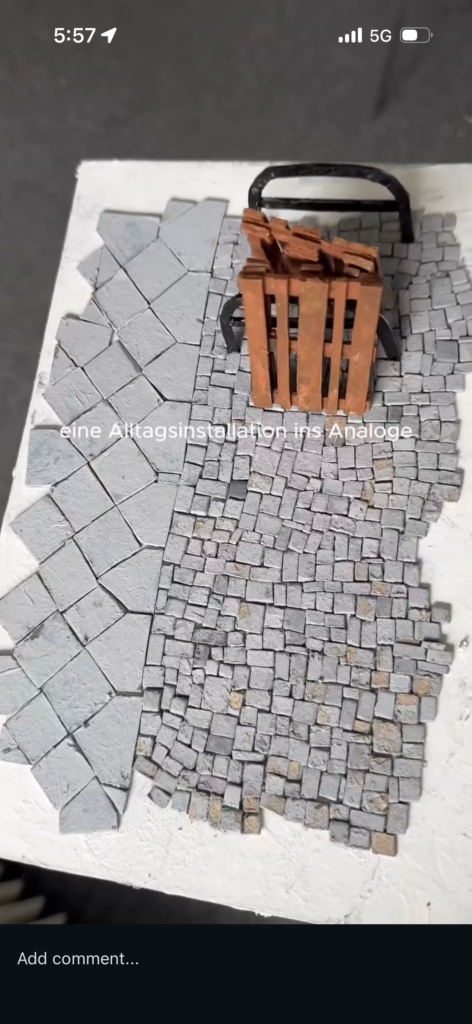
Paulus Goerden. “Ein Versuch es einzufangen” Instagram video, January 11, 2026. Screenshot. Accessed January 13, 2026. https://www.instagram.com/paulusgoerdon/
Let me know in the comments what you think of his interpretation of this everyday installation.
