For this Impulse blog entry, I wanted to share my insights from my lectures at Kingston University. After my first lecture, I felt so inspired that I went straight to the library and started doing research that would eventually lead me toward my master’s thesis topic.
On our first day, we got to hear about the career path of our lecturer, Cathy. She talked about moving through different creative and political spaces, from being part of a rebel music group to convincing students to create an alternative art school as a form of protest against London’s high tuition fees. The way she told these stories was incredibly engaging. With her comedic timing and honesty, it felt much more like sitting in the audience of a stand-up show than attending a university lecture. Of course, because it was my very first lecture in London and I was already buzzing with excitement about learning new things, I was probably way more impressed than everyone else. For the other students, it was likely just another rainy Thursday morning.
What I appreciated most about this lecture and the course in general is how seriously the university prepares students for their dissertation. This entire semester is dedicated to finding and shaping a topic, and they really take the time to guide us through that process. All the research we do is meant to lead toward a final project, supported by workshops that help us along the way. We work in groups, talk openly about our ideas, and constantly reflect on where we are and where we want to go.
One piece of advice Cathy keeps repeating really stuck with me: “Start with something small, you can always go bigger.” It’s exactly what I’ve been struggling with. I have a tendency to aim straight for big, complex problems that realistically require way more power, time, or resources than I currently have. Cathy explained that it’s often much more effective to start with something small and specific, and then slowly build on it. Over time, that small idea can grow, expand, and take on more layers. That’s what I’m trying to focus on now: collecting smaller ideas, letting them develop naturally, and then gradually adding more literature, references, and sources.
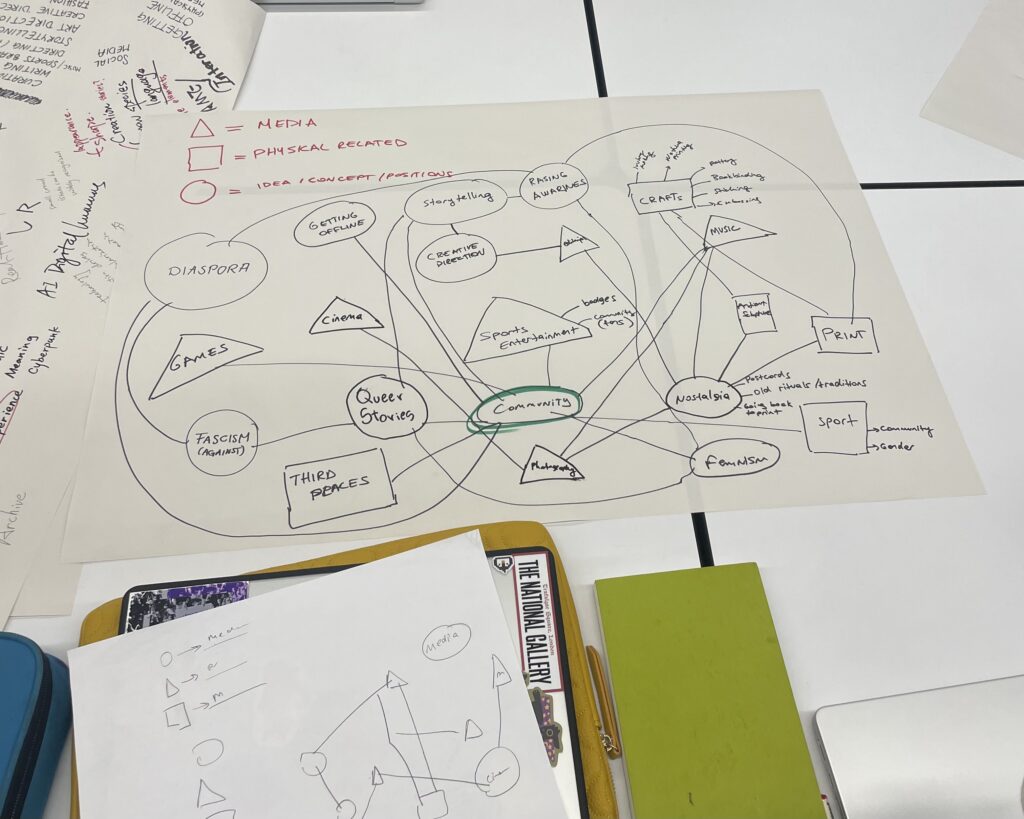
To help us through this process, Cathy divided us into three groups: Making Public, Making Situated Knowledge, and Making Meaning. Within these groups, we wrote down all of our interests and started mapping them together with the others. This simple exercise turned out to be surprisingly powerful. Seeing my thoughts laid out visually and alongside the ideas of others helped bring some structure to the chaos that had been floating around in my head. It made everything feel a little more tangible and manageable.
Links:
DE7608 intro Graphic Design – Future Practices Slides
https://docs.google.com/presentation/d/1SvQrDOy-4GwHipNV4sZ7klFm0ZUWH4DDy84T-SGMcjQ/edit?slide=id.p#slide=id.
Our Mindmaps:
https://padlet.com/qr-code/lhh5tuq2qwomtmav?source=image
