Before arriving at my current thesis direction, I spent a long time thinking about randomness. I was interested in how things appear unstructured, accidental, or uncontrolled. At the time, I didn’t yet have the language to describe what exactly fascinated me about it. It was more of a feeling than a clearly defined concept.
As my research progressed, I began collecting thoughts, references, and observations in my Figma file I showed you before. Looking at everything together, I started noticing connections between ideas that initially seemed unrelated. Many of the things I was drawn to shared a similar tension between order and disorder. They were not completely random, but they also weren’t fully controlled.
At some point, I wrote down the phrase “curating chaos.” It wasn’t something I had read anywhere. It was just an attempt to describe what I was observing. When I later searched for this term, I realised that it already existed. I came across several articles that explored similar ideas, including one titled Curated chaos: What Instagram’s photo dumps say about art today. Reading it felt like encountering something I had already been thinking about, but expressed in a different context.
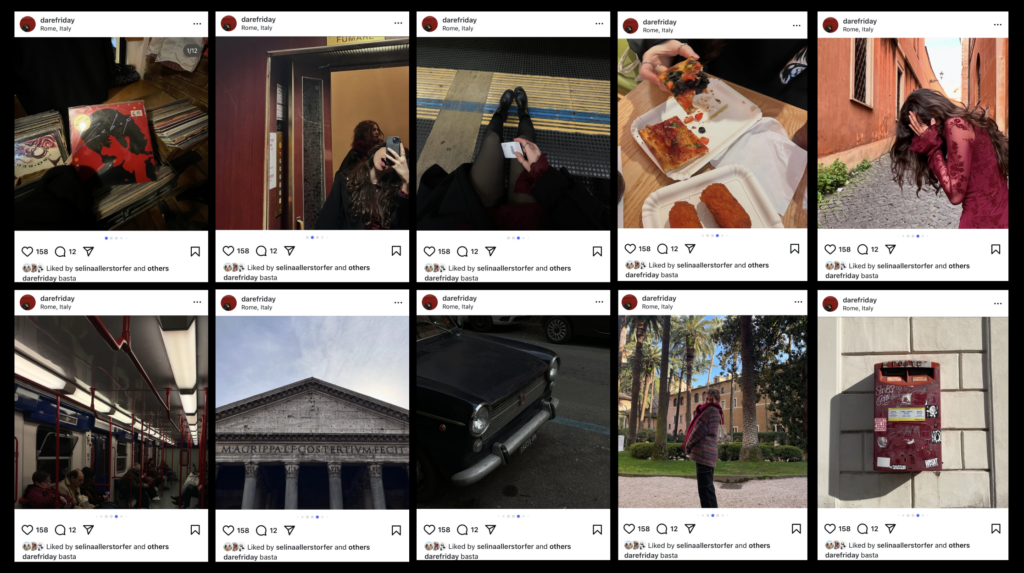
The article described the rise of “photo dumps” on Instagram: collections of images that appear spontaneous and unfiltered, but still communicate a specific atmosphere or identity. At first glance, they seem chaotic and unstructured. But looking closer, they often create a carefully constructed impression. The chaos is intentional. This made me realise that chaos, especially in visual culture, is rarely neutral. It can be used as an aesthetic or a strategy.
The article also reflected on how Instagram has shifted from a platform focused on individual images to one driven by volume and engagement. Posts with multiple images receive significantly more visibility than single, carefully crafted works. As a result, artists are often pushed to produce more content, rather than more meaningful content.
This creates a tension between artistic integrity and algorithmic visibility. Instead of rewarding depth, the system rewards frequency and engagement. Chaos becomes not just an aesthetic, but a condition created by the platform itself. What interested me most was the idea that even chaotic image collections still communicate something coherent.
This connects directly to my own research process. My Figma file, for example, could also be seen as a form of curated chaos. It contains fragments from different sources like books, conversations, lectures, images, and ideas. Individually, they may seem disconnected. But together, they begin to form patterns.
My previous interest in randomness was never really about randomness itself. It was about how meaning emerges from seemingly disorganised systems. Finding this article helped me understand that my thesis topic had been present from the beginning, even when I didn’t have the words for it yet. The concept of curating chaos connects many of the themes I have been exploring, including attention, atmosphere, creative direction, and perception.
I really think that creative direction itself can be understood as a process of curating chaos. It involves selecting, organising, and giving form to something that initially exists in an open and undefined state. Rather than eliminating chaos, creative direction works with it.
Links:
https://www.catalinamunoz.me/p/curated-chaos-what-instagrams-photo
