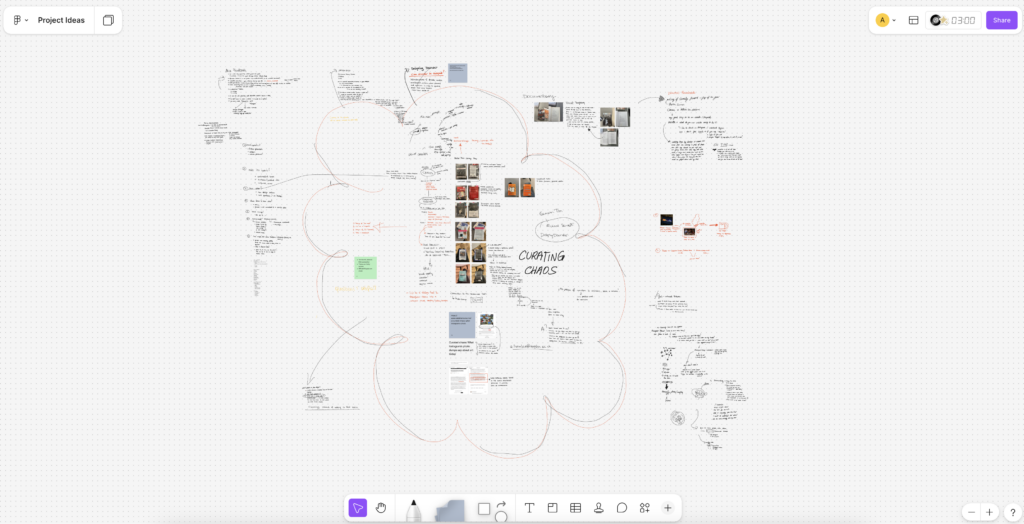
One of the first concrete steps I took in my research process was creating a Figma file to collect references. Instead of using traditional academic tools, I began documenting books, images, and thoughts visually. Whenever I found a book in the library that interested me, I took photos of the front and back cover and placed them into this file.
This method might feel informal and unstructured for some. I mean, it did not follow conventional academic standards, and people might question whether it is the “right” way to approach research. However, I realised that this visual system allowed me to engage with my research in a more intuitive way.
Seeing the books as images, alongside my own notes and reflections, made the research feel more tangible. It allowed me to see relationships between different sources more clearly. Instead of existing as isolated texts, the books became part of a larger visual landscape of ideas.
What surprised me most was how naturally patterns began to emerge. Even when I selected books based on intuition rather than relevance, many of them explored similar themes. Questions about perception, environment, attention, and meaning appeared repeatedly.
Over time, the Figma file became much more than just a collection of books. It started to include everything that influenced my thinking. I wrote down things that were said during lectures at Kingston, notes from the workshop at UAL, and reflections on documentaries I watched, even when they were not directly related to my thesis. I added feedback I received from my lecturers, ideas my friends shared with me in conversations, and even things my dad said that stayed with me afterwards. Sometimes it was just a sentence, a question, or a song title that captured a certain feeling or direction.
This made me realise that research does not only happen in structured academic settings. It happens constantly, through conversations, experiences, and observations. The Figma file became a space where all of these fragments could exist next to each other. It allowed me to take these moments seriously and recognise them as part of the research process. (I love it)
This process helped me understand that research does not have to follow a rigid structure from the beginning. Developing a personal system made the process more accessible and engaging. It also made me more confident in trusting my own way of working. Looking at the file now, I don’t see a finished structure, but a growing archive of my thinking. What initially felt random and unorganised slowly began to form connections.
