(Offline Activity – mini experiment with 3 participants, 1 hour)
For this impulse I wanted to test something that sits at the center of my thesis: framing. I keep writing about how context changes meaning, and how the same everyday installation can be read as trash, as suspicious, or as art depending on how it is presented. But instead of staying in theory, I decided to test it with a small experiment.
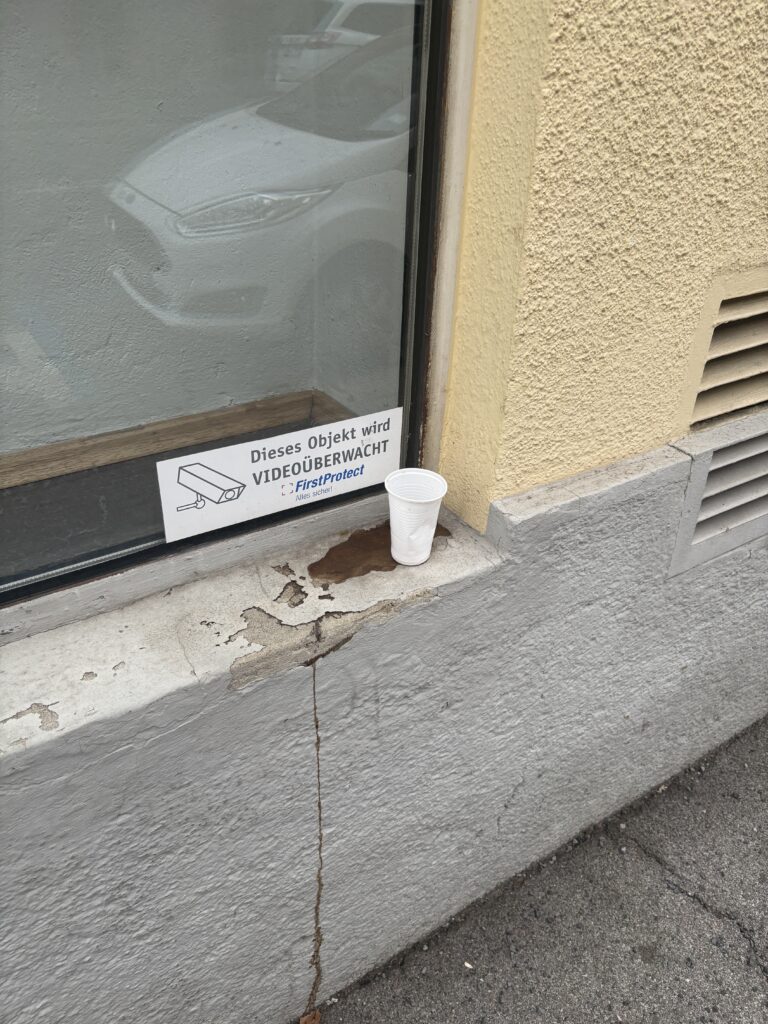
I used one photograph from my archive, taken in Graz (Geidorf) on 03.12.2025. The image shows a very simple scene: a white plastic cup placed on a window ledge. Under the window there is a sign that reads: “Dieses Objekt wird VIDEOÜBERWACHT.” The cup itself looks casual, like someone just left it there after drinking. At the same time, the surveillance sign makes the situation feel strangely tense. It turns a completely ordinary object into something that suddenly feels “watched,” important.
I then showed this image to three different people. All three participants were non-design friends, which was important for me because I wanted reactions that are not trained through art or design education.
The setup: I showed everyone the exact same photograph in three different framings.
Version A: the image without any title or context.
Version B: the image with an artsy title (Surveillance Cup, 2026).
Version C: the image with additional context (date, location, and the label “found everyday installation”).
I asked each participant the same questions:
- What do you think this is?
- Would you describe it as art? Why or why not?
- What do you think is happening here?
- Does the title or context change your interpretation?
- Would you stop and look at this in real life?
Across all three participants, the first reaction was surprisingly similar: they tried to explain the scene through logic. The cup was interpreted as “someone’s trash,” “a coffee left behind,” or simply “a random thing on a ledge.”
But even in Version A, the sign already triggered something. All three people mentioned the surveillance text immediately. Without me asking, they started wondering why the sign was there, and why it was placed so close to the cup. The cup became suspicious because of the context around it.
Once I introduced Version B (the title), the reactions shifted. The participants stopped treating the cup as a practical object and started reading the scene as a message. One person said it feels like “a joke about how seriously we take surveillance, even when there’s nothing to protect.” The title didn’t fully convince them that it is art but it did change the way they looked at the image. They started searching for details.
Version C created another shift. When I added the location and the label “found everyday installation,” the participants became more open to the idea that the scene could be something worth noticing. Interestingly, the added context didn’t make the scene feel more emotional. It turned the image from a random situation into something documented on purpose.
What became very clear is that framing does not only change the final judgment (art or not). It changes the entire viewing process. In Version A, the image was scanned quickly. In Version B and C, the participants looked longer and started analysing: the stain under the cup, the typography of the sign, the relationship between object and text, and the strange contrast between cheap plastic and official surveillance language.
This experiment was useful because it produced direct evidence for something I’ve been circling around for months: meaning does not sit inside the object. Meaning happens between the object and the viewer. And even minimal framing can push interpretation in completely different directions.
For my thesis, this confirms that everyday installations can communicate — but they do not automatically do so. Communication begins when attention is activated. Sometimes all it takes is a title. Sometimes all it takes is one sentence. Sometimes it takes a whole institutional frame.
As a next step, I want to repeat this experiment with more images from my archive and compare which types of everyday installations react most strongly to framing.
Links
https://www.britannica.com/topic/framing
https://www.britannica.com/science/semiotics
https://www.britannica.com/science/Gestalt-psychology
AI Disclaimer
This blog post was written with the assistance of AI.
