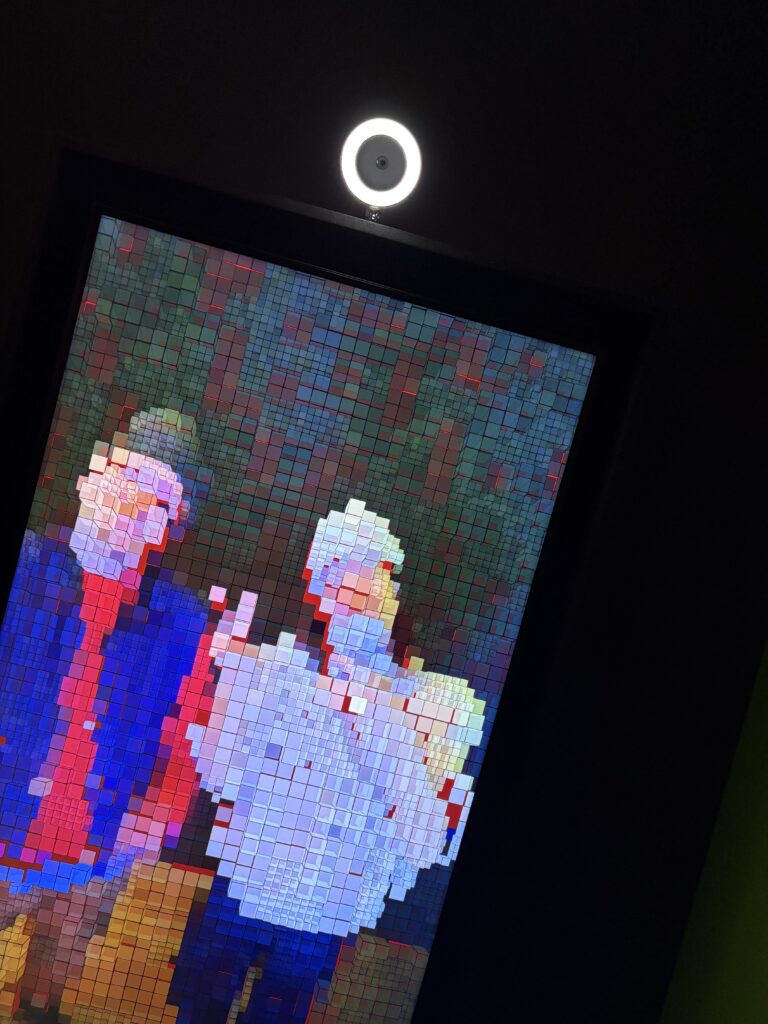
When I visited the Kunsthalle in Munich, I honestly had pretty high expectations of what I was about to see. My mom had visited the exhibition previously and was talking about how nice and impressive she experienced it. In the past, I have made a couple of visits to a lot of immersive exhibitions, and many of them start to feel very similar. What surprised me about “Digital by Nature – The Art of Miguel Chevalier” was that I could often imagine how the works were made. I kept thinking about Processing, generative systems, maybe some robotics or AI running in the background. Instead of ruining the magic, this actually made me happy. It didn’t feel like some unreachable high-tech spectacle, but more like something that exists on the same planet as my own small experiments. Because of that, I feel like I moved through the exhibition a bit differently, less like a visitor just taking photos, and more like someone walking through and taking notes on what I could try out as well.
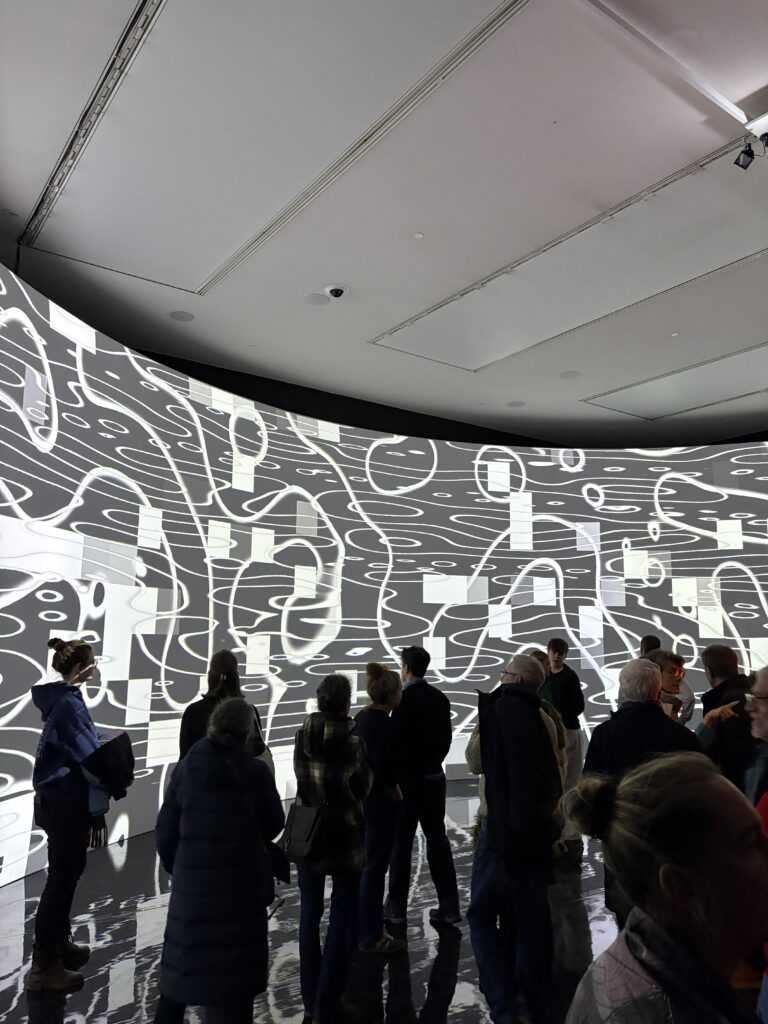
The first big projection room already set the tone. A large curved wall was filled with flowing animations that reacted subtly when people came closer or moved their arms. I liked that the room didn’t explain too much. It just invited you to figure out the system with your body. At first, I thought it was mainly about pretty visuals, but after spending some time there, I realized how choreographed the whole space actually was. The reflections on the shiny floor doubled the image, the sound, or sometimes even the absence of sound, influenced how long people stayed, and the movement of the crowd became part of the composition. It made me realize again how important physical space is for digital work, something I often forget when I’m just sitting in front of my laptop.
Later on, I spent quite a bit of time with the works where Chevalier combines AI with floral motifs. These generative flowers reminded me a lot of a project I saw at Klanglicht 2024, where Processing was used to create plant-like forms that constantly changed shape. Here, the idea felt similar but pushed further. The flowers didn’t just move, they seemed to grow, dissolve, and transform, almost like watching an artificial ecosystem in fast-forward. I noticed that this kind of imagery really speaks to me because it sits somewhere between digital and organic. In general, I have noticed that I like to work with natural elements and not just simply digital things. For my own work, this opened up the idea of using generative techniques not only for abstract visuals, but for forms that reference the real world without directly copying it.
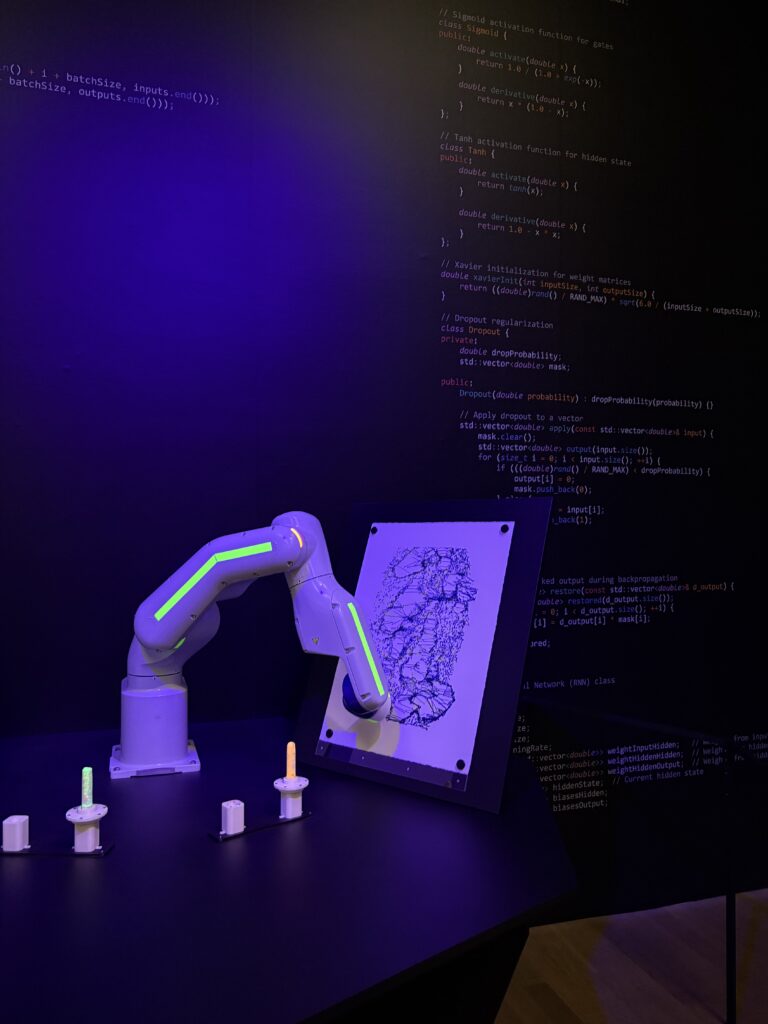
At the same time some rooms felt a bit too polished, almost like they were mainly designed to be photographed. The surfaces were very glossy, the colors extremely intense, and sometimes it felt like the technology was there mostly to impress. I realized that I was more interested in the works that showed some roughness. For example, the drawing robot with its industrial arm and felt-tip pen, or pieces where small delays and glitches were still visible.
One of the nicest feelings I had throughout the exhibition was this sense of “I kind of understand how this could work.” In the past, I often looked at digital installations and thought that they must have been made by huge teams using some kind of very complicated technologies. Here, even if I didn’t know the exact details, I could imagine basic structures: shaders reacting to movement, particle systems, data mapped to color and form, maybe some kind of camera tracking feeding into generative visuals. For my own project, the exhibition gave me a few clear impulses. I want to think more about how people physically move in front of my work and how this movement can become part of the piece, instead of just triggering random reactions. I’m also very interested in this mix of organic imagery and clear digital structure, almost like nature wearing a pixel costume.
