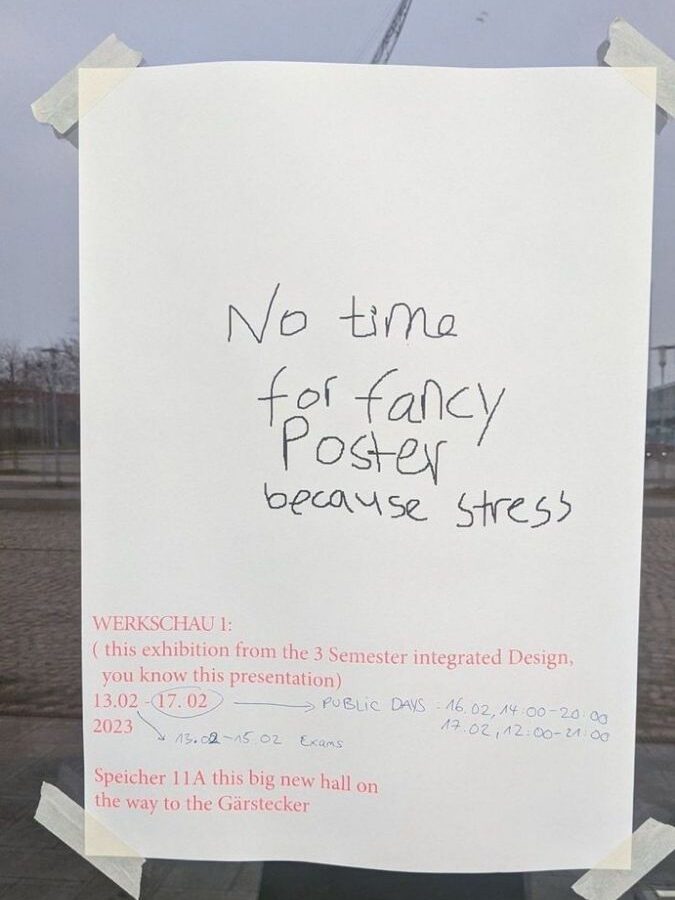
Sometimes I scroll past something like a blurry flyer, a crooked layout, a typo on a poster and instead of seeing it as a mistake, I pause. Not because it’s “good” design, but because it feels real. I keep coming back to this question: can a design fail on purpose? And even more what if that failure is what makes it memorable? Text misaligned, color combinations that clash, images pixelated beyond recognition. But somehow, it sticks.
We’re taught that good design should be functional and clean. But in the wild, in cities, on street corners, and walls layered with years of posters, we see something else. We see communication that’s chaotic, emotional, confusing but also honest. It doesn’t always follow the rules. And maybe that’s exactly why it sticks with us.
There’s a term in music called “perfect mistake”, when something technically wrong sounds better than what was planned. Maybe design works the same way. Maybe a clashing color combination or awkward composition leaves a stronger impression than the perfectly aligned, grid-locked poster.
When design tries to be too perfect, it often blends into everything else.
I started thinking about this as “visual noise”, a layer of design pollution that feels out of place in clean visual systems. But what if that noise is actually part of the city’s memory? What if that sticker someone made at home on Word and slapped onto a pole at Südtirolerplatz is part of the design culture here, even if no designer approved it?
So what does it mean to intentionally design something that’s not “right”? Can failure be a method? Some artists and graphic designers already work this way, playing with bad spacing, clashing type, broken printing processes. The point isn’t to be anti-design, it’s to reframe our idea of what visual communication can be.

Reading “The Shape of Things” by Vilém Flusser, I came across this:
“Design is a trick — a way to make function appear as form, and form as intention.”
Flusser argues that design is always somewhat misleading. It guides us while pretending to be neutral. But once you notice the trick, the illusion breaks. That’s where broken design or “anti-design” becomes interesting. When it refuses to play by the rules, it draws attention.
That’s also what Brückner explores in “Rough: Anti-Design”. How glitch aesthetics, misprints, raw textures, or visual overload became part of a new graphic language. Especially in an age where everything is optimised and polished, this type of chaos feels honest. These “failures” remind us that a person was there and not a content strategy.
What happens when design stops performing efficiency and instead creates space for emotion? What if “bad” design is a more accurate reflection of our overstimulated world?
Sources
Brückner, L. (2021). Rough: Anti-Design, Glitch Aesthetics and the New Imperfection in Visual Culture. Berlin: Gestalten.
Flusser, V. (1999). The Shape of Things: A Philosophy of Design. Reaktion Books.
Elkins, J. (2003). Visual Studies: A Skeptical Introduction. Routledge.
