#15 Prototyping

TOPIC IS CHOSEN: urban planning

Introduction and background

The project went in the direction of urban gardening and creating good city spaces for people. I have been very inspired by Jan Gehl, the danish architect behind the “human friendly cities” movement and the urban strategy company Gehl. They work with relationships between people, their communities, and the broader systems that sustain the planet.

The key difference between standard of living and quality of life, as I see it, is that standard of living comes down to the money we have and how we spend it, whereas quality of life is about the time we have and how we spend it. One is more about quantity, the other is more about quality

Gehl 2019

David Sim, the creative director at Gehl, wrote an article about the Soft City, of how to design the physical environment of our cities and towns, neighbourhoods, and streets to give us more time for the things that give us meaning (Gehl 2019). They emphasis that the “time left” in your day, should be spent doing something meaningful and not commuting, or running stressful errands far away from where you live. Their take on the problem is to design urban spaces that gives you closer proximity to the places we visit on a daily basis like school, work, shops, parks, and freetime activities.

Ideation

When in the universe of urban planning, I wanted to do something that could contribute to solving more than one problem. What if I tried to design a space in the city that could do this?

From research, I found that green areas do good for people and the environment. Therefore, I went into the universe of urban gardening. Also that co-locating everyday activities into one place in close proximity to home would give better lives as you would spend less time in transit. A necessity for these spaces is also that it can bring enjoyment and fulfilment, for example by making a practical task like getting to work more pleasantly by biking through a park (Gehl 2019). So how to give peoples lives more meaning through urban spaces?

The idea came down to create a space between the houses, that could function as a place to rest, to meet with your neighbours or friends, and to give you the opportunity to work on a garden. These assets I thought to be a good combination, and something that both can boost an individuals life, but also boost the community in the neighbourhood.

An inspiration for vegetable garden is a garden association in Trondheim (see picture below), by study town in Norway, where you can sign up and join gardening in the middle of the city. When a member, you both contribute, but also get to enjoy the benefits and the produce.
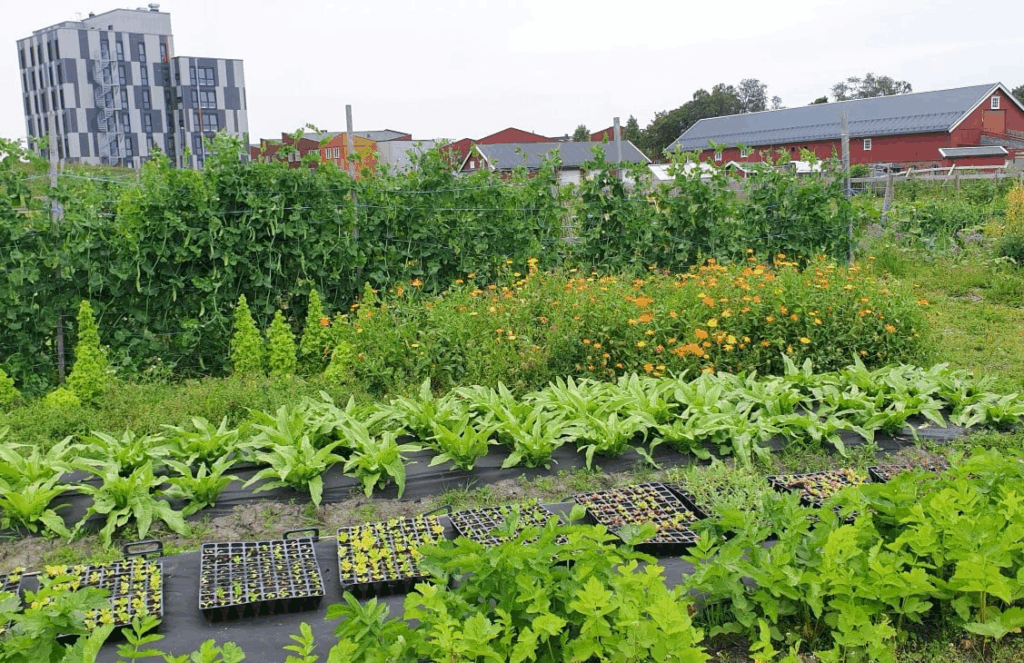
Local vegetable garden, Markedshager Norge

Other inspiration is “Grow more”, a modular urban gardening set that accommodates a hangout area:
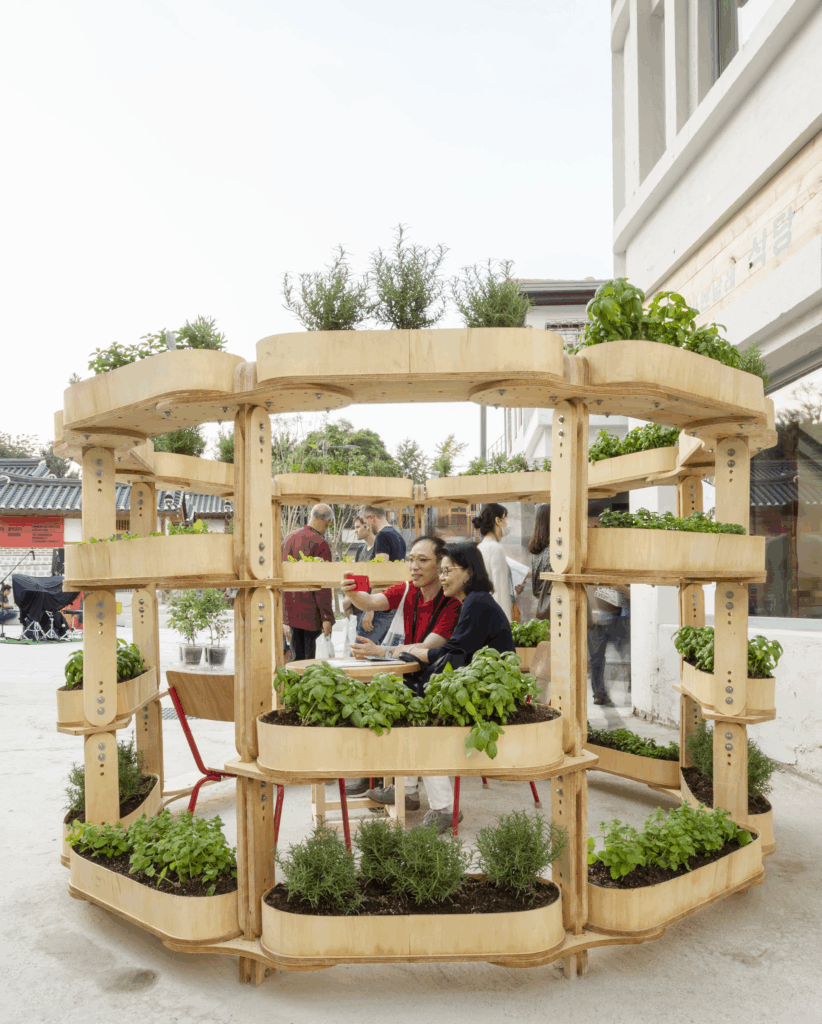
Grow more, by Sine Lindholm

What I want to include is:

  • seating area to hang out
  • something green, either vegetable garden or also just bushes or trees
  • modularity, self planning system?

Should be:

  • inviting
  • intuitive
  • aesthetically pleasing

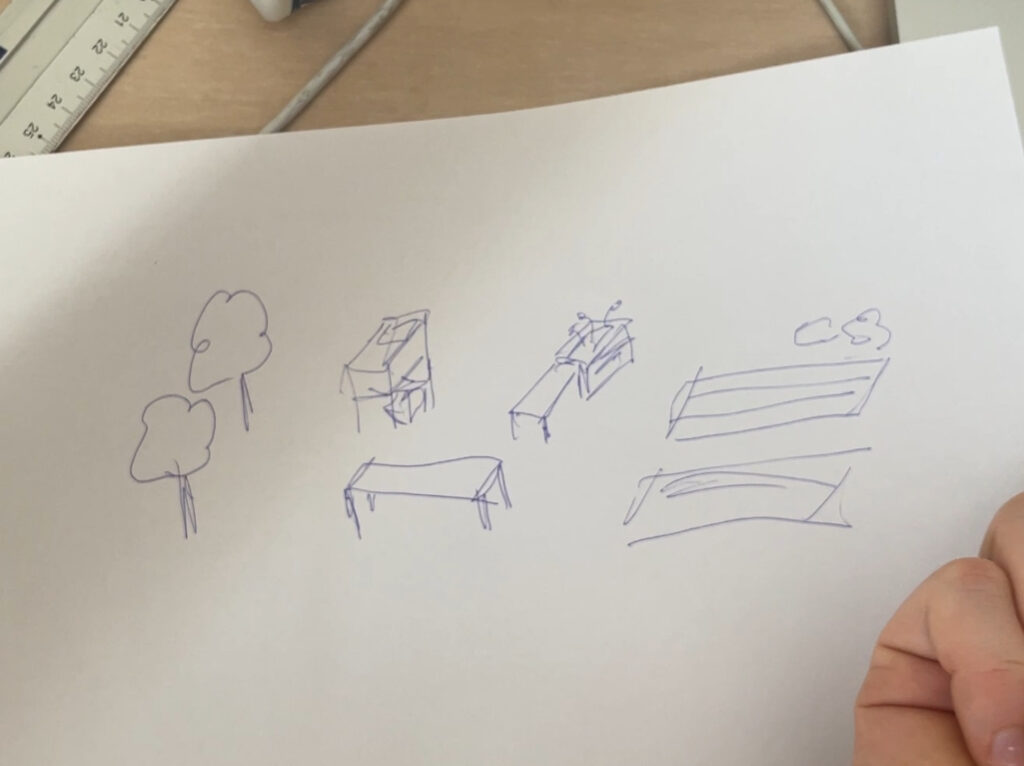
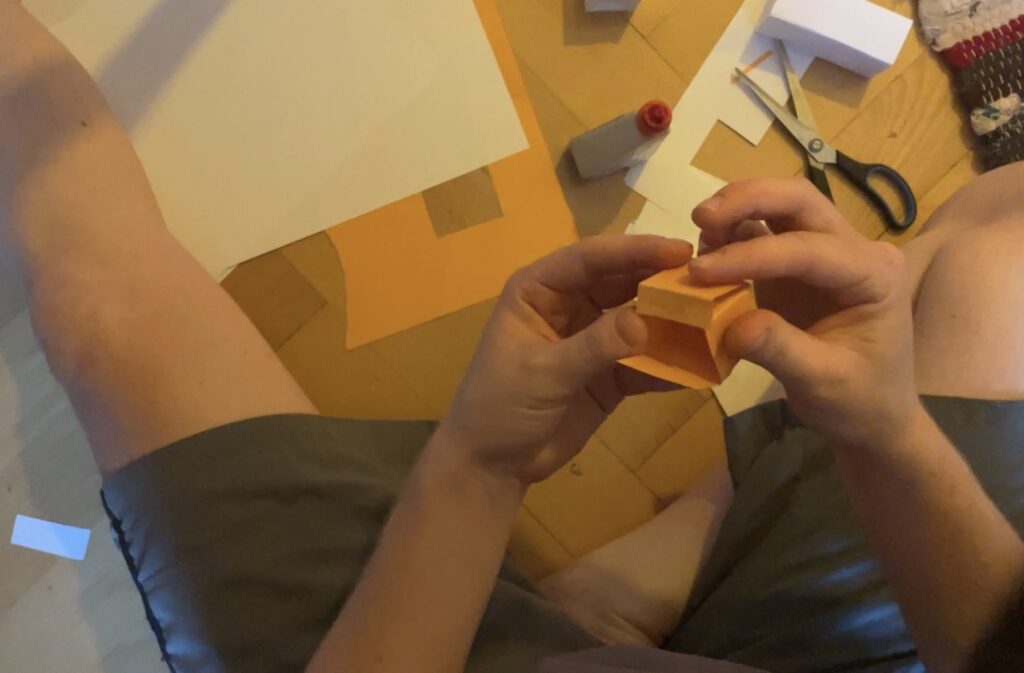
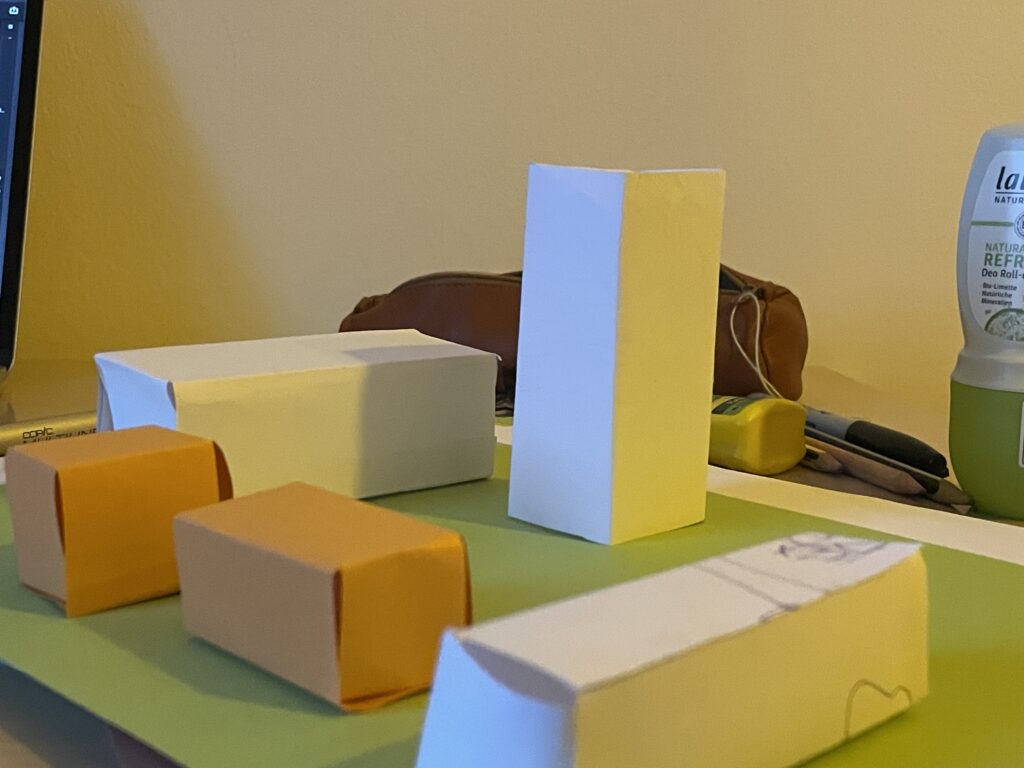
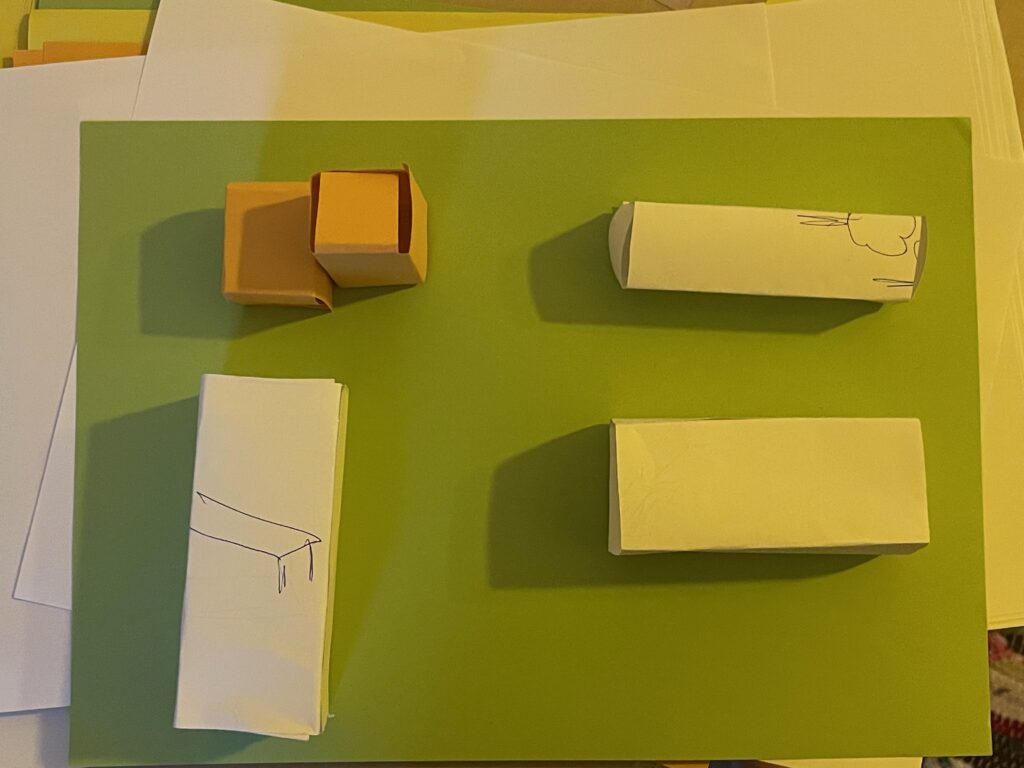
Ideation prosess shown through pictures

I am very glad I chose paper when prototyping the modules. The end result worked perfectly fine for visualising the idea, even though each one of them where very lo-fi and not perfect.

The idea

The final idea is a modular set of seating area, plant boxes, tool crates, work benches and everything else needed for the urban gardening space. In the first round, I want to make a toolkit for planning and envisioning the space – for anyone who would like to implement this. In the future, I would like to make real size modules and try them out in an actual city context.
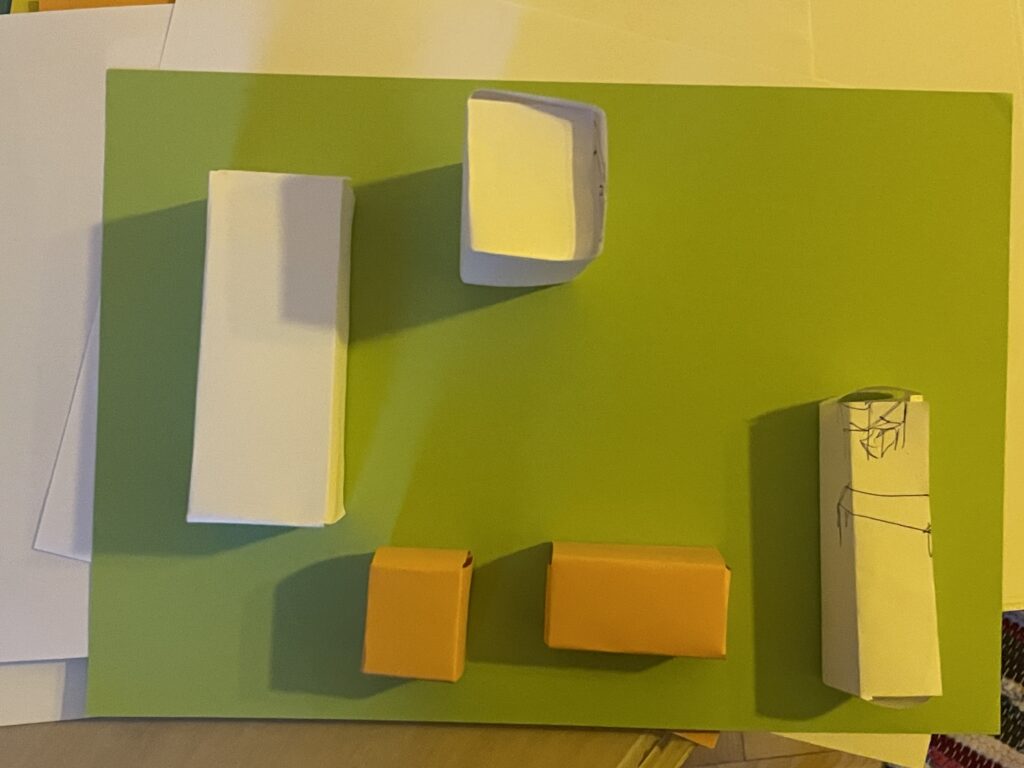
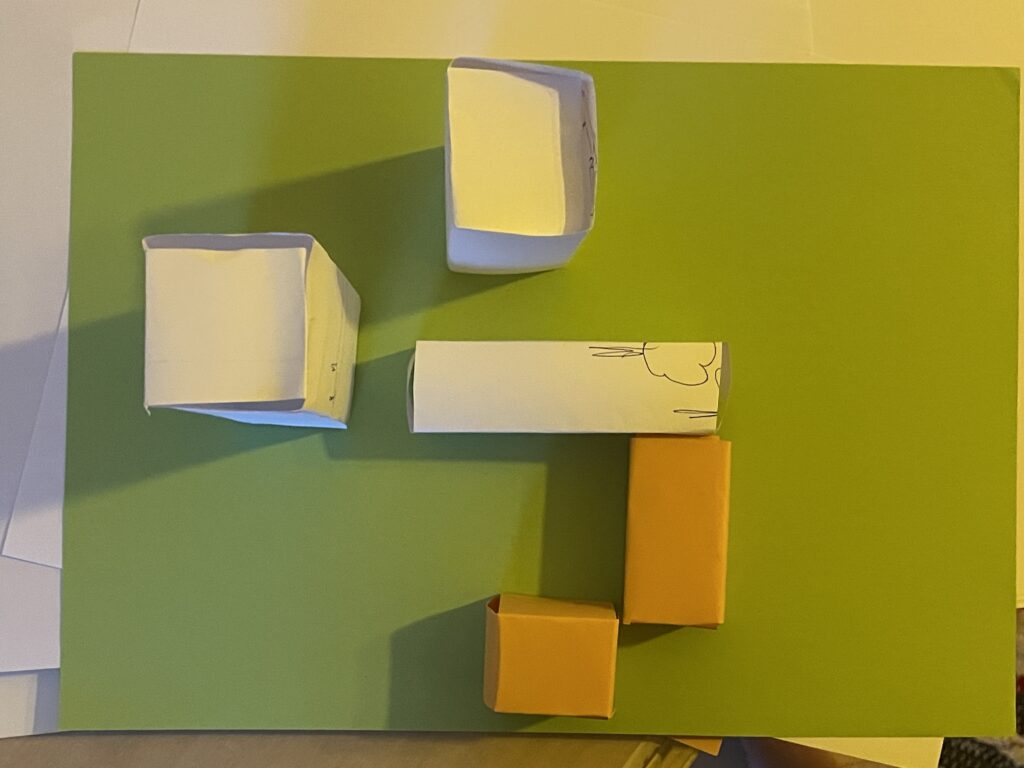
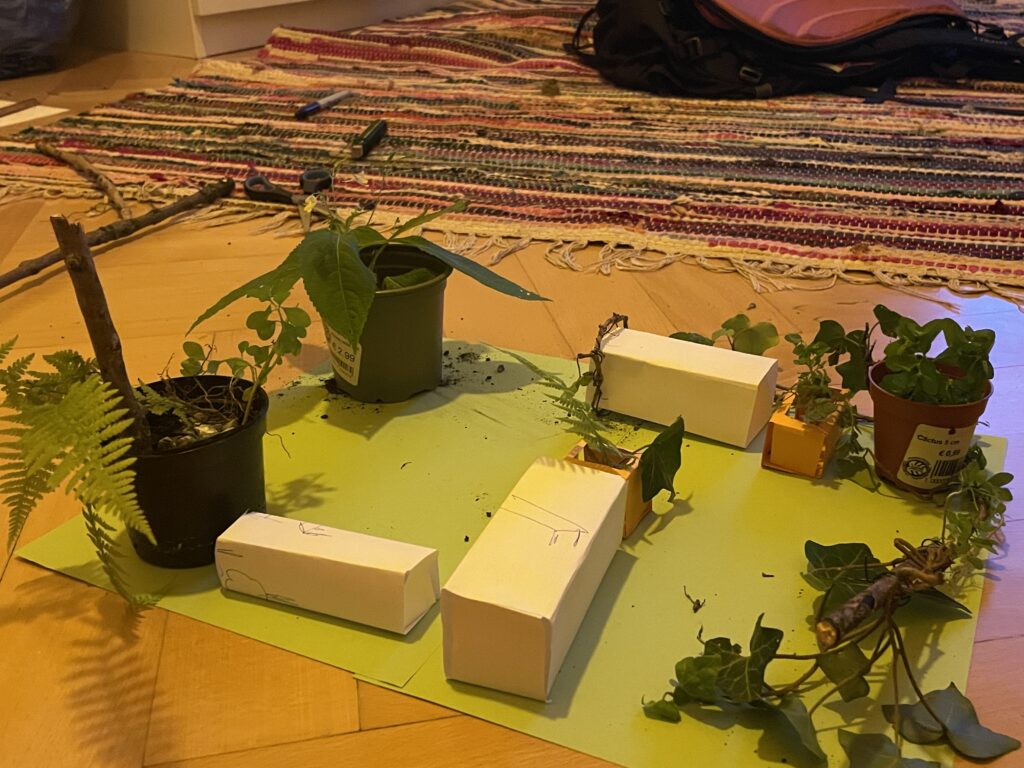
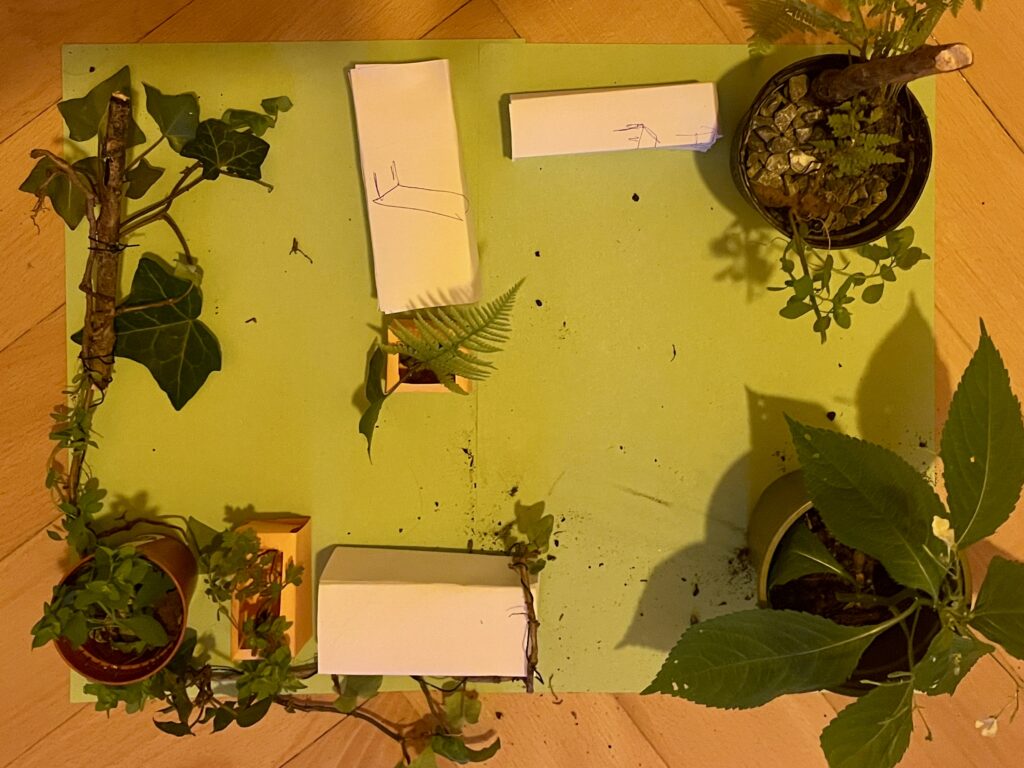
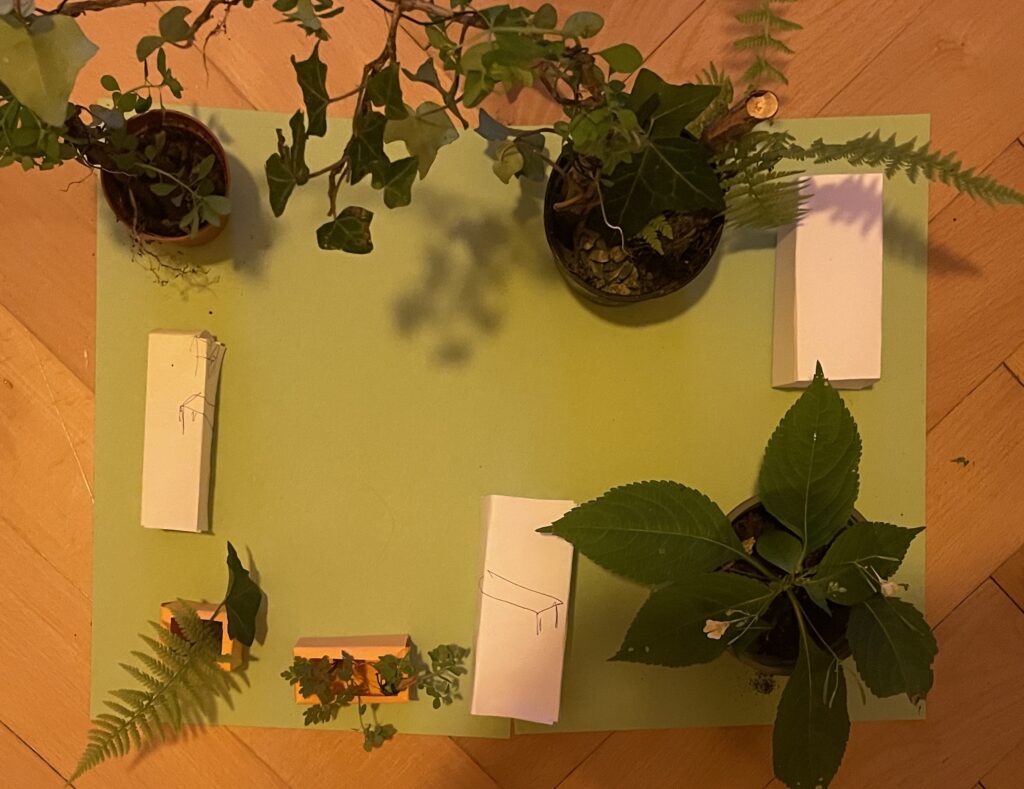
For the first prototype, the modules consist of a set of paper boxes in different shapes that represent different assets for the urban space. They can be assembled in different ways to quickly and easy test different setups for the space. The vision is that the act of planning and putting together the modules is a perfect activity for a neighbourhood community – for them to co-design, work together and therefore gain more relation and responsibility of the area (and each other!).

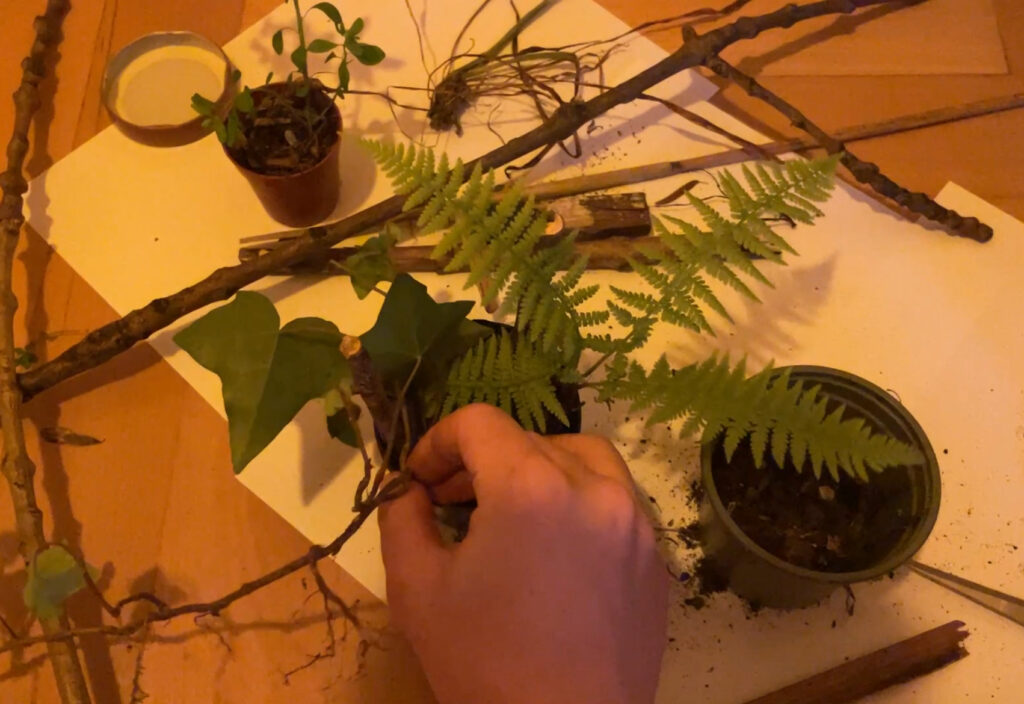
Using found objects/trash
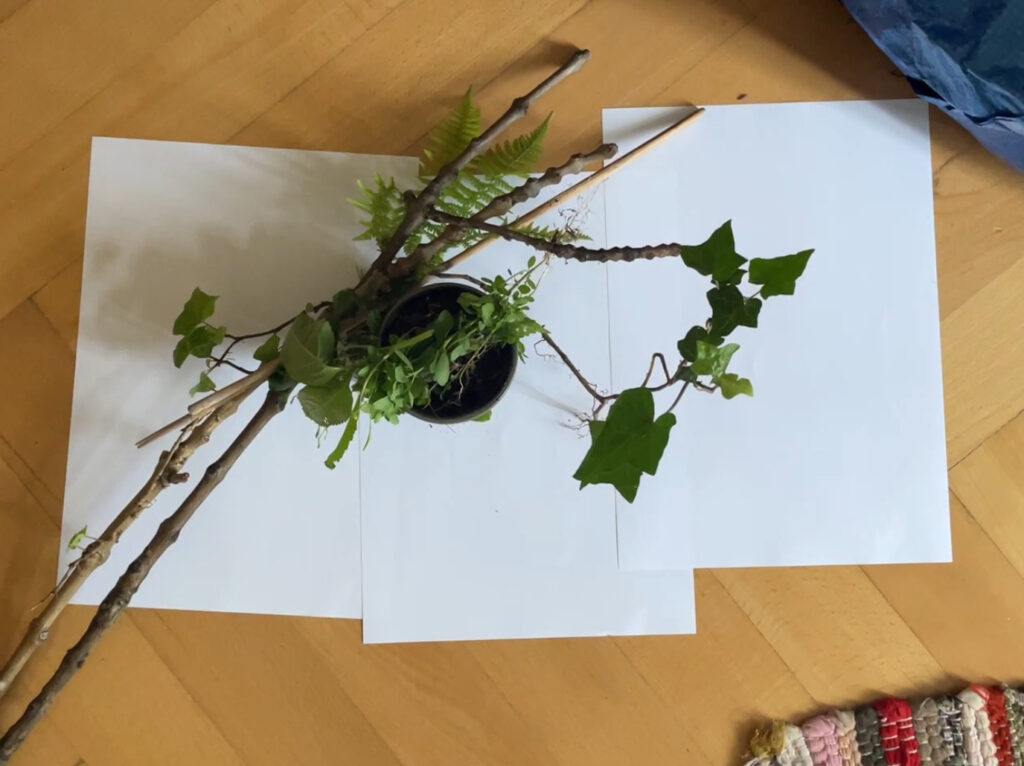
For the second prototype, I really wanted to use real life things, but especially found things. My vision was that with different textures, colours and actual plants, the idea of the modules could become more real. Therefore, I went down in the backyard of my apartment and gathered everything I could find from sticks, plants and trash. I found this part of the process especially fun, since I have a profound love for miniature things and figures. Like, I LOVE lego and small model worlds – I think I need to get myself a terrarium because THE SMALL PLANTS? Love it.

Final prototype
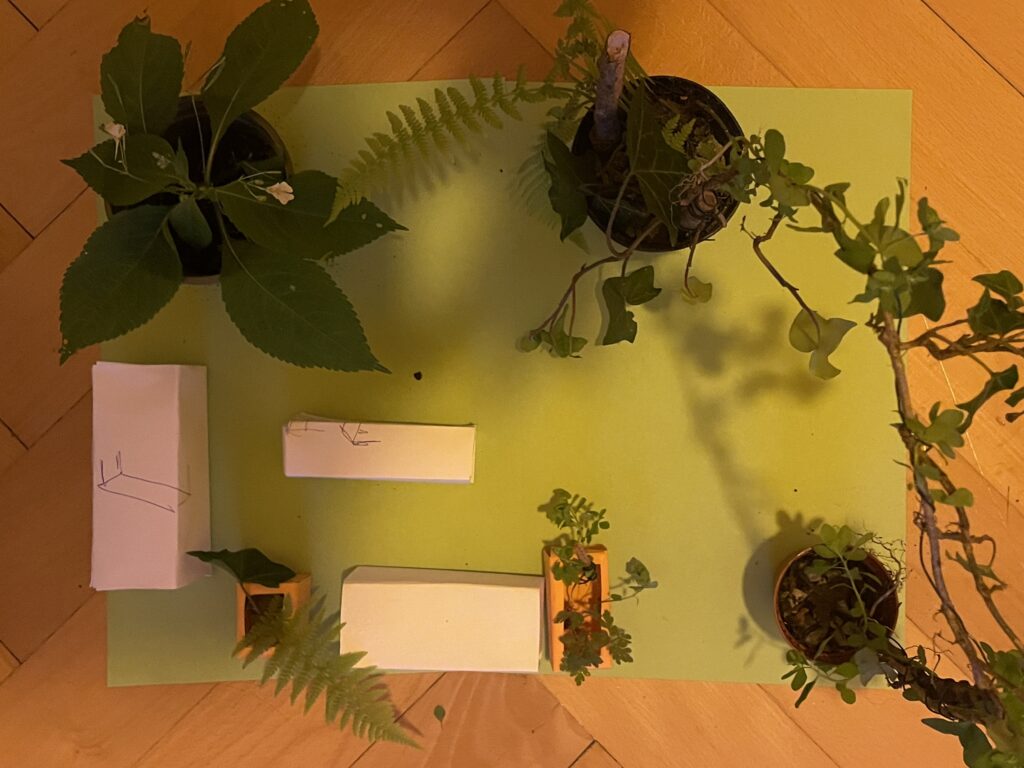
This is the final visualisation of how the blocks can be used with more context and details added. In this way, it is easier to envision how the final, real world space would look like.

For the process video, see the next blog post.

Sources:

Gehl, Jan & Sim, David. 2019. Soft City: Building Density for Everyday Life. Island Press. Excerpt published at: https://www.gehlpeople.com/knowledge-hub/publications/soft-city-the-time-of-your-life

Lindholm, Sine. https://www.sinelindholm.com/new-page-3

Markedshager Norge. 2022. Trøndelag – Oppstartsprogram for markedshager i 2022/23. https://www.markedshage.no/kalender/2022/10/trondelag—oppstartsprogram-for-markedshager-i-202223/
Where do we go from here? Possible approaches for designing connection

What I’ve discovered is that there’s a strong awareness of loneliness as a problem, especially in the research community. There are countless studies, statistics, and even political measures addressing it, but what’s missing are concrete steps and ideas on how to tackle it.
There are some considerations, such as guidelines for urban planners and architects, that lay the groundwork. But direct, creative, and innovative approaches are harder to find. Most existing solutions focus on open spaces, but few actively invite specific forms of interaction. What’s needed is a deep understanding of both the structural aspects of loneliness and the personal experience of it. This means understanding what people need in order to change their behavior and the way they operate in the world we currently live in. Is it the online world and our phone addiction? The fast paced life style? The way and amount we work? The ways our offices, homes an cities are designed and built?

It might be helpful to focus on specific scenarios where loneliness occurs, as its causes and effects vary depending on the context. Loneliness looks different for an older person in a retirement home than it does for a young person who just moved to a new city. Patients in hospitals or reha centers face different challenges than single parents with little time for social interaction. Immigrants who have been separated from their families and cultures experience isolation differently than someone struggling with mental health issues. People who have been removed from or disconnected from their communities also face unique forms of loneliness.

So what can design do? There are different angles and scales from which to approach this issue. One possibility is rethinking urban planning to create spaces that naturally foster human interaction. Another is shifting public perception by raising awareness and reducing the stigma around loneliness, making it something we can talk about openly rather than something to be ashamed of. Smaller interventions can also play a role, like simple design elements that spark interaction and connection, allowing relationships to develop organically.

The next step is to explore possible directions. Should this take the form of a framework or set of guidelines for urban design? A workshop that actively engages communities? A game or interactive tool that initiates connection? A digital platform that helps people meet in meaningful ways? Maybe physical installations or experimental spaces designed to encourage spontaneous interactions. Or maybe artistic works that highlight and address loneliness could invite reflection and conversation.

To move forward, more research is needed and the questions that came up during research need to be answered. Interviews, testing, and case studies could provide valuable insights into what actually works. Understanding the real experiences of people struggling with loneliness and setting a direction for a project are key to designing solutions that go beyond theory and make a real impact.

#07 How Interaction Design can shape Public Spaces

In our today’s fast paced and connected world, public places are gradually shifting from passive environments to places of interaction and engagement. As technology continues to change and improve, so too do the ways in which we experience and engage with the world around us. Public spaces are not only for physical gatherings but also serve as a platform for digital interaction, social engagement, and sensory experience. Interaction Design plays an important role in transforming these spaces. 

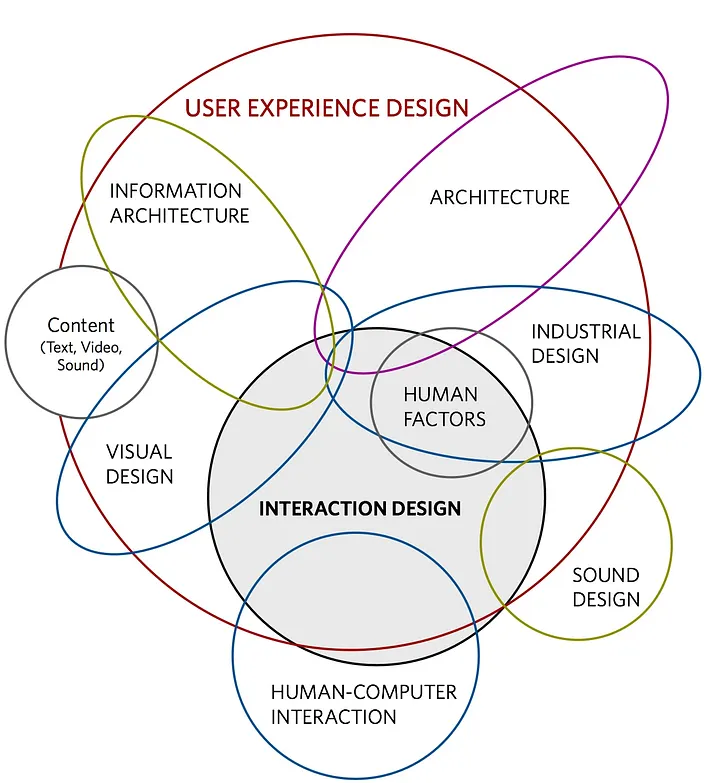
Interaction Design vs. Experience Design

Interaction Design:

This field focuses on how individuals interact with technology, their surroundings and the environment and, most importantly, one another. Its primary aim is to improve users’ understanding of what can be done, what is currently happening, and what has just occurred. Interaction design integrates principles from psychology, design, art, and emotion to create a positive and enjoyable experience for users.  

Source: https://uxdesign.cc/10-steps-to-interaction-design-ixd-6abe778cb8b8
Experience Design:

This practice focuses on creating products, services, processes, events, and environments with an emphasis on the overall quality and enjoyment of the user’s experience. The goal is to ensure a seamless, engaging, and meaningful interaction throughout every stage of the experience. 2

How Interaction Design shapes public spaces

How people perceive the world around them is a key question in urban planning, and it’s central to Kevin Lynch’s groundbreaking book, The Image of the City (1960). In this work, Lynch explores how individuals create mental maps of their surroundings, which mirrors how user interface (UI) research looks at how people interact with digital designs.Integrating UX/UI principles into urban planning can enhance the environment by improving usability, accessibility and user experience. 3

Human-Centered Design

One of the most important reasons why Interaction Designers should be incorporated into urban planning is that architects and urban planners concentrate more on the spatial layout and functionality. Interaction Designer focus on the people who use the space. They prioritize the human needs, capabilities and behaviors first, before designing. 2

Digital integration

Public spaces are no longer just physical places. With the increasing presence of technology in our everyday lives, these spaces are also becoming more and more digital. Since it influences how people move through the city and interact with each other in public spaces we need a new approach that combines both the physical and digital dimensions – Urban Interaction Design. 4 5 

Wayfinding and Navigation

Large public spaces such as parks, transfer areas and city centers can quickly become confusing and overwhelming. With an intuitive navigation system, these places are accessible and more user-friendly. Such systems could include interactive maps, apps or digital signs.

Facilitating Social Interaction

The goal in public spaces or in third spaces is to encourage people to connect — not just with the space itself, but with each other. Since Interaction Design focus on how people interact with physical and digital elements, they can help creating environments that feel alive and are adapting for the needs and wishes of the people. 

Interaction design can therefore also make a small contribution to breaking loneliness and social isolation in public spaces.

Multidisciplinary Approach

However, a multidisciplinary approach between architects, urban planners and interaction designers is best. When all disciplines bring their expertise to the planning, a holistic approach can be created that combines functionality, aesthetics and the human experience. This leads to an accessible, inclusive and engaging space.

Interaction Design has the potential to reshape how public spaces come alive, become centered around people, and connect with the very people they serve. Embracing human-centered design principles, integrating digital systems, and collaborating in design enables shaping public spaces that create valuable social connections.


Sources

[1] S. Li, H. Duan, Y. Yao, W. Zhang und J. Cho, „Enhancing User Experience: A Study of Interaction Design in Coastal Public Spaces“, Asia-pacific Journal Of Convergent Research Interchange, Bd. 10, Nr. 1, S. 473–483, Jan. 2024, doi: 10.47116/apjcri.2024.01.37.

[2] D. Norman, The Design of Everyday Things: Revised and Expanded Edition. Hachette UK, 2013.

[3] J. Kiviluoto, „The lost connection between urban planning and interface design: Ideas towards a re-enactment | LAB Open“, LAB Open, 9. Oktober 2024. https://www.labopen.fi/en/lab-rdi-journal/the-lost-connection-between-urban-planning-and-interface-design-ideas-towards-a-re-enactment/

[4] „Urban Interaction Design – Civic Interaction design“. https://civicinteractiondesign.com/projects/urban-interaction-design/#:~:text=Urban%20Interaction%20Design%20is%20an,design%20approach%20from%20multiple%20perspectives.

[5] „Minor urban interaction design – Minor urban interaction design“. https://urbaninteractiondesign.nl/home/

#06 Designing for Connection: Prioritizing People in Public Space Design

Public spaces can foster social connections, promote inclusivity, and nurture a sense of community. In today’s fast-paced world, where technology often replaces face-to-face interaction and individuals retreat into private spaces, designing public areas that encourage connections has become more crucial than ever. Achieving this goal, however, requires a more human-centered approach — one that focuses not just on the physical environment, but also on how individuals experience and interact with the space. Eric Klinenberg’s concept of social infrastructure provides a compelling framework to understand why these spaces are vital for addressing inequality, polarization, and community resilience. 1 2

Social Infrastructure

Klinenberg believes that a healthy community is not only about shared values, but also about shared spaces so he defines social infrastructure as “the physical places and organizations that shape the way people interact.” As mentioned in the previous posts such places include libraries, playgrounds, parks, but also sidewalks or community gardens. Klinenberg states that the social infrastructure is as essential for society as the infrastructure for power or transportation. 1 2

Designing for people not just for purposes

People have diverse needs, given a wide range of demographics, abilities, and social backgrounds, yet surprisingly often, design decisions for public spaces are done either in favor of functionality or aesthetics alone. Designing public spaces needs to address this diversity by prioritizing accessibility, visibility and inclusivity. In the book “Life Between Buildings” Gehl highlights, that a human-centered approach to public spaces creates meaningful social interactions. 3

First life, then spaces, then buildings. The other way around never works. – Jan Gehl

Principles of Human-Centered Public Space Design

Designing public spaces with a focus on people, rather than just on aesthetic or functional objectives, is guided by human-centered principles. These principles aim to meet users’ physical needs while also addressing their emotional, social, and cultural well-being. These are some qualities of human-centered public urban spaces: 

Spatial qualities:

Accessible: Public spaces must be accessible to all individuals, regardless of socio-economic status, gender, ethnicity, or ability. Everyone should have equal opportunities to use and benefit from the space and its amenities.

Walkable: Neighborhoods designed with walkable pathways and well-connected bike lanes promote physical activity while decreasing dependence on cars. This is especially important in rural areas, where limited transportation options often make car travel the primary means of getting around.

Safe: Well-lit, open spaces without blind spots enhance safety and make public areas more inviting. Gehl highlights that poor visibility fosters fear and exclusion, while transparent, well-lit environments promote comfort, interaction, and community.

Delightful: Public spaces need to incorporate human-scale design, aesthetics and pleasant microclimate like greenery, clean streets and inviting storefront to turn these areas into destinations that foster social connections. 

Comfortable: A comfortable space for spending time and engaging in various activities like walking, standing, sitting, people-watching, and having conversations.

Socio-spatial qualities:

Liveable: Public spaces should be designed with areas for a variety of activities, from quiet reflection to lively social gatherings. This multifunctionality allows individuals to engage with the space in ways that suit their preferences and needs.

Inclusive: Inclusive and welcoming to all, free and open. Urban spaces that foster a diverse range of users and activities.

Sociable: Spaces should be designed to foster social engagement by encouraging natural gatherings. Key elements include thoughtfully arranged seating, pedestrian-friendly walkways, and dedicated areas for social interaction. 1 3 4 5 6

Participation in Urban Planning

While human-centered design provides a strong foundation, its true value lies in practical application that prioritizes community voices. A truly human-centric approach relies on understanding “what people want” by using qualitative tools that assess the social and emotional well-being of residents, including their perceptions, motivations, emotions, ways of living, and values, rather than focusing only on quantitative metrics like the number of blocks or units installed. Tools such as focus groups, workshops, and community-led design sessions help planners shape spaces that align with community needs and wishes while strengthening shared civic identities. However, often the easiest way to gain insights is by talking to the people who are affected by infrastructural proposals. 7

Meaningful public participation becomes increasingly important and is also identified as a core human need. This participation is vital for upholding the principles of participatory democracy, enhancing the effectiveness and quality of the planning process, and improving as well as validating political decision-making. In such a perspective, residents are empowered to have their say in decisions influencing their daily life, ensuring better community involvement. The goal of participatory planning is to incorporate public perspectives into the design of public spaces, recognizing residents not only as stakeholders but as active users, alongside organizations, experts, and professionals. 8


Sources:

[1] E. Klinenberg, Palaces for the People: How Social Infrastructure Can Help Fight Inequality, Polarization, and the Decline of Civic Life, New York, NY: Crown Publishing Group, 2018.

[2] Palaces for the People,” 99% Invisible, Spotify. [Online]. Available: https://open.spotify.com/episode/7fE5rzAYtoCyVMzJnuwf0H?si=b64OVUphRBaOdbErUuyFtg&t=2399. [Accessed: Jan. 13, 2025].

[3] J. Gehl, Life Between Buildings, New York: Van Nostrand-Reinhold, 1987.

[4] M. Almahmood, N. M. Gulsrud, O. Schulze, T. A. Carstensen und G. Jørgensen, „Human-centred public urban space: exploring how the ‘re-humanisation’ of cities as a universal concept has been adopted and is experienced within the socio-cultural context of Riyadh“, Urban Research & Practice, Bd. 15, Nr. 1, S. 1–24, Okt. 2018, doi: 10.1080/17535069.2018.1539512.

[5] “Human-centered design for inclusive urban environments: Building cities that embrace diversity and accessibility,” Buildings. [Online]. Available: https://www.buildings.com/architecture/article/55139034/human-centered-design-for-inclusive-urban-environments-building-cities-that-embrace-diversity-and-accessibility. [Accessed: Jan. 13, 2025].

[6] R. Oldenburg, The Great Good Place: Cafes, Coffee Shops, Bookstores, Bars, Hair Salons and Other Hangouts at the Heart of a Community, New York: Marlowe & Company, 1999.

[7] “Making Cities Human-Centric,” One Works. [Online]. Available: https://www.one-works.com/journal/relate/making-cities-human-centric/. [Accessed: Jan. 13, 2025].[8] E. J. Cilliers und W. Timmermans, „The Importance of Creative Participatory Planning in the Public Place-Making Process“, Environment And Planning B Planning And Design, Bd. 41, Nr. 3, S. 413–429, Apr. 2014, doi: 10.1068/b39098.