After discussing the concept of third places (informal gathering spots like cafes, libraries, and parks) I would now like to shine light on a relatively new idea that has emerged in the recent years: fourth spaces. While third places serve as a “home away from home,” fourth spaces are (depending on the definition) a response to the increasing blurring of physical and digital boundaries in our lives. They go beyond the physicality of third places, incorporating hybrid, inclusive, and adaptive elements to address the evolving ways people connect and build community today. But what exactly are fourth spaces, and how can they shape a sense of belonging?
Definition
Like with loneliness and Third Places there isn’t one single definition for fourth spaces. Some interpretations focus on the physical world and informal interactions in places that are undefined, similar to third places, while others place more emphasis on the digital world [3] and how it interacts with physical spaces. Fourth spaces can be seen as in-between places, blending traditional environments with digital layers. Not all definitions consider the digital aspect in the same way, but all highlight the role of these spaces in fostering spontaneous, casual connections that contribute to shared public life. [1, 2]
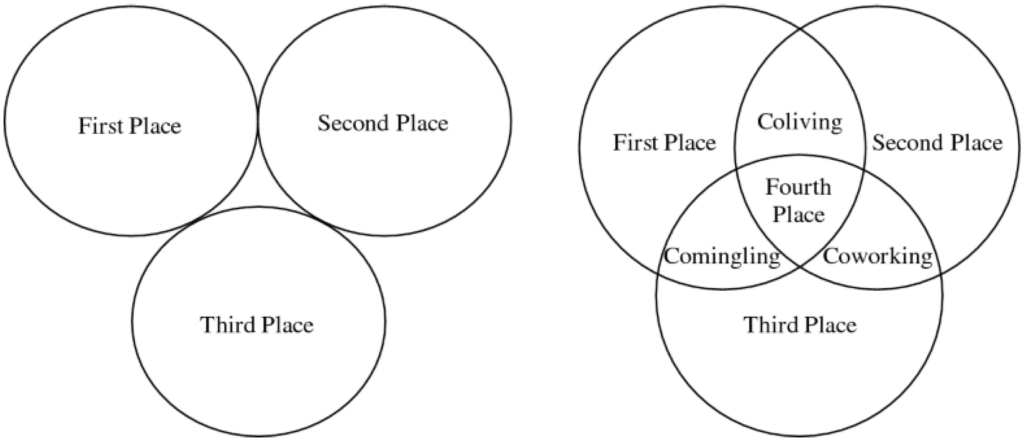
Fouth Places as the “in-between” [3]
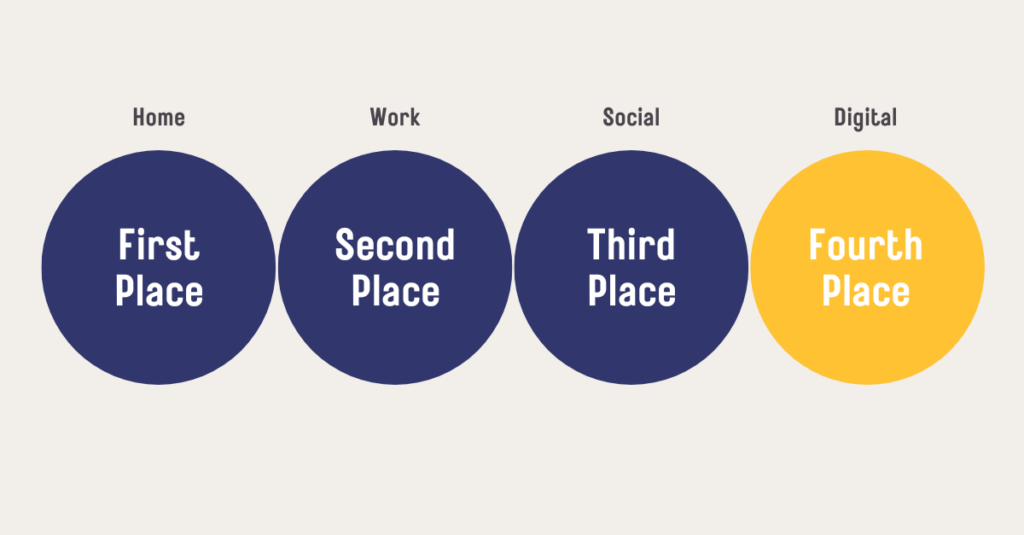
Fourth Spaces as the digital realm [5]
Fourth spaces can counteract the impersonal aspects of “non-places” by embracing in-betweenness and publicness in their design. These spaces often include open, diverse layouts that are intentionally flexible, allowing people to adapt them for various uses that encourage spontaneous interactions.
Novel typologies – new forms of spatial design
Fourth space frameworks blend elements from traditional public spaces with modern innovations, such as integrating green spaces into urban environments or combining digital and physical interactions. In the context of fourth spaces, typology focuses on creating new forms of environments that encourage interaction, creativity, and adaptability to meet modern societal needs. These strategies ensure inclusivity and dynamic social interactions, creating environments where diverse individuals can connect and feel a sense of shared experience. By doing so, fourth spaces move beyond sterile functionality, fostering creativity, community, and belonging. [3]
An example approach to actively creating a fourth space is a project called „The Commons“. It is described as: „A modern-day town square for communal meaning-making, personal discovery, and self-expression in the heart of San Francisco.“ This concept focuses mostly on creating a place that is versatile and open in its functionality and can become whatever it needs to be at any given time. So in reference to the earlier definition, this is less an approach of combining digital and real world places, and follows more the idea of in-between places and meaning-making. They themselves define Fourth spaces as follows: „A physical space that facilitates meaning-making through intentional programming and pluralistic discussion, where individuals explore questions of ultimate concern without seeking conclusive answers. It honors the authenticity and uniqueness of each person’s path while fostering deeper bonds through consistent encounters in a supportive holding environment.“ [4]
Designing Fourth spaces is not an easy task, since it is quite hard to grasp what exactly fourth places are and how they fit into our lives. In terms of digital Fourth spaces the concept is just now emerging and changing constantly. It is important to clearly define the Fourth space in order to utilize it for designing in the context of loneliness. Is a fourth space an in-between place with unlimited potential that needs to be programmed and directed? Or is it the digital world that has emerged in the past few years? And if so, do we integrate it into the real world and try to find ways to combine the two? Or is it maybe even those places where the two meet?
Sources
- P. S. Aelbrecht, “‘Fourth places’: the contemporary public settings for informal social interaction among strangers,” Journal of Urban Design, vol. 21, no. 1, pp. 124–152, Jan. 2016, doi: 10.1080/13574809.2015.1106920.
- “The fourth place and re-imagining the city | Urbanarium.” https://urbanarium.org/journal/fourth-place-and-re-imagining-city
- D. Hardegger, “A First Holistic ‘4th Space’ Concept,” Mdpi, p. 72, Mar. 2022, doi: 10.3390/proceedings2022081072.
- “The Commons” https://www.thesfcommons.com/
- T. Masuku, “The fourth place,” Showit Blog, Jun. 15, 2024. https://ticamasuku.com/the-fourth-place/