Before I begin, soundtrack of this post: I´d love to change the world – Ten Years After
Now that I have researched a whole lot of different aspects of the interconnected nature- and climate crisis, I need to look deeper what some of the solutions can be. What are the most efficient ways to create real change? And in this context? Understanding and imagining solutions for societal-scale decision-making is a complex challenge, often called a wicked problem. This complexity arises from the diverse ways people perceive the issues and the uncertainty of decision outcomes. It is also difficult to bring people together at the right scale to reach a shared understanding. Trying to find the answer to this, I have come across Speculative Design and Future Thinking– something that may show it self to be the tools I (/we) need.
Speculative Design explores future possibilities and societal impacts of emerging technology and shifting cultural and social trends, diverging from traditional design to provoke new thought, debate, directions, preferences, and strategy (Neeley, 2024).
Futures-thinking is a diverse scholarship and practice, drawing on multiple disciplines across the sciences, arts, and humanities, that explore the nature of change, how humans conceive of futures, the range of possible (not just probable) futures, and how alternative futures might emerge (Corc, et. al., 2023).
Anthropocene refers to the period since the 1950s, which has seen exponential increases in human impacts on global ecological systems, with implications for the nature and quality of life, across all societies (Corc, et. al., 2023).
Speculative design is an approach that explores possible futures by using design as a tool to imagine and provoke thought about what could be. Unlike traditional design, which focuses on solving existing problems, speculative design pushes boundaries by addressing “what if” scenarios. It challenges assumptions and opens up discussions about potential futures. Speculative design often combines elements of storytelling, critical thinking, and visual representation to create thought-provoking and immersive artifacts, experiences, or scenarios.
The article Exploring Alternative Futures in the Anthropocene on future-thinking was published by a group of scientist by the Swinburne University of Technology about “[…] cognitive, cultural, and institutional constraints on the societal uptake of futures-thinking” (Corc, et. al., 2023). The authors´ objective was to “[…] help newcomers to futures-thinking make sense of what has been happening in scholarship and practice and to encourage existing participants to reflect on past and recent developments”. Therefore, this article is the perfect way into the topic of speculative design.
These scientists, claim that the two critical requirements for transformative change are:
- The cognitive and/or institutional capabilities for understanding and acknowledging humanity’s current predicament (i.e., the relationship between people and the planet).
- The capabilities to imagine new futures—ones involving possibilities not encountered before—and the possible pathways toward achieving them
They also argue that these requirements are especially poorly developed across humanity, and are therefore also the key vulnerabilities of our era.
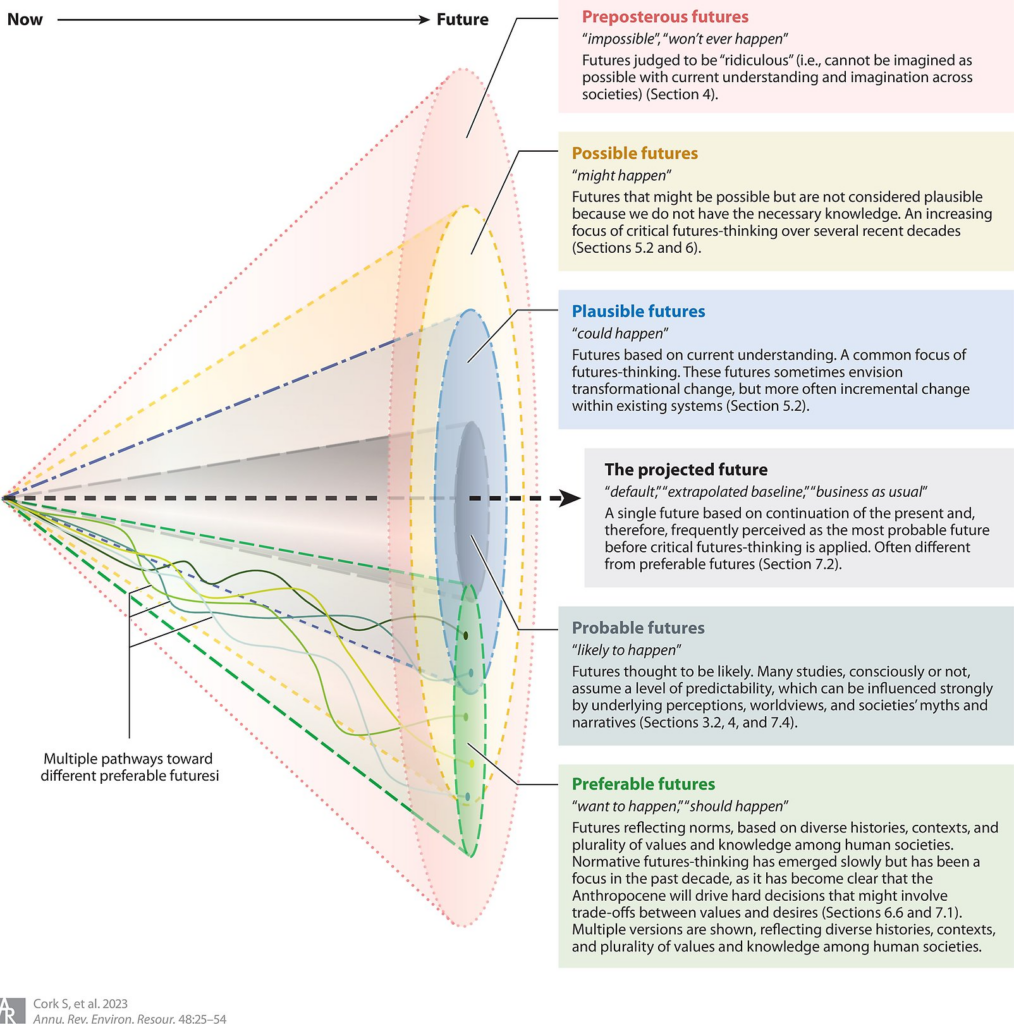
The scientists summed up their article into 4 important takes:
- To achieve the transformations required to address Anthropocene challenges, societies need opportunities that bring a diversity of knowledge and perceptions together to seek shared understandings of current situations and to imagine what alternative futures might be possible, including radical ones never before imagined.
- Incremental adjustment within current paradigms and systems is no longer an option that will allow humanity to survive the Anthropocene, let alone achieve sustainable futures with high levels of human well-being and harmonious coexistence with other species.
- Lessons from more than seven decades, especially the past two, suggest that the diverse knowledge and expertise embodied in theories, philosophies, approaches, and methods for futures-thinking offer models for achieving the above, although coupling futures-thinking with mainstream decision-making and governance remains a challenge.
- Many cognitive, cultural, and institutional constraints on broad societal uptake of futures-thinking exist, but none are insurmountable once understood (Corc, et. al., 2023).
Transformative change is required to meet many of the challenges of the Anthropocene. To make this change happen, people need to better understand the present situation, strengthen their ability to imagine and share hopeful futures, and explore different ways to reach those futures. That is why speculative design or future-thinking will play a crucial role in the great shift that is needed. It will help bridge the gap between scientific data and public engagement by presenting future scenarios in an accessible and emotionally resonant way. Through these methods, we can imagine resilient cities, regenerative agriculture systems, and circular economies that prioritise ecological balance – and maybe start to believe that change is possible.
By using speculative design as a tool, I can challenge existing paradigms in the pursuit of environmental sustainability. Ultimately, speculative design is not just about imagining futures—it is about shaping them, and as a designer, this may be one of the most impactful contributions I can make to addressing the climate and nature crisis.
Sources:
Cork, S., Alexandra, C., Alvarez-Romero, J.G., Bennet, E.M., Berbés-Blásquez, M., Bohensky, E., Bok, B., Constanza, R., Hashimoto, S., Hill, R., Inayatullah, S., Kok, K., Kuiper, J.J., Moglia, M., Pereira, L., Peterson, G., Weeks, R. & Wyborn, C. (2023). Exploring Alternative Futures in the Anthropocene. Annual Review of Environment and Resources, 48, 25-54. Swinburne University of Technology. Retrieved from https://www.annualreviews.org/content/journals/10.1146/annurev-environ-112321-095011
Neeley, J. Paul. (2024, 19th of June). What is Speculative Design? School of Critical Design. Retrieved from https://www.critical.design/post/what-is-speculative-design