SURF SKATE SIMULATION AND TEST RECORDINGS

Purpose of the Simulation

Before deploying the system in ocean conditions, a controlled test was performed using a surf skate on land in order to structure the synchronization part of the different media in advance. Therefore, the simulation served multiple purposes:

  • First, to test the stability and functionality of the hardware setup under strong movements
  • To collect and analyze motion data from surfing-like movements like the cutback using the ximu3 sensor
  • To test and evaluate the contact microphone’s responsiveness to board interaction and different movement patterns
  • To practice audiovisual synchronization between footage an external camera setup, the Zoom H4n recorder, the contact microphone and the x-IMU3 motion data.

Therefore, the surf skate was chosen because of its closely representation of  the body movement and board rotation then surfing. Especially the cutback movement can be imitated by using a skate ramp.  

This testing setup consists of the following tools:

  • A Carver-style surf skateboard
  • The x-IMU3 sensor mounted on the bottom of the board to capture movement dynamics
  • The Piezo contact microphone taped next to the motion sensor on the bottom of the board. After testing the microphone was placed in the middle of the skateboard deck in order to capture the movement of both axes of the board at the same amount of loudness. Placing the microphone closer to the wheels of the board would result in much more noise in the recording due to the internal rotation of the axes. 
  • The Zoom H4n recorder was help in the hand of the skater and was connected to closed over ear headphones. 
  • Using the external film camera Sony Alpha 7iii the whole test was captured. This additional recording was helpful later in the synchronization part. 

The board was ridden in a skate ramp simulating the composition of the wave. ON the top of the ramp the cutback movement can be executed. 

A skateboard with headphones and a remote

AI-generated content may be incorrect.

At the start of the recording session, all devices were synchronized through a short impulse sound (hitting on the board) recorded on all three devices: Zoom, GoPro, and x-IMU3. The single surf skate tackes lasted approximately 2 minutes of recording and were repeated multiple times. 
The data recorded consists of:

  • accelerometer, gyroscope, orientation from the x-IMU3
  • Mono WAV audio from the contact mic
  • 1080p video footage from the external camera

The files were transferred and loaded into the respective analysis environments:

The x-IMU3 data was decoded using the official GUI and exported as CSV files;

The WAV audio was imported into REAPER and cross-referenced with the GoPro’s audio to align the sync impulse;

Motion data was plotted using Python and matched frame-by-frame to movement events in the video.

The result was a perfectly aligned audio-motion-video composite, usable both for analysis and composition.

  1.  Observations and Results

The contact mic successfully captured vibrational data including surface noise, carving intensity, and road texture;

The x-IMU3 data revealed clear peaks in angular velocity during simulated cutbacks and sharp turns;

The GoPro footage confirmed that movement gestures correlated well with sonic and motion data markers;

The Pelican case and foam provided sufficient shock insulation and no overheating or component failure occurred;

The synchronization method using a single impulse sound proved highly reliable.

The surf skate test validated the concept and highlighted important considerations:

Movement-based sonic gestures are highly expressive and usable for composition;

Vibration sensitivity of the contact mic is sufficient for detailed sound capture;

The sync strategy will work equally well in ocean sessions with minor adjustments;

Battery and storage life are adequate for short-to-medium-length surf sessions;

Cable insulation and structural mounting are durable under stress.

This test confirmed the system’s readiness for its full application in Morocco, where ocean sessions will build upon the structure and learnings of this simulation.
HARDWARE SYSTEM SURFBOARD


  1. 1.1. OVERVIEW OF THE SETUP
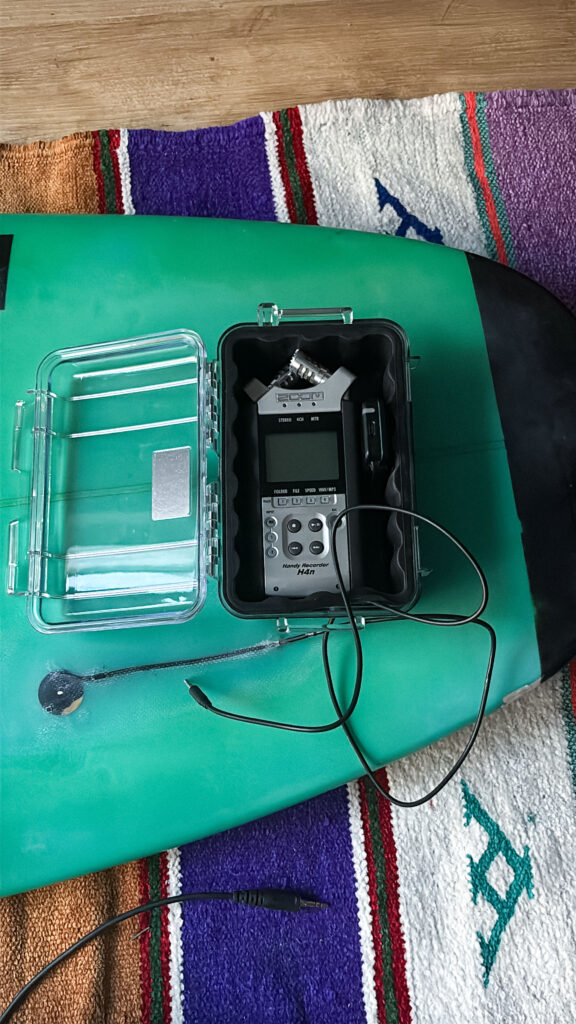
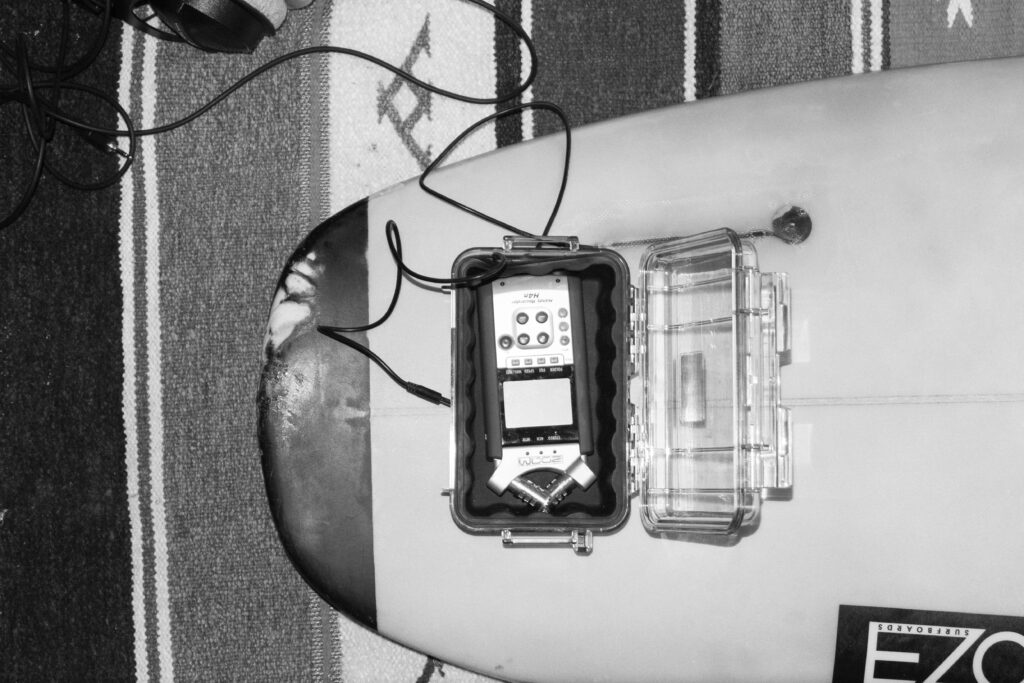
    The hardware setup of this project was developed to function and withstand under the challenging environmental conditions typical for surfing. Therefore, the full equipment needs to not only be made for saltwater exposure, but also be strong enough to handle strong hits and impacts. The sunlight, and hot temperatures also act as another impactor. Therefore, building components were selected based on their stability, mobility, and compactness. The complete system includes a waterproof Pelican 1050 case mounted on the surfboard, containing a Zoom H4n audio recorder, a piezoelectric contact microphone and an x-IMU3 motion sensor. An externally mounted GoPro Hero 3 camera records video and sound. The interior of the Peli case is filed with protective foam to minimize shock and mechanical disturbance. Concluding, the arrangement was optimized to allow a smooth operation during surfing while maintaining robust data acquisition.

1.2. MOTION SENSOR – X-IMU3

The x-IMU3, was developed by x-io Technologies. It is a compact inertial measurement tool (IMU) capable of logging tri-axis accelerometer, gyroscope, magnetometer and orientation data with timestamp precision. For this application, the sensor operated in standalone mode and will be charged by an external small power bank later retrieval. After each recording session, the x-IMU3 GUI and SDK were used to decode. ximu3 binary files into structured CSV datasets (x-io Technologies, 2024). These data streams are then available for the synchronization part with audio and video recordings. Furthermore, these recorded values will be used to manipulate the recorded audio using Pure Data.

The x-IMU3 sensor was selected due to its reliability, sampling rate of up to 500 Hz, and OSC-compatible output structure. This enables later integration with sound synthesis software’s in the later process. The sensor is placed in the box cushioned within protective foam in the Pelican case to minimize noise artifacts caused by board vibration.

1.3. CONTACT MICROPHONE – PIEZO DISC
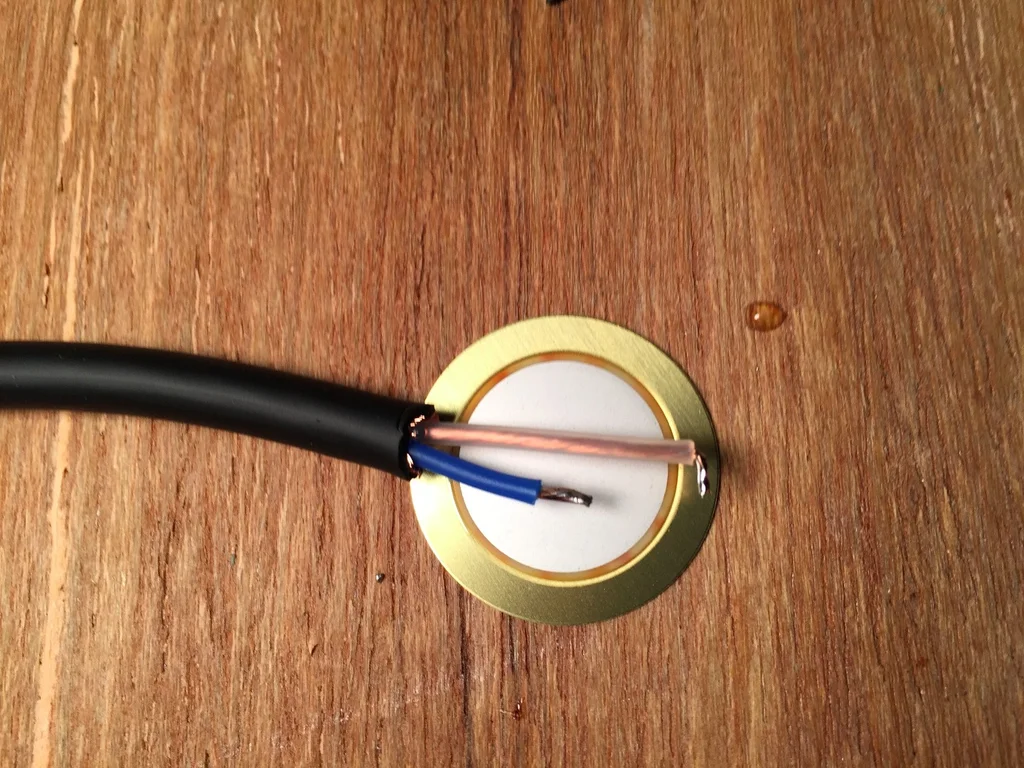
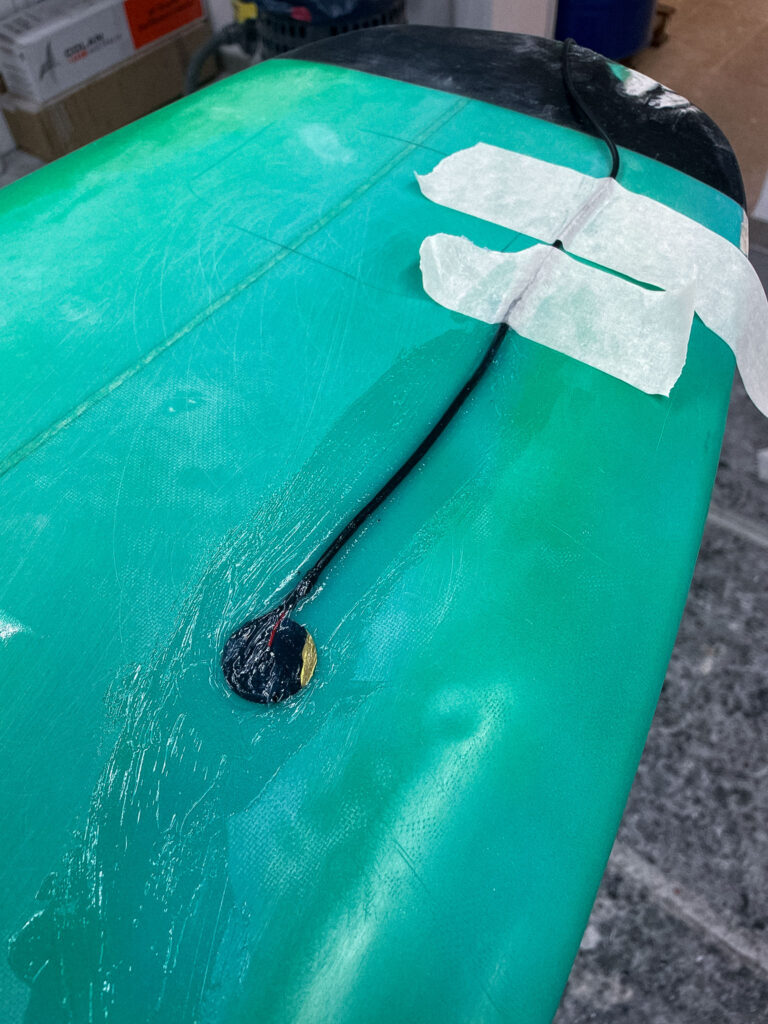
In order to add another dimension to the sound recording by capturing board vibrations and internal mechanical changes, a piezoelectric contact microphone was mounted beneath the surfboard wax layer, at the right side of the nose, near the front foot position. Unlike traditional microphones, piezo elements record vibrations through physical material contact, making them suitable for capturing impactful sound events. Also, due the good implementation movements of the surfer on the board are recorded very well. The sensor is routed to the case using a sealed cable channel and insulation to prevent water from getting in the box or inside the board.
This microphone setup allows for the recording of impactful events such as hits, flex, and frictional interactions between the board, the water and the surfer. These signals, together with the recordings of the zoom, form the primary audio source used in the sonic interpretation of the surf session. This implementation of a piezo mic in a surfboard has not been done or documented before and is therefore an innovative approach which is of course interesting for sound engineers, as well as surfers and surfboard builder (Truax, 2001).

1.4. AUDIO RECORDER – ZOOM H4N
The audio data was recorded using a Zoom H4n Handy Recorder, configured to capture a mono signal from the contact microphone. The recorder was selected for its portability, sound quality (24-bit/44.1 kHz), and dual XLR/TRS inputs. It was housed inside the Pelican case using closed-cell foam to dampen mechanical noise. Battery-powered operation and SD card storage enabled autonomous recording during mobile sessions.
Gain levels were calibrated before each session to preserve signal integrity and prevent clipping. The system was designed to ensure consistent signal acquisition even under dynamic surf conditions (Zoom Corporation, 2023).

1.5. VISUAL SYNCHRONIZATION – GOPRO HERO 3
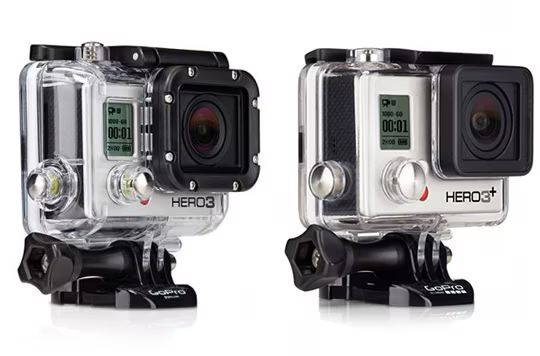
To also have a video output of the surf session, GoPro Hero 3 camera is mounted at the board’s nose. This video material served as both documentation and reference for synchronization. Here, the synchronization of different audio sources and the sensor data is challenging but will made easier with having audiovisual references. For example, a double tapping on the board can help synchronize image to sound. The GoPro’s audio, while limited in quality, served as another layer reference for alignment.
In addition, the video recordings serve also as a tool to analyze body posture, movement patterns, and spatial context (Watkinson, 2013). The surf movie will be consisting of many shots taken by the GoPro and will support the surf film with an immersive camera angle.


1.6. ENCLOSURE AND MOUNTING
– PELICAN CASE 1050
The Zoom Recorder, sensor, power bank and cables of the contact microphone are enclosed in a Pelican 1050 Micro Case. This model was selected for its IP67-rated waterproof sealing, shock resistance, and small form, making it not too bulky on the board, but still big enough to fit all the necessary equipment.
Moving forward, the case is mounted to the surfboard using strong glue and surfboard wax and is incorporated in the general body of the board. In order to connect the contact microphone from outside to the inside, one hole was made in the box. This hole is again sealed with silicone caulk to make it leak and saltwater proof.

Inside, the box a special Peli foam is inserts to prevent internal motion and a fixation for the sensor and the recorder.
The case and cabling configuration underwent field testing, including simulated riding on a surf skate and controlled submersion for a specific amount of time, to ensure no leakage will occur during recording