IRCAM Forum 2025 – Turning Pixels into Sound: Sonifying The Powder Toy

During our visit to IRCAM Forum 2025, one of the most unexpected and inspiring presentations came from Kieran McAuliffe, who introduced us to a unique way of experiencing a video game — not just visually, but sonically. His project, Sonifying The Powder Toy, brought an old genre of games to life in a way that made both sound designers and game designers lean forward.

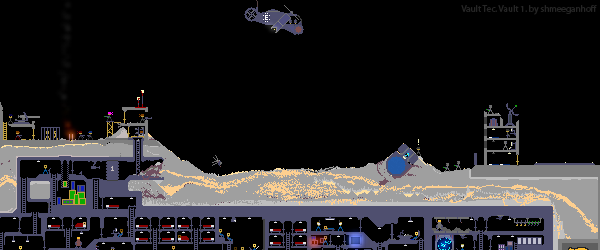
If you’ve never heard of it, The Powder Toy is part of a quirky, cult genre called “falling sand games.”
https://powdertoy.co.uk/

These are open-ended, sandbox-style simulations where players interact with hundreds of different particles — fire, water, electricity, explosives, gases, and even fictional materials — all rendered with surprising physical detail. It’s chaotic, visual, and highly addictive. But one thing it never had was sound.

Kieran, with his background as a composer, guitarist, and researcher, decided to change that. His project wasn’t just about adding booms and fizzles. He approached the challenge like a musical instrument designer: how can you play this game with your ears?

The problem was obvious. The game’s physics engine tracks up to 100,000 particles updating 60 times per second — trying to create sounds for every interaction would melt your CPU. So instead, Kieran developed a method of analytic sonification: instead of responding to every pixel, his system tracks the overall distribution of particles and generates sound textures accordingly.

That’s where it gets beautifully nerdy. He uses something called stochastic frequency-modulated granular synthesis. In simpler terms, think of it like matching grains of sand with grains of sound — short, tiny bursts of tones that collectively create textures. Each type of material in The Powder Toy — be it lava, fire, or metal — gets its own “grain stream,” with parameters like pitch, modulation, duration, and spatial position derived from the game’s internal data.

To make all of this work, Kieran built a custom Max/MSP external called LuaGran~. This clever little tool lets him embed Lua scripts directly inside Max, giving him the power to generate and manipulate thousands of grains per second. It allows for both tight control and high performance — a critical balance when your “instrument” is a particle system going haywire in real time.

Some mappings were linear — like more fire equals higher pitch — while others used neural networks or probabilistic logic to shape more complex sonic behaviors. It was a blend of art and science, intuition and math.

During the presentation, I had the chance to join Kieran live by downloading his forked version of The Powder Toy, which sends Open Sound Control (OSC) data to his Max patch. Within minutes, a room full of laptops was sonically simulating plasma storms and chemical reactions. It was fun, chaotic, and surprisingly musical.

One thing that stood out was how Kieran resisted the temptation to make the sound effects too “realistic.” Instead, he embraced abstraction. A massive explosion might not sound like a movie boom — it might produce a textured whoosh or a burst of granular noise. His goal was not to recreate reality, but to enhance the game’s emergent unpredictability with equally surprising sounds.

He described the system more like a musical instrument than a tool, and that’s how he uses it — for laptop ensemble pieces, sound installations, and live improvisation. Still, he hinted at the potential for this to evolve into a standalone app or even a browser-based instrument. The code is open source, and the LuaGran~ tool is already on his GitHub (though it still needs some polish before wider distribution).

https://github.com/trian-gles

As sound designers and creatives, this project reminds us that sound can emerge from the most unexpected places — and that play, chaos, and curiosity are powerful creative engines. The Powder Toy might look like a simple retro game, but under Kieran’s hands, it becomes a dense sonic playground, a platform for experimentation, and a surprisingly poetic meeting of code and composition.

If you’re curious, I encourage you to try it out, explore the sounds it makes, and maybe even mod it yourself. Because as Kieran showed us, sometimes the most interesting instruments are the ones hiding inside games.

Here you can find manual how to instal game and sonification:

https://tinyurl.com/powder-ircam

It’s more fun to do it with friends)

IRCAM Forum 2025 – RIOT v3: A Real-Time Embedded System for Interactive Sound and Music

When you think of motion tracking, you might imagine a dancer in a suit covered with reflective dots, or a game controller measuring hand gestures. But at this year’s IRCAM Forum in Paris, Emmanuel Fléty and Marc Sirguy introduced R-IoT v3, the latest evolution of a platform developed at IRCAM for real-time interactive audio applications. For students and professionals working in sound design, physical computing, or musical interaction, RIOT represents a refreshing alternative to more mainstream tools like Arduino, Raspberry Pi, or Bela—especially when tight timing, stability, and integration with software environments like Max/MSP or Pure Data are key.

What is it, exactly?

RIOT v3 is a tiny device—about the size of a USB stick—that can be attached to your hand, your foot, a drumstick, a dancer’s back, or even a shoe. Once it’s in place, it starts capturing your movements: tilts, spins, jumps, shakes. All of that motion is sent wirelessly to your computer in real time.

What you do with that data is up to you. You could trigger a sound sample every time you raise your arm, filter a sound based on how fast you’re turning, or control lights based on the intensity of your movements. It’s like turning your body into a musical instrument or a controller for your sound environment.

What’s special about version 3?

Unlike Raspberry Pi, which runs a full operating system, or Arduino, which can have unpredictable latency depending on how it’s programmed, RIOT runs bare metal. This means there’s no operating system, no background tasks, no scheduler—nothing between your code and the hardware. The result: extremely low latency, deterministic timing, and stable performance—ideal for live scenarios where glitches aren’t an option.

In other words, RIOT acts like a musical instrument: when you trigger something, it responds immediately and predictably.

The third generation of RIOT introduces some important updates:

  • Single-board design: The previous versions required two boards—the main board and an extension board—but v3 integrates everything into a single PCB, making it more compact and easier to work with.
  • RP2040 support: This version is based on the RP2040 chip, the same microcontroller used in the Raspberry Pi Pico. It’s powerful, fast, and has a growing ecosystem.
  • Modular expansion: For more complex setups, add-ons are coming soon—including boards for audio I/O and Bluetooth/WiFi connectivity.
  • USB programming via riot-builder: The new software tool lets you write C++ code, compile it, and upload it to the RIOT board via USB—no need for external programmers. You can even keep your Max or Pure Data patch running while uploading new code.

Why this matters for sound designers

We often talk about interactivity in sound design—whether for installations, theatre, or music—but many tools still assume that the computer is the main performer. RIOT flips that. It gives you a way to move, breathe, and act—and have the sound respond naturally. It’s especially exciting if you’re working in spatial sound, live performance, or experimental formats.

And even if you’ve never touched an Arduino or built your own electronics, RIOT v3 is approachable. Everything happens over WiFi or USB, and it speaks OSC, a protocol used in many creative platforms like Max/MSP, Pure Data, Unity, and SuperCollider. It also works with tools some of you might already know, like CataRT or Comote.

Under the hood, it’s fast. Like really fast. It can sense, process, and send your movement data in under 2 milliseconds, which means you won’t notice any lag between your action and the response. It can also timestamp data precisely, which is great if you’re recording or syncing with other systems.

The device is rechargeable via USB-C, works with or without a battery, and includes onboard storage. You can edit configuration files just like text. There’s even a little LED you can customize to give visual feedback. All of this fits into a board the size of a chewing gum pack.

And yes—it’s open source. That means if you want to tinker later on, or work with developers, you can.

https://github.com/Ircam-R-IoT

A tool made for experimentation

Whether you’re interested in gesture-controlled sound, building interactive costumes, or mapping motion to filters and samples in real time, RIOT v3 is designed to help you get there faster and more reliably. It’s flexible enough for advanced setups but friendly enough for students or artists trying this for the first time.

At FH Joanneum, where design and sound design meet across disciplines, a tool like this opens up new ways of thinking about interaction, performance, and embodiment. You don’t need to master sensors to start exploring your own body as a controller. RIOT v3 gives you just enough access to be dangerous—in the best possible way.

IRCAM Forum Workshops 2025 – Promenade Sonore

Sound Meets the City: Nadine Schütz’s Promenade Sonore Transforms a Footbridge into a Living Instrument

We first encountered Nadine Schütz’s fascinating work during her presentation at the IRCAM Forum Workshops 2025, where she introduced her project Promenade Sonore: Vent, Soleil, Pluie (“Wind, Sun, Rain”). The talk offered deep insights into her creative process and the technical and ecological thinking behind the installation.

In the heart of Saint-Denis, just north of Paris, Swiss sound artist Nadine Schütz has reimagined the way we move through and experience urban space. Her project Promenade Sonore: Vent, Soleil, Pluie (“Wind, Sun, Rain”) is not just a public art installation—it’s a multi-sensory experience that turns an ordinary walk across a footbridge into an acoustic encounter with the environment.

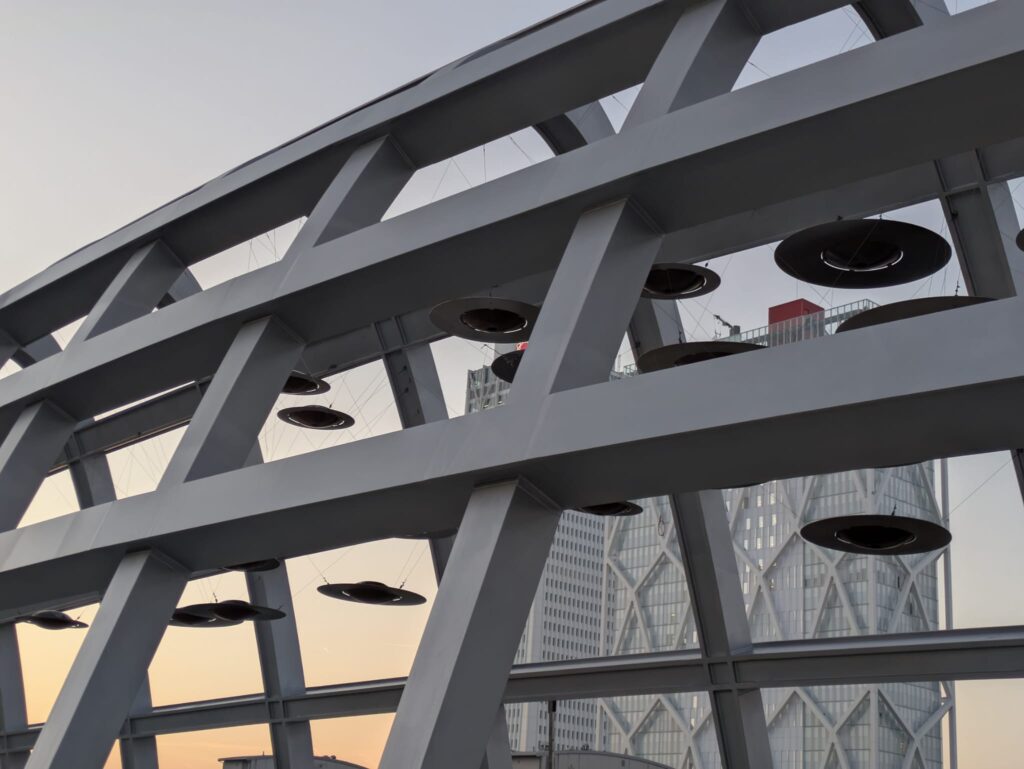
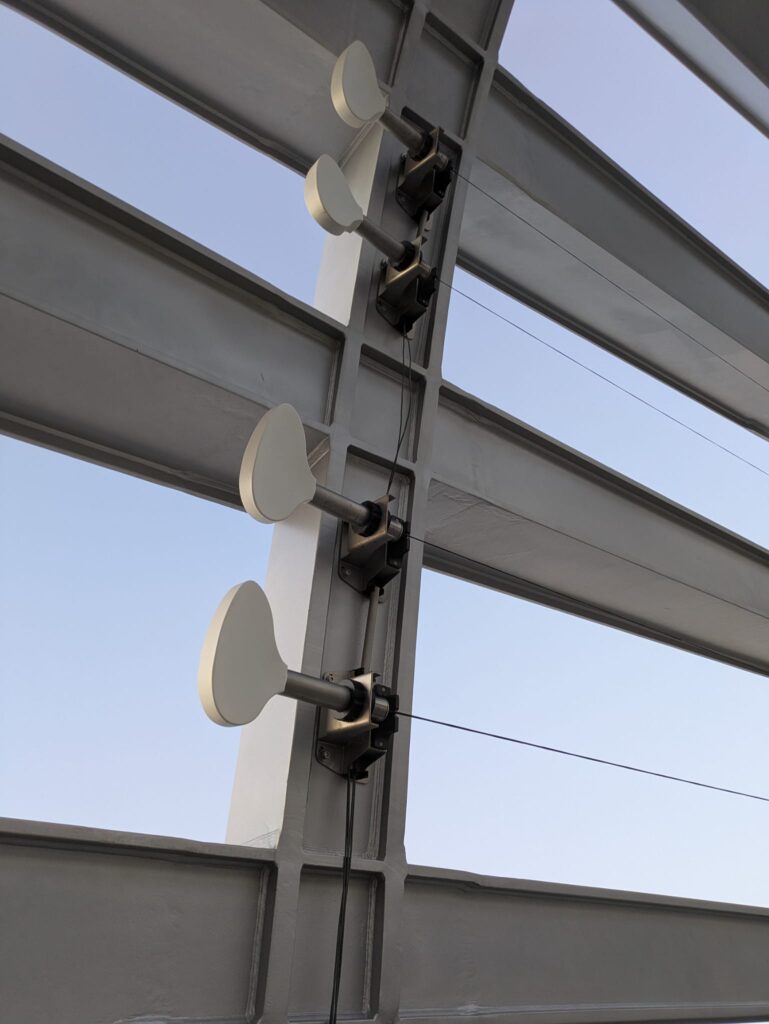
Commissioned by Plaine Commune and developed in close collaboration with architect-engineer Marc Mimram, the installation is located on the Pleyel footbridge, a key link between the neighborhoods of Pleyel and La Plaine. Rather than adding passive sound or music, Schütz has embedded three sculptural sound instruments directly into the architecture of the bridge, each one activated by a different natural element: wind, sun, and rain.

These instruments aren’t just symbolic; they actually respond to the environment in real time. Wind passes through a metal structure that produces soft, organ-like tones. When sunlight hits specific points, it activates solar-powered chimes or sound emitters. During rainfall, the structure becomes percussive, resonating with the rhythm of droplets. The bridge becomes a living, breathing instrument that reacts to weather conditions, turning nature into both performer and composer.

What makes Promenade Sonore truly compelling is how seamlessly it blends technology, ecology, and design. It’s not loud or intrusive—it doesn’t drown out the urban soundscape. Instead, it subtly enhances the auditory experience of the city, encouraging passersby to slow down and listen. It transforms a utilitarian space into a space of poetic reflection.

Schütz’s work is rooted in the idea that sound can deepen our connection to place. In this project, she brings attention to the sonic qualities of weather and architecture—things we often overlook in our fast-paced, screen-driven lives. The soundscape is never the same twice: it shifts with the wind, the angle of the sun, or the mood of the rain. Every walk across the bridge is a unique composition.

More than just an artistic gesture, Promenade Sonore is part of a broader vision of “land-sound” design—a practice Schütz has pioneered that treats sound as an essential component of landscape and urban planning. In doing so, she challenges traditional boundaries between art, science, and infrastructure.

Visit of the pleyel bridge

We had the chance to visit the Pleyel footbridge ourselves—and it was a one-of-a-kind experience. Walking across the bridge, immersed in the subtle interplay of environmental sound and sculptural form, was both meditative and inspiring. While on site, we also conducted our own field recordings to capture the dynamic soundscape as it unfolded in real time. Listening through headphones, the bridge became even more alive—each gust of wind, each shifting light pattern, each ambient tone weaving into a delicate, ever-changing composition.

IRCAM Forum Workshops 2025 – ACIDS

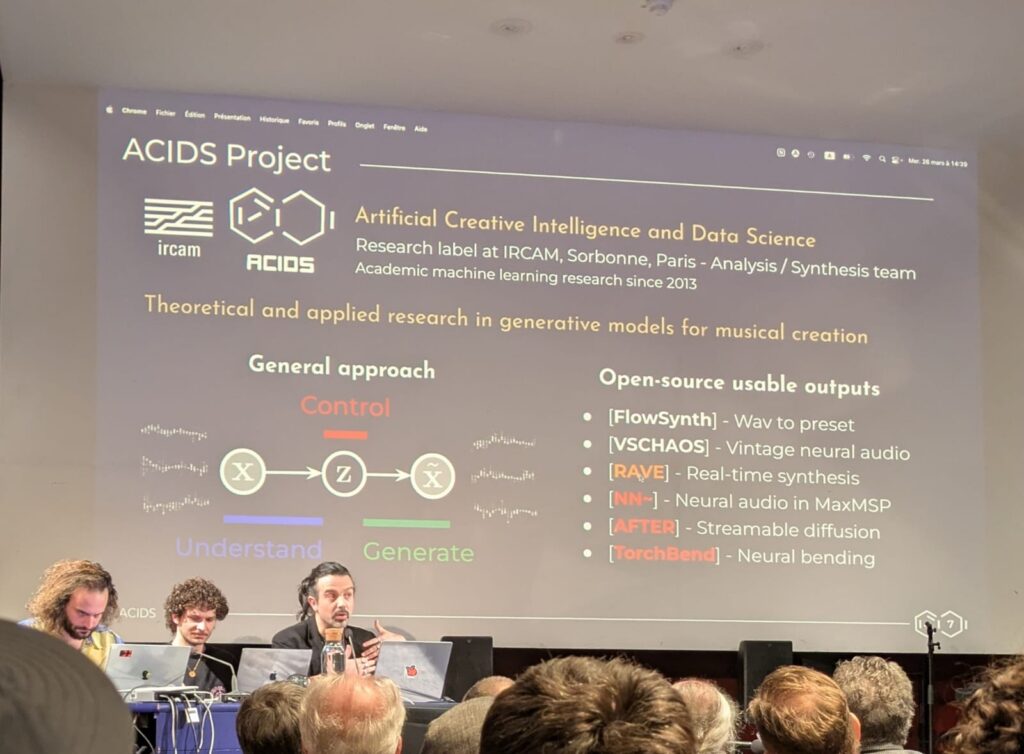
From 26 to 28th of March, we (the sound design master, second semester) had the incredible opportunity to visit IRCAM (Institut de Recherche et Coordination Acoustique/Musique) in Paris as part of a student excursion. For anyone passionate about sound, music technology, and AI, IRCAM is like stepping into new fields of research, discussion and seeing prototypes in action. One of my personal highlights was learning about the ACIDS team (Artificial Creatiive Intelligence and Data Science) and their research projects—RAVE (Real-time Audio Variational autoEncoder) and AFTER (Audio Features Transfer and Exploration in Real-time

ACIDS – Team

The ACIDS team is a multidisciplinary group of researchers working at the intersection of machine learning, sound synthesis, and real-time audio processing. Their name stands for Audio, Communication, Information, Data, and Sound, reflecting their broad focus on computational audio research. During our visit, they gave us an inside look at their latest developments, including demonstrations from the IRCAM Forum Workshop (March 26–28, 2025), where they showcased some of their most exciting advancements. Beside their really good and catchy (also a bit funny) presentation I want to showcase two projects.

RAVE (Real-Time Neural Audio Synthesis)

One of the most impressive projects we explored was RAVE (Real-time Audio Variational autoEncoder), a deep learning model for high-quality audio synthesis and transformation. Unlike traditional digital signal processing, RAVE uses a latent space representation of sound, allowing for intuitive and expressive real-time manipulation.

Overall architecture of the proposed approach. Blocks in blue are the only ones optimized,
while blocks in grey are fixed or frozen operations.

Key Innovations

  1. Two-Stage Training:
    • Stage 1: Learns compact latent representations using a spectral loss.
    • Stage 2: Fine-tunes the decoder with adversarial training for ultra-realistic audio.
  2. Blazing Speed:
    • Runs 20× faster than real-time on a laptop CPU, thanks to a multi-band decomposition technique.
  3. Precision Control:
    • Post-training latent space analysis balances reconstruction quality vs. compactness.
    • Enables timbre transfer and signal compression (2048:1 ratio).

Performance

  • Outperforms NSynth and SING in audio quality (MOS: 3.01 vs. 2.68/1.15) with fewer parameters (17.6M).
  • Handles polyphonic music and speech, unlike many restricted models.

You can explore RAVE’s code and research on their GitHub repository and learn more about its applications on the IRCAM website.

AFTER

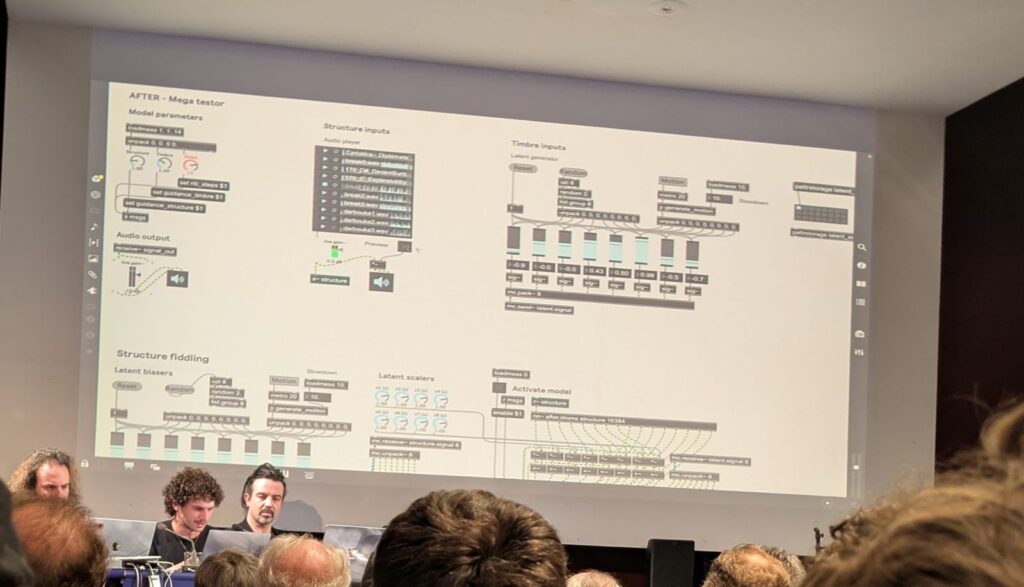
While many AI audio tools focus on raw sound generation, what sets AFTER (Audio Foundation Transformer) apart is its sophisticated control mechanisms—a priority highlighted in recent research from the ACIDS team. As their paper states:

“Deep generative models now synthesize high-quality audio signals, shifting the critical challenge from audio quality to control capabilities. While text-to-music generation is popular, explicit control and example-based style transfer better capture the intents of artists.”

How AFTER Achieves Precision

The team’s breakthrough lies in separating local and global audio information:

  • Global (timbre/style): Captured from a reference sound (e.g., a vintage synth’s character).
  • Local (structure): Controlled via MIDI, text prompts, or another audio’s rhythm/melody.

This is enabled by a diffusion autoencoder that builds two disentangled representation spaces, enforced through:

  1. Adversarial training to prevent overlap between timbre and structure.
  2. A two-stage training strategy for stability.
Detailed overview of our method. Input signal(s) are passed to structure and timbre encoders, which provides
semantic encodings that are further disentangled through confusion maximization. These are used to condition a latent
diffusion model to generate the output signal. Input signals are identical during training and but distinct at inference.

Why Musicians Care

In tests, AFTER outperformed existing models in:

  • One-shot timbre transfer (e.g., making a piano piece sound like a harp).
  • MIDI-to-audio generation with precise stylistic control.
  • Full “cover version” generation—transforming a classical piece into jazz while preserving its melody.

Check out AFTER’s progress on GitHub and stay updated via IRCAM’s research page.

References

Caillon, Antoine, and Philippe Esling. “RAVE: A Variational Autoencoder for Fast and High-Quality Neural Audio Synthesis.” arXiv preprint arXiv:2111.05011 (2021). https://arxiv.org/abs/2111.05011.

Demerle, Nils, Philippe Esling, Guillaume Doras, and David Genova. “Combining Audio Control and Style Transfer Using Latent Diffusion.”