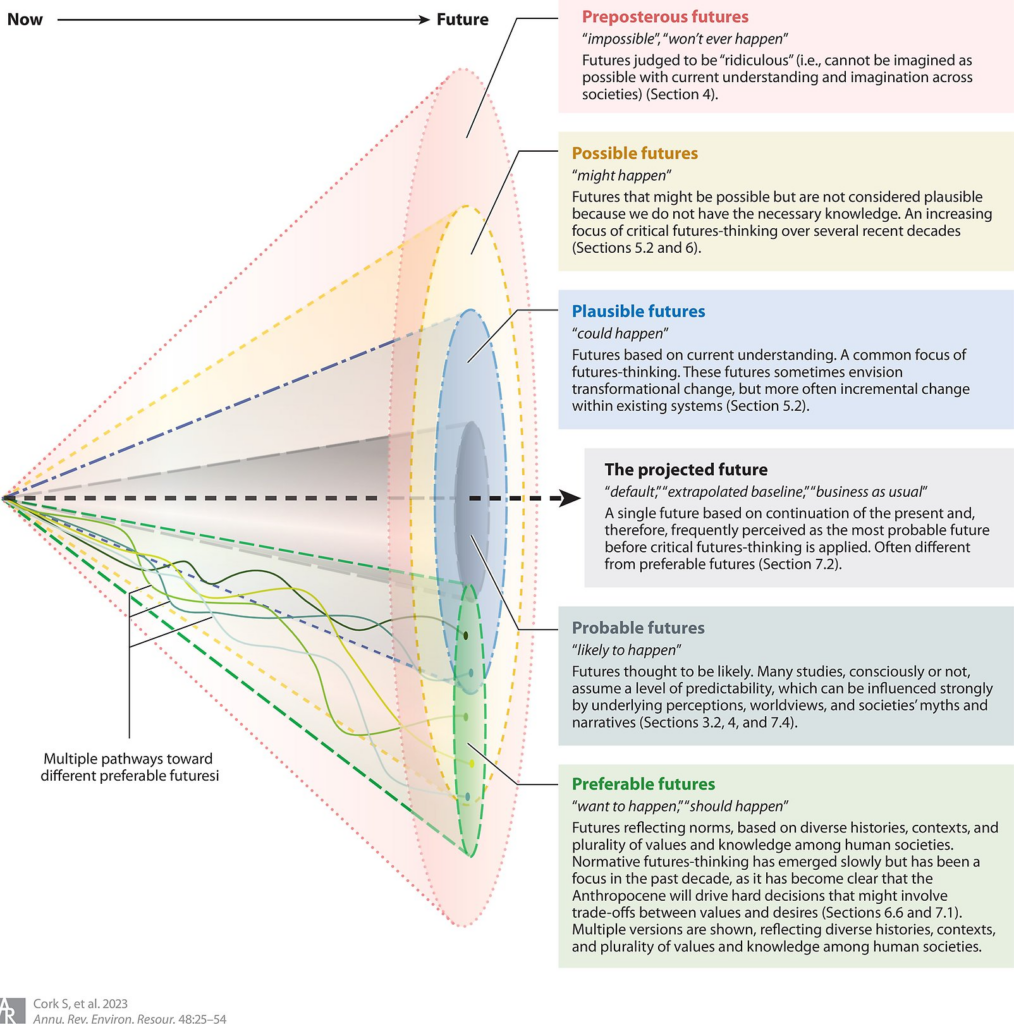
Throughout my research, I have explored the complexity of the climate and biodiversity crises, uncovering both their vast scope and the challenges in addressing them. These crises are deeply interconnected, involving a multitude of factors such as land use, policy decisions, economic structures, and environmental conservation efforts. Understanding this complexity has been essential in identifying viable solutions. Given the broad nature of the problem, I needed a structured approach to navigate my inquiry, which led me to adopt a design-oriented perspective. By framing my research through the lens of design solutions, I had something to navigate by throughout the process.
I began by examining the role of major international organisations such as the United Nations, the World Wildlife Fund (WWF), and the Intergovernmental Science-Policy Platform on Biodiversity and Ecosystem Services (IPBES). These institutions play a critical role in shaping global responses to environmental challenges, setting policy frameworks, and guiding conservation efforts. However, despite their influence, many of the strategies implemented at the international level struggle with enforcement and accountability, often relying on voluntary commitments from nations and industries and a lot of financial support. This highlighted the need for systemic changes that go beyond policy declarations and focus on tangible, enforceable actions.
A significant focus of my research has been the political dimensions of the climate and biodiversity crises. While various policies have been enacted to curb environmental degradation, gaps remain in implementation, enforcement, and long-term commitment. Many policies prioritise economic growth over ecological stability, leading to continued environmental harm. The issue of land use exemplifies this challenge. Land-use change is currently the greatest driver of biodiversity loss, yet responsibility for managing and protecting nature is often diffuse and difficult to assign. This lack of clear accountability makes it difficult to implement lasting solutions, as economic and infrastructural interests frequently take precedence over conservation.
In seeking potential solutions, I explored alternative approaches such as the permaculture movement and regenerative agriculture. Both emphasize sustainable land management practices that restore ecosystems rather than deplete them. Permaculture focuses on designing agricultural and social systems that work in harmony with nature, while regenerative agriculture seeks to improve soil health, increase biodiversity, and create resilient farming practices. These methods demonstrate the potential for human activities to coexist with and even enhance natural systems. However, while promising, they require widespread adoption, supportive policies, and systemic shifts in agricultural practices to have a large-scale impact.
One of the most intriguing topics I have explored is speculative design and future-thinking as a means of addressing environmental challenges.
Large societal transformations are only possible if humanity gets better at imagining and envisioning positive futures
(Corc, et. al., 2023)
Unlike conventional solutions that react to existing problems, speculative design allows for the exploration of potential futures, considering how societies might evolve in response to climate change and biodiversity loss. Future-thinking integrates interdisciplinary knowledge, systems thinking, and design methodologies to anticipate long-term outcomes and create visionary solutions.
Future-thinking offers several advantages in tackling environmental crises. First, it enables proactive rather than reactive decision-making, allowing policymakers, designers, and communities to plan for multiple scenarios. Second, it encourages holistic solutions that consider ecological, social, and technological dimensions simultaneously. Finally, it fosters creativity and adaptability, which are crucial for addressing the unprecedented challenges posed by climate change and biodiversity loss.
Another factor that makes this method superior, is that scenario based future-thinking, can create such immersive and strong future-scenarios that can impact and appeal to the audience in a much stronger degree than other methods. An since value-change and understanding from the audience is what true transformation needs, it is a important factor to take into account.
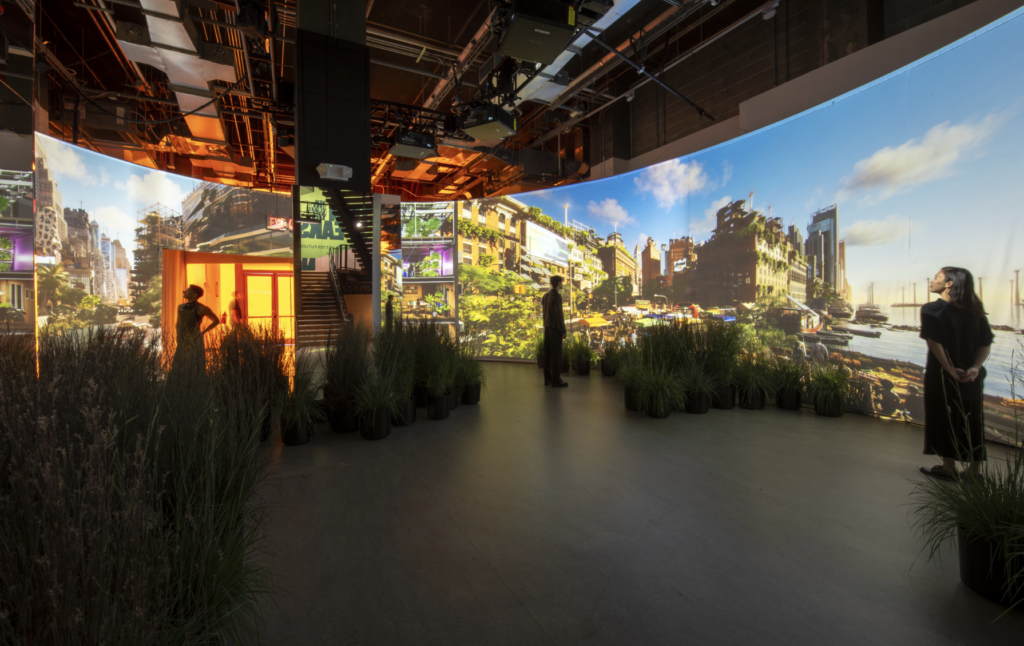
In a TED Talk “Why We Need To Imagine Different Futures”, the CEO Anab Jain says (Superflux, 2009, 6:30):
One of the most powerful tools for driving change is allowing people to experience the future consequences of their actions today
Anab Jain, CEO of Superflux
From a design perspective, future-thinking is particularly compelling because it provides a framework through which I can contribute meaningfully. Rather than being confined to mitigating existing damage, I can use design to imagine and construct sustainable futures. This might involve creating resilient urban environments that incorporate nature, developing innovative materials and technologies that reduce environmental impact, or designing policies and infrastructures that prioritize ecological health. By merging speculative design with real-world applications, future-thinking allows for the integration of visionary ideas with practical implementation.
As I conclude this phase of my research, I recognise that future-thinking is the most promising and encompassing solution I have encountered. It not only addresses the immediate and long-term challenges of climate and biodiversity crises but also provides a structured, design-oriented methodology that aligns with my expertise. However, this realisation is only the beginning. Moving forward, I intend to dive deeper into the field of future-thinking, exploring its applications in environmental policy, urban planning, and ecological restoration. By continuing this research, I hope to contribute to the development of innovative strategies that bridge the gap between imagination and action, ultimately shaping a future where nature and human progress coexist harmoniously.
Sources:
Cork, S., Alexandra, C., Alvarez-Romero, J.G., Bennet, E.M., Berbés-Blásquez, M., Bohensky, E., Bok, B., Constanza, R., Hashimoto, S., Hill, R., Inayatullah, S., Kok, K., Kuiper, J.J., Moglia, M., Pereira, L., Peterson, G., Weeks, R. & Wyborn, C. (2023). Exploring Alternative Futures in the Anthropocene. Annual Review of Environment and Resources, 48, 25-54. Swinburne University of Technology. Retrieved from https://www.annualreviews.org/content/journals/10.1146/annurev-environ-112321-095011
Superflux. (2017, 19. juni). TED Talk: Why We Need To Imagine Different Futures [Video] Superflux. Retrieved from https://superflux.in/index.php/ted-2017-the-future-you/#