Reimagining Concert Spaces: The Acoustic Landscape of Joanneum Quarter
Music and spaces have always shared a deep and inextricable relationship. The way sound interacts with space transforms the listening experience. By playing with it consciously we are creating an immersive experience that goes beyond traditional concert settings. This is the core idea behind the “Sounds of the Joanneum Quarters Graz” project—an innovative approach to ambient music and concert formats that redefines how audiences engage with sound.
The Vision: Transforming Public Spaces into Concert Venues
The project explores how the spatial dynamics of the Joanneum Quarter in Graz can shape a unique musical experience. Unlike conventional concert halls with fixed seating and predictable acoustics, this public space presents a lively environment where sound can evolve organically. The goal is to break down barriers associated with classical concert settings by offering an open, interactive listening experience that invites both intentional audiences and casual passersby.
Architectural Influence on Sound
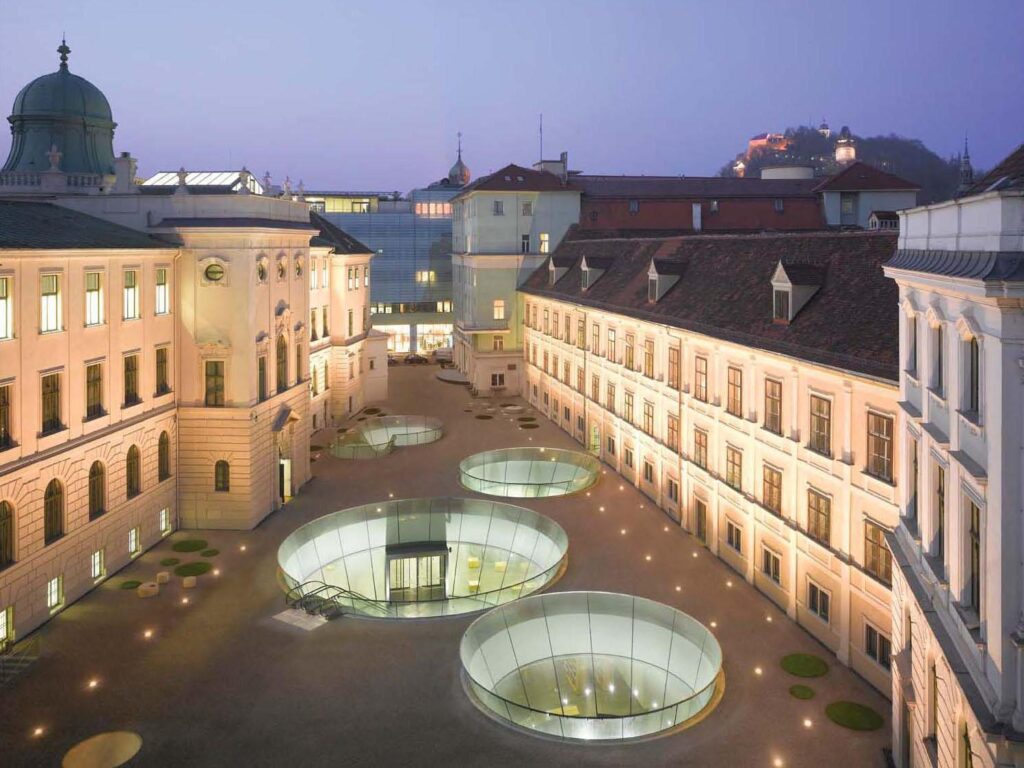
A key element of this project is the relationship between sound and architecture. The Joanneum Quarter is defined by its distinct conical funnels, made of curved glass with a silk-screen print that filters light. These architectural features create natural acoustic properties that influence how sound behaves within this space. By treating these funnels as integral instruments, the composition can interact with the environment rather than simply existing within it.
There are two primary compositional approaches considered:
Treating each funnel as an individual instrument, crafting site-specific musical material that resonates with the unique properties of each space.
Creating soundscapes that work across all funnels, allowing listeners to move through the space and experience varied auditory perspectives.
What I’ve discovered is that there’s a strong awareness of loneliness as a problem, especially in the research community. There are countless studies, statistics, and even political measures addressing it, but what’s missing are concrete steps and ideas on how to tackle it. There are some considerations, such as guidelines for urban planners and architects, that lay the groundwork. But direct, creative, and innovative approaches are harder to find. Most existing solutions focus on open spaces, but few actively invite specific forms of interaction. What’s needed is a deep understanding of both the structural aspects of loneliness and the personal experience of it. This means understanding what people need in order to change their behavior and the way they operate in the world we currently live in. Is it the online world and our phone addiction? The fast paced life style? The way and amount we work? The ways our offices, homes an cities are designed and built?
It might be helpful to focus on specific scenarios where loneliness occurs, as its causes and effects vary depending on the context. Loneliness looks different for an older person in a retirement home than it does for a young person who just moved to a new city. Patients in hospitals or reha centers face different challenges than single parents with little time for social interaction. Immigrants who have been separated from their families and cultures experience isolation differently than someone struggling with mental health issues. People who have been removed from or disconnected from their communities also face unique forms of loneliness.
So what can design do? There are different angles and scales from which to approach this issue. One possibility is rethinking urban planning to create spaces that naturally foster human interaction. Another is shifting public perception by raising awareness and reducing the stigma around loneliness, making it something we can talk about openly rather than something to be ashamed of. Smaller interventions can also play a role, like simple design elements that spark interaction and connection, allowing relationships to develop organically.
The next step is to explore possible directions. Should this take the form of a framework or set of guidelines for urban design? A workshop that actively engages communities? A game or interactive tool that initiates connection? A digital platform that helps people meet in meaningful ways? Maybe physical installations or experimental spaces designed to encourage spontaneous interactions. Or maybe artistic works that highlight and address loneliness could invite reflection and conversation.
To move forward, more research is needed and the questions that came up during research need to be answered. Interviews, testing, and case studies could provide valuable insights into what actually works. Understanding the real experiences of people struggling with loneliness and setting a direction for a project are key to designing solutions that go beyond theory and make a real impact.
In our today’s fast paced and connected world, public places are gradually shifting from passive environments to places of interaction and engagement. As technology continues to change and improve, so too do the ways in which we experience and engage with the world around us. Public spaces are not only for physical gatherings but also serve as a platform for digital interaction, social engagement, and sensory experience. Interaction Design plays an important role in transforming these spaces.
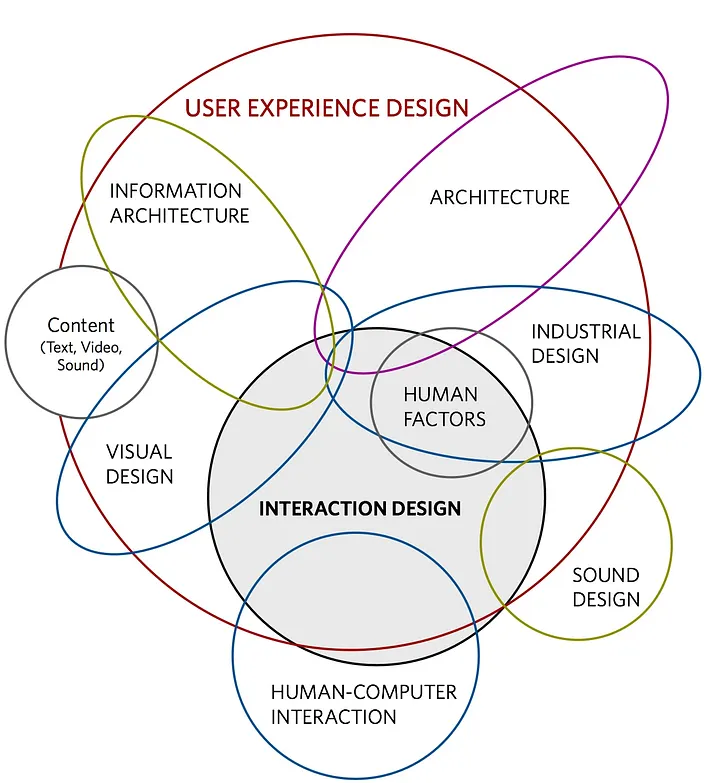
Interaction Design vs. Experience Design
Interaction Design:
This field focuses on how individuals interact with technology, their surroundings and the environment and, most importantly, one another. Its primary aim is to improve users’ understanding of what can be done, what is currently happening, and what has just occurred. Interaction design integrates principles from psychology, design, art, and emotion to create a positive and enjoyable experience for users. 2
This practice focuses on creating products, services, processes, events, and environments with an emphasis on the overall quality and enjoyment of the user’s experience. The goal is to ensure a seamless, engaging, and meaningful interaction throughout every stage of the experience. 2
How Interaction Design shapes public spaces
How people perceive the world around them is a key question in urban planning, and it’s central to Kevin Lynch’s groundbreaking book, The Image of the City (1960). In this work, Lynch explores how individuals create mental maps of their surroundings, which mirrors how user interface (UI) research looks at how people interact with digital designs.Integrating UX/UI principles into urban planning can enhance the environment by improving usability, accessibility and user experience. 3
Human-Centered Design
One of the most important reasons why Interaction Designers should be incorporated into urban planning is that architects and urban planners concentrate more on the spatial layout and functionality. Interaction Designer focus on the people who use the space. They prioritize the human needs, capabilities and behaviors first, before designing. 2
Digital integration
Public spaces are no longer just physical places. With the increasing presence of technology in our everyday lives, these spaces are also becoming more and more digital. Since it influences how people move through the city and interact with each other in public spaces we need a new approach that combines both the physical and digital dimensions – Urban Interaction Design. 4 5
Wayfinding and Navigation
Large public spaces such as parks, transfer areas and city centers can quickly become confusing and overwhelming. With an intuitive navigation system, these places are accessible and more user-friendly. Such systems could include interactive maps, apps or digital signs.
Facilitating Social Interaction
The goal in public spaces or in third spaces is to encourage people to connect — not just with the space itself, but with each other. Since Interaction Design focus on how people interact with physical and digital elements, they can help creating environments that feel alive and are adapting for the needs and wishes of the people.
Interaction design can therefore also make a small contribution to breaking loneliness and social isolation in public spaces.
Multidisciplinary Approach
However, a multidisciplinary approach between architects, urban planners and interaction designers is best. When all disciplines bring their expertise to the planning, a holistic approach can be created that combines functionality, aesthetics and the human experience. This leads to an accessible, inclusive and engaging space.
Interaction Design has the potential to reshape how public spaces come alive, become centered around people, and connect with the very people they serve. Embracing human-centered design principles, integrating digital systems, and collaborating in design enables shaping public spaces that create valuable social connections.
Sources
[1] S. Li, H. Duan, Y. Yao, W. Zhang und J. Cho, „Enhancing User Experience: A Study of Interaction Design in Coastal Public Spaces“, Asia-pacific Journal Of Convergent Research Interchange, Bd. 10, Nr. 1, S. 473–483, Jan. 2024, doi: 10.47116/apjcri.2024.01.37.
[2] D. Norman, The Design of Everyday Things: Revised and Expanded Edition. Hachette UK, 2013.
[3] J. Kiviluoto, „The lost connection between urban planning and interface design: Ideas towards a re-enactment | LAB Open“, LAB Open, 9. Oktober 2024. https://www.labopen.fi/en/lab-rdi-journal/the-lost-connection-between-urban-planning-and-interface-design-ideas-towards-a-re-enactment/