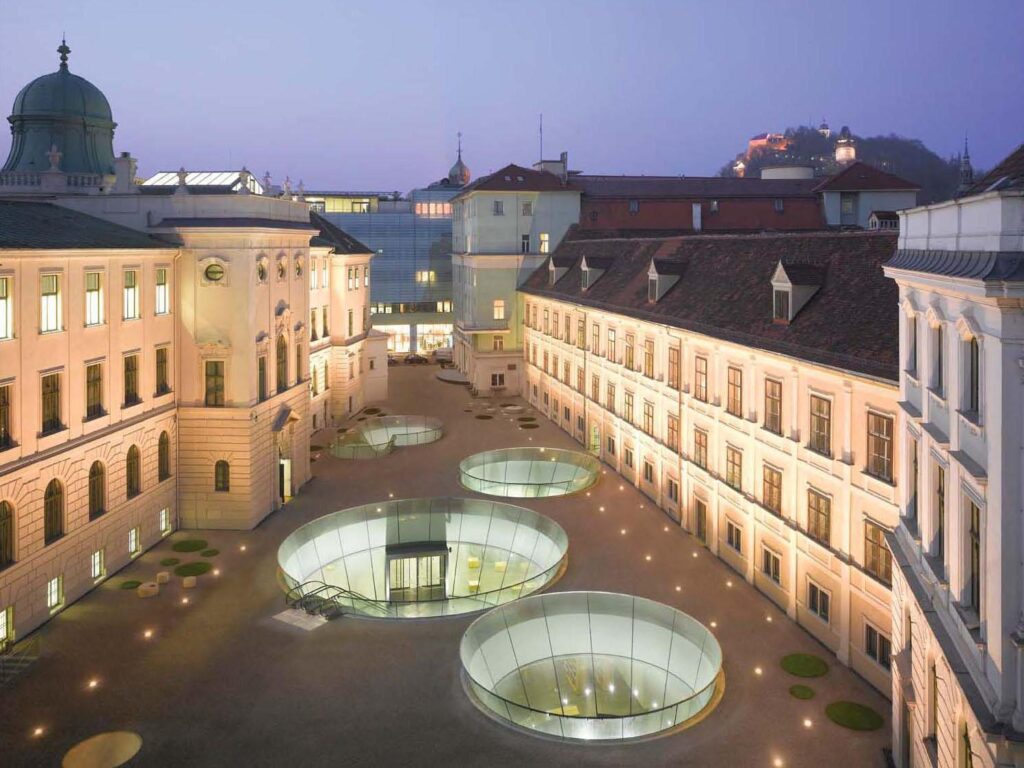
When I first planned my project “Sounds of the Joanneum Quarter”, the goal was ambitious: a site-specific ambient music installation, deeply integrated into the architectural and acoustic landscape of the Joanneum Quarter in Graz. Inspired by these unique sounding conical glass funnels and spatial openness of the site, I imagined turning the piazza into a dynamic concert space; one where the audience’s movement and the physical structures would shape the sonic experience.
However, during this semester a certain “reality check” demanded a shift in direction. Logistical constraints, timing and access issues meant that the Joanneum setting wouldn’t be possible for this phase of the project. Still, this place holds a special place in my heart, because it gave me a lot of inspiration to dig deeper into this topic. Together with my supervisor I brainstormed about re-approaching the topic: how could I scale the core ideas of spatial interaction, site-responsiveness, and ambient composition down to a format that’s more flexible, portable, and even testable at home?
A Scaled-Down Version with Broader Potential
The new direction retains the essence of the original project – interaction, spatial sound, resonance, and ambience – but re-frames it within a more universally accessible framework. Instead of relying on a single, monumental site, the project now aims to create a tool-set for composers and installation-makers, enabling them to transform any room or environment into a site-specific sound installation.
This smaller-scale approach not only makes the concept more versatile regarding the adaptability for different locations, but also supports a hands-on, iterative development process. I can now begin building, testing, and refining the tools at home and FH, implementing a workflow that builds a bridge between research and practice.
Building the Infrastructure: Tools for Room-Scale Sound Art
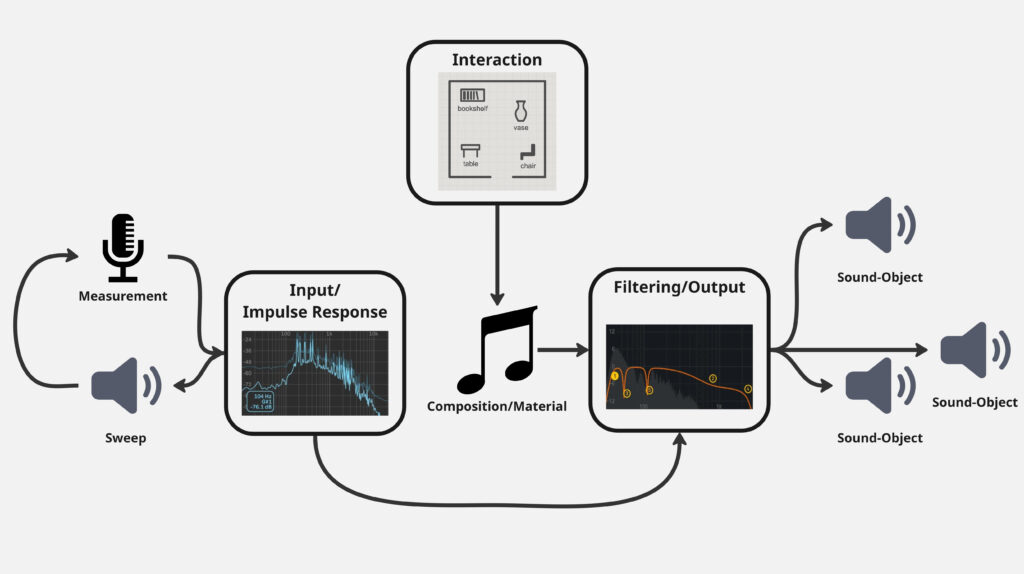
At the heart of this shift is a technical infrastructure that turns any kind everyday objects within a room into potential sound objects. The toolkit consists of both hardware and software components:
- Hardware: Contact microphones or measuring microphones as input, and transducers as output
- Software: A modular environment built in Max/MSP within the Max4Live framework, tailored to site-specific sound creation.
One of the tool-kit’s key features is its ability to identify an object’s natural resonances via impulse response measurements (input). These measurements inform the creation of custom filter curves that can be used to excite those resonances musically (output). In this way, a bookshelf, table, a metal lamp or even a trash-can becomes a playable, resonant sound object.
Interactive Soundscapes in Everyday Spaces
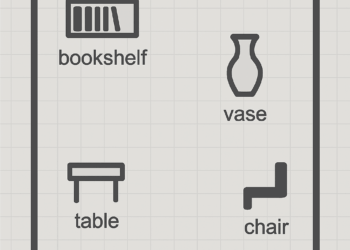
A third component of the tool-set introduces basic interaction mechanics, allowing potential users or audiences to engage with the sound installation. These control objects can be mapped to a digital version of the room (upload of a literal map) and may include for examples:
- Panners that move sound from object to object.
- One-shot triggers that activate specific objects.
With these tools, rooms become navigable soundscapes, where UI interaction can influence sonic outcomes, echoing the spatial interactivity originally imagined for the Joanneum Quarter, but within reach of smaller spaces.
From Site to System
While the grand setting of the original concept served as a powerful starting point, the shift toward a modular, adaptable toolkit has opened up new creative and technical possibilities. What began as a site-specific composition approach can now be framed maybe as a site-adaptive system; one that gives myself or others the opportunity to explore the relation between sound, space, and interaction in their own settings.
The essence remains: redefining how music and sound inhabit space. But now, instead of building for one site, I’m building a foundation that others can use in many.