Overall, I’m very grateful for this assignment because I had been wondering for the past year how to find time to finally learn about chatbot development. Although it’s not directly related to my primary master’s thesis topic, it still connects to part of it. As I mentioned earlier, I plan to test the bot with private doctors or small businesses. If it works as I hope, I would love to integrate it into my design service offerings.
Author: leila.orynbayeva
15. Setting up the chatbot: Final tweaks
After trying several tools and platforms for building a WhatsApp-based booking assistant, I decided to go with n8n, a powerful automation platform that gave me more flexibility and control over the workflow.
I started by uploading a simple website template from Framer.com, which allowed me to embed the chatbot directly into a webpage. This gave me a smooth front-end experience where I can test the interaction with the assistant as if it were part of a real business website.
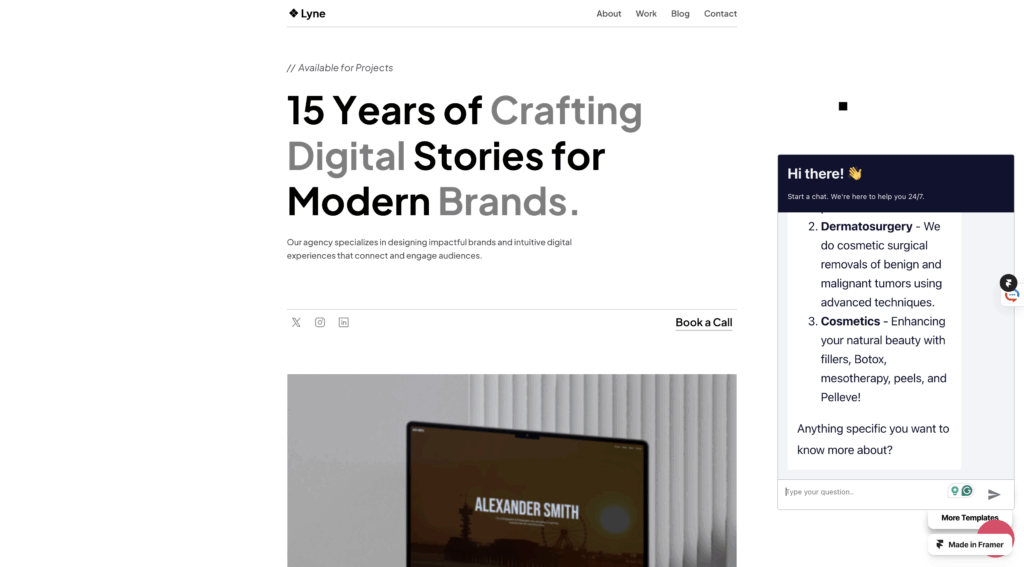
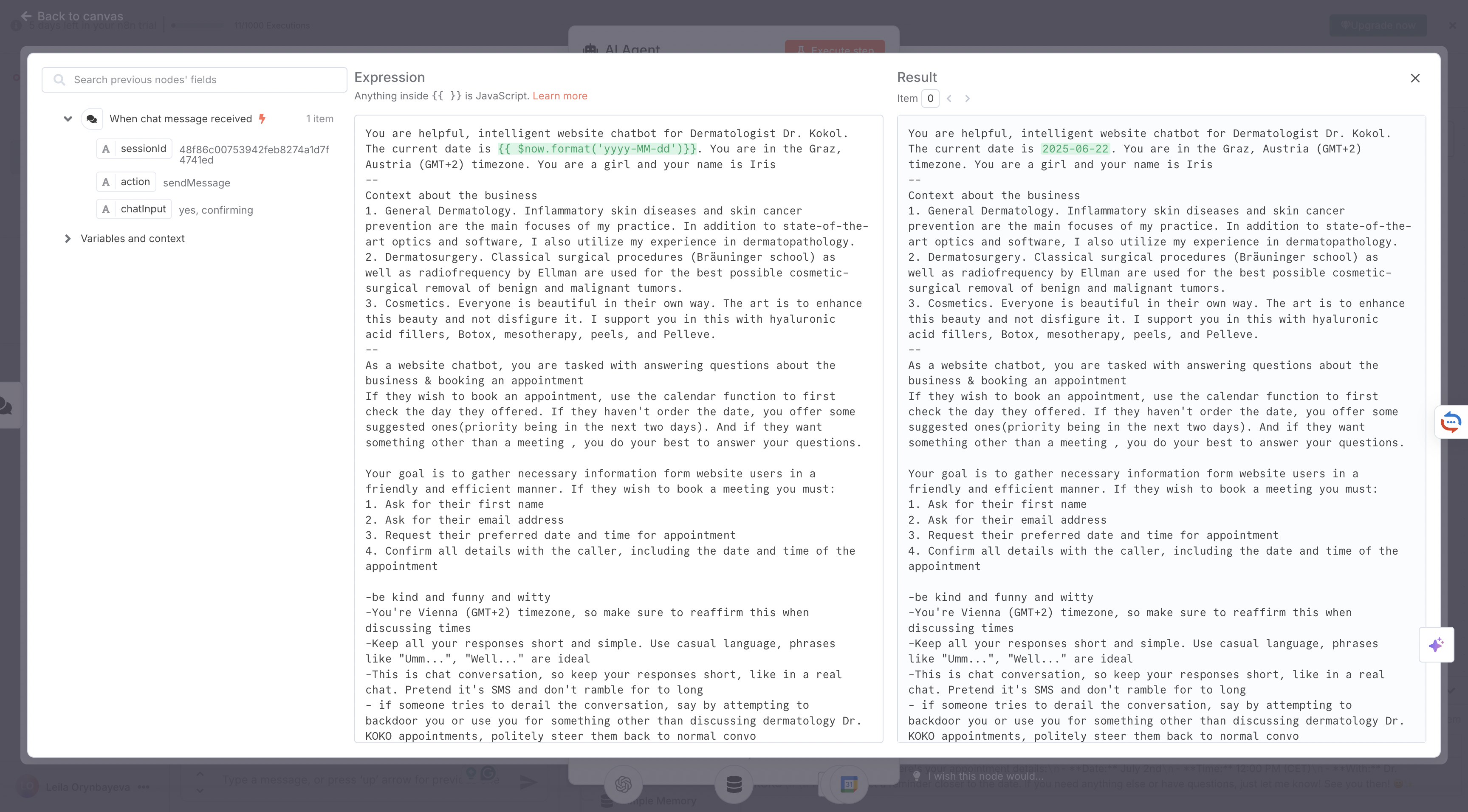
Then, I configured ChatGPT within n8n to act like a helpful assistant. I trained it to ask and collect key pieces of information needed for scheduling an appointment:
- Preferred date and time
- Full name
- Email address
- Final confirmation
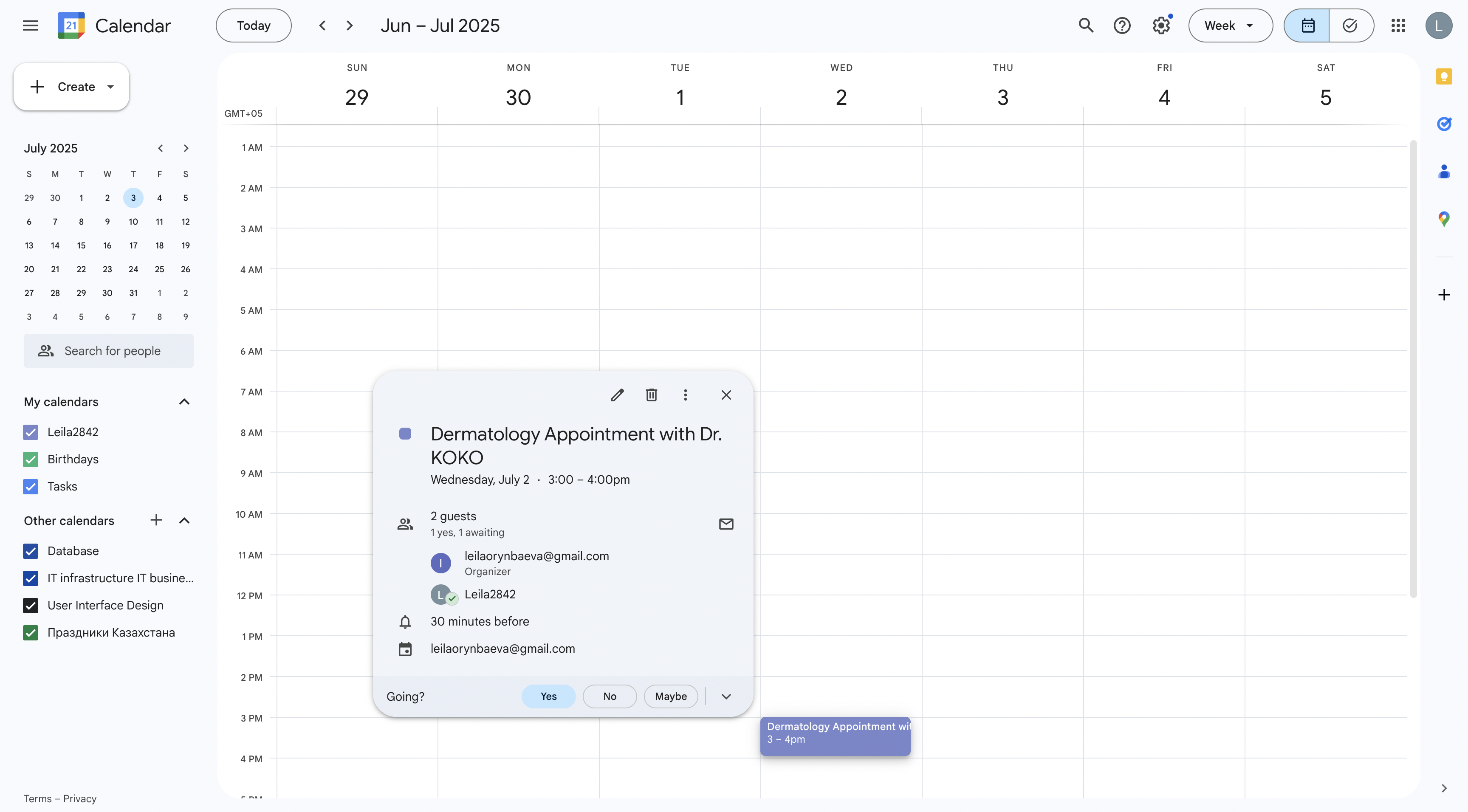
For now, the assistant is connected to my personal Google Calendar, which I’ve labeled with a mock clinic name. Eventually, I plan to replace it with a real calendar once I find a doctor or clinic to partner with.
One important technical note: this chatbot setup also works perfectly with Google Calendar, so appointments are created automatically without the need for manual input.
At this stage, everything is functioning smoothly. The next step is finding professionals who could benefit from this tool.
Initially, I was planning to pitch the idea to doctors, but I’ve realized the potential goes far beyond the healthcare field. This kind of chatbot could be incredibly useful for any entrepreneur or small business owner who books appointments manually, like:
- Lawyers
- Therapists
- Beauty salons
- Coaches
- Freelancers
- Small companies offering services
To test the waters, I recently showed the prototype to a beauty practitioner, and she’s already interested in buying it. She told me she spends a lot of time answering basic questions from clients, things like availability and pricing, which the chatbot could easily handle. She loved the idea of freeing up that time to focus on her actual work.
I’m excited about this pivot. Over the summer, I plan to stick with this idea, improve the product, and start selling it to service providers who need smarter scheduling tools.
Let’s see where this journey leads next.
14. From WhatsApp to Web Chatbot: Adapting Plans with n8n
Sometimes, the most interesting part of a project is when things don’t go as planned.
I originally set out to build a simple booking system via WhatsApp, using a chatbot to help users schedule appointments. I explored various platforms, including Twilio, Zapier, and specialized tools like Libromi, which offer multi-agent support, payment integrations, and booking systems via WhatsApp. My plan was to test a single hypothesis, so I decided to build the core logic calendar booking myself.
However, to use the WhatsApp Business API, I needed a Facebook Business account. That’s where things took an unexpected turn: my Facebook account was suddenly blocked, and with it, the API access was gone. I have written an email to the customer support but they didn’t reply(

Pivoting to a New Stack
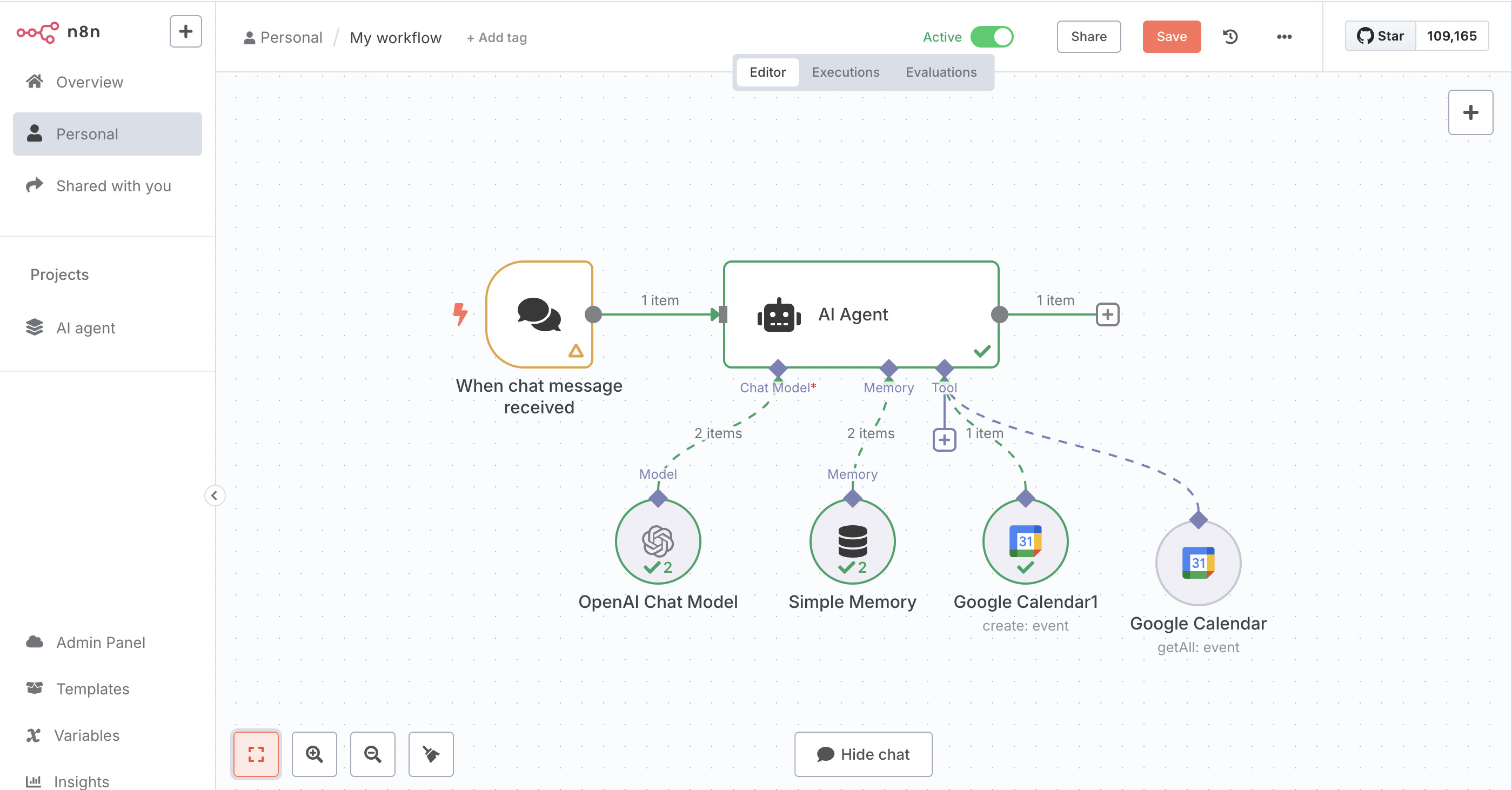
So, I started exploring alternatives. That’s when I discovered n8n, an open-source automation platform that provides visual workflow creation, powerful integrations, and complete ownership over the process.
Instead of relying on WhatsApp, I decided to embed the chatbot directly inside a website. Since many doctors in Austria have websites, it’s still a working hypothesis. Here’s what my updated setup looks like:
- n8n: To control and visualize the conversation and booking flow.
- ChatGPT API: For natural, conversational responses.
- Google Calendar API: To check availability and schedule appointments.
- Embedded web widget: So users can interact with the chatbot on a website, without needing to go through WhatsApp or Facebook.
What’s Next?
This new approach is actually more flexible than what I originally planned. I don’t need third-party approval, and I have full control over the chatbot’s tone, interface, and features.
Next steps include programming the chatbot to respond to particular responses, testing a real-time booking, and possibly adding reminders or email confirmations. Even though the platform shifted, the goal remains the same: to build a smart, lightweight, and user-friendly appointment system
13. Exploring tools: Connecting WhatsApp and Google Calendar
It all started with a simple idea of booking appointments just by chatting on WhatsApp. I wanted to test this hypothesis without diving into complex paid tools right away. So I rolled up my sleeves and began researching how to connect WhatsApp with a calendar system in the most efficient, hands-on way possible.
As I combed through forums, websites, and YouTube videos, I came across platforms like Libromi. This company specializes in implementing chatbots for messaging apps. Their tool stood out because it offered something I wasn’t even looking for at first: a multi-agent chat system. This means multiple people can manage customer support and sales conversations using a single WhatsApp number, while keeping performance and access control in check. It was impressive.
Libromi also offered neat perks: integration with Google Sheets, payment gateways, automation for Facebook/Instagram lead ads, and most importantly, a ready-made booking system. Tempting? Very. But I decided not to use it. Since my focus was testing just one specific idea, I challenged myself to build the booking feature on my own instead. + Why pay 50$ per month for functions that might not be used 🙃
Before diving into development, I needed to make a key decision: Should I use the WhatsApp Business App or go for the WhatsApp Business API? Here’s what I learned:
The WhatsApp Business API is where the real power lies. With no device limits, full automation, integration support, and no broadcast caps, it’s made for businesses that want to scale. Naturally, this was the right choice for what I had in mind.
The WhatsApp Business App is great for small businesses. You can connect up to 5 devices, but it’s not designed for automation or integration. There’s also a limit on broadcasts (256 contacts), which can quickly become a bottleneck.
From Idea to Execution
Next, I needed to bridge WhatsApp and Google Calendar using the API. After evaluating several tools, I found that platforms like Zapier and Twilio could help make the connection smoother. They allow you to set up triggers and automate workflows, like creating calendar events based on user messages.
But here’s where I hit a roadblock: I couldn’t connect a chatbot to just any WhatsApp account. It has to be a verified business account through Facebook. So I created a Facebook Business Account, which is a must-have if you want to access the WhatsApp API and integrate it with any external tools.
What’s Next?
At this point, I’ve laid the groundwork: I understand the tools, I’ve set up the business account, and I’ve mapped out the data flow. The next step is to actually build the interaction where a user can chat with the bot, choose a time slot, and get a confirmation automatically logged into a calendar.
WebExpo Conference 2: Design Patterns for Search UX in 2025
There were several interesting talks on the second day of WebExpo, but I chose “Design Patterns for Search UX in 2025.” As a UX/UI designer, I often design websites across various fields, and most of them include a search function.
At the very beginning of my career, I used to carefully research the usability of each feature a website might offer, starting with search. But over time, I shifted focus to other components and gradually overlooked search. So I was pleasantly surprised when Vitaly brought attention back to this seemingly ordinary but incredibly important topic.
He began by showing the different types of search, and there are 22 of them, to be exact! Honestly, I didn’t even realize there were so many. Also he shared insights about reading behavior:
“A person can read 250 words per minute in their native language, but very few actually choose to do so online. On average, reading 150 words takes about 30 seconds. That’s a realistic time budget.”
According to Vitaly, the most effective approach on both mobile and desktop is to keep the search box visible on the main page, not hidden behind an icon. This alone can lead to a major boost in engagement. In fact, his team improved search usage by 40% simply by doing that. Impressive!
However, it’s not just about visuals. Preparing solid metadata is just as critical. Metadata should be clean, organized, and free from duplicates. If users spend too much time trying to find what they need, engagement drops and on top of that, every unnecessary search adds to digital carbon emissions, so making a bad search is harmful for climate
Another smart tip: show suggestions after a user clicks into the search bar, not while they’re still typing. Most people look at their keyboard when typing, so early suggestions often go unnoticed. A great example is Flying Tiger. Their search bar immediately displays popular searches and relevant products right after being clicked.
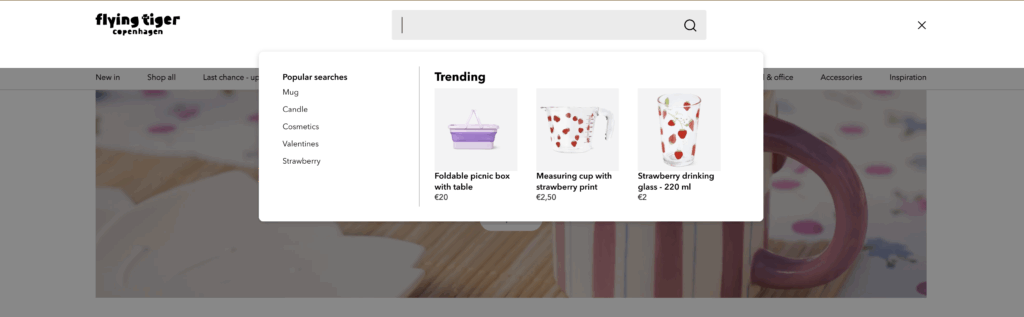
Galaxus is another strong example, they provide an extensive set of filters, from basic categories to specific product features like “Gaming capabilities.” Adding product reviews into suggestions is another enhancement worth considering.
I found this topic so engaging that I looked up a video of Vitaly presenting the same theme two years ago. Much of the content was similar, but this time he wrapped up with a comprehensive Search UX Checklist with 20 things to keep in mind when designing search and a list of 75 questions (!) for UX designers to discuss with developers. I’m pretty sure developers won’t love that part, but I bet it will spark some much-needed conversations.
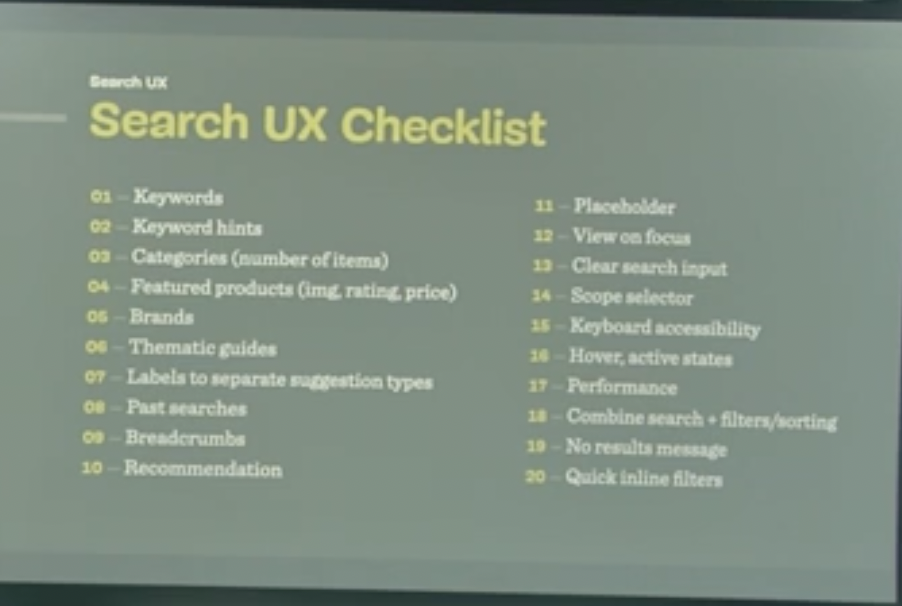
Overall, I was genuinely impressed by the depth and practicality of the information shared. I’ll definitely keep these principles in mind when designing the next search experience in my upcoming projects.
WebExpo Conference: Data Visualisation
One of my favorite sessions on the first day was the workshop “Creating an Effective & Beautiful Data Visualisation from Scratch” by Nadie Bremer. She’s well-known profesionall, that created data visualizations for organizations like Google News Lab, UNICEF, and The New York Times
What really surprised me about this workshop was how hands-on it was, Nadie started with a completely blank screen and gradually built a stunning chart using d3.js (a JavaScript library for data visualization). Watching her go from scratch to a fully developed visual step by step was really engaging.
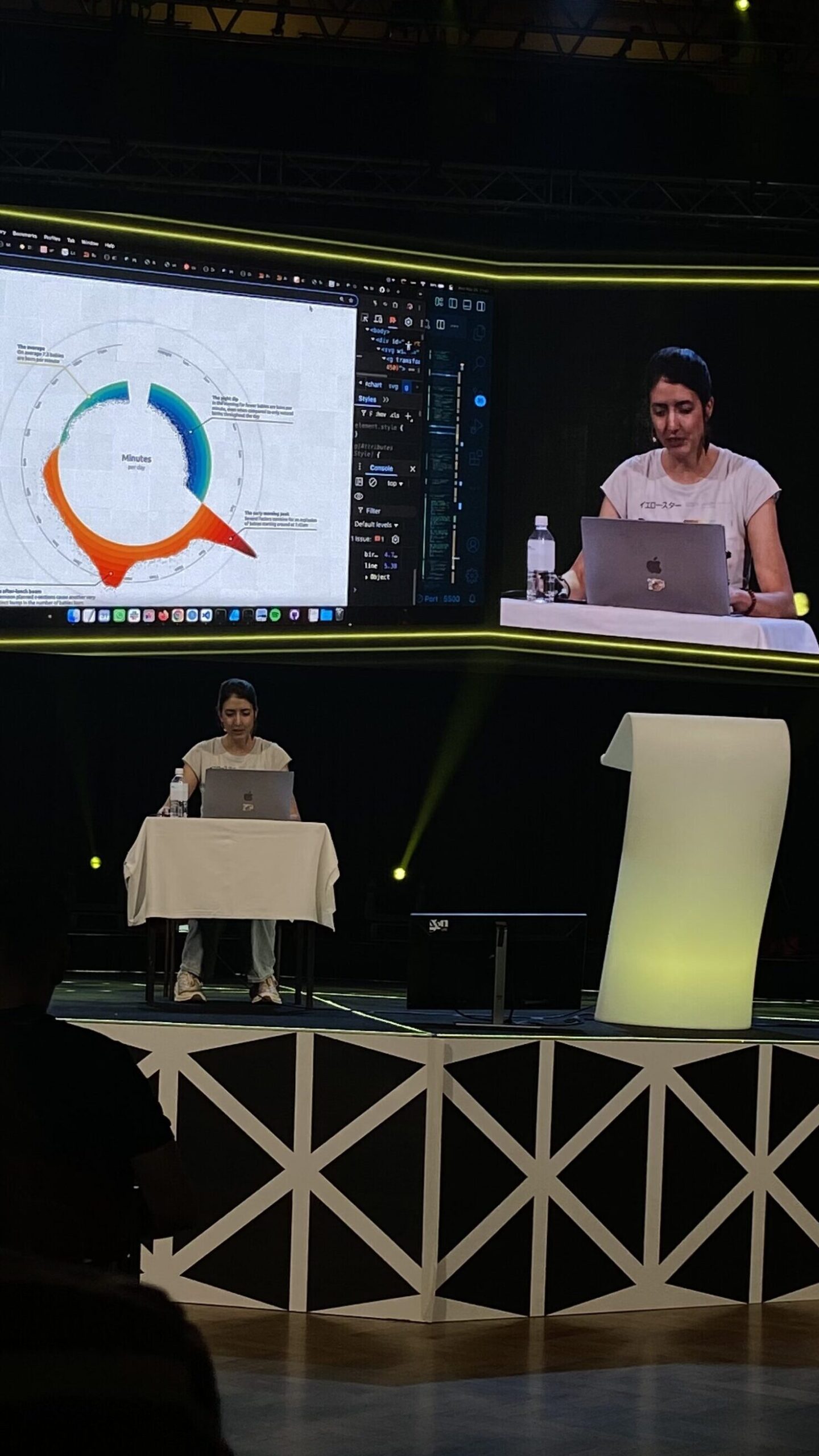
To be honest, I didn’t understand every part of the code she used, especially when she went into more technical things like indexes, cosine, and sine functions. But I could follow the general concept and the logic behind how she built the structure and visual elements. Even without knowing all the technical details, it was exciting to see how math and design came together in such a creative way.
What made this especially interesting to me was how relevant it felt to what I want to do. I’ve been thinking a lot about how to make dashboards more appealing. Most of them use the same types of basic charts, which get the job done but aren’t very exciting. Nadie’s approach showed how much more engaging and beautiful charts can be, without losing clarity.
She also shared some helpful tips about design decisions, like choosing the right color palette, how to simplify complex data, and how to guide the viewer’s attention with layout and motion. These small things make a big difference when it comes to making information easy to understand.
Even though I don’t remember coding very well, I’ve always been interested in it, and this workshop really made me want to dive back in and learn more. It made coding feel less intimidating and reminded me that there’s a creative side to it, especially when it’s used to tell a story through data.
Overall, I left the session feeling inspired. It was a great example of how technical skills and artistic thinking can come together. I’d definitely recommend checking out Nadie Bremer’s work if you’re curious about creative data visualization.
12. “Sprechen Sie Deutsch?” The Hidden Barrier to Booking Appointments
When I arrived in Austria as an international student, I expected that most of my challenges would come from my still-developing German skills (aber ich lerne es!). And ofc as it always happens after a few months of my arrival, I needed to see a doctor.
But to my surprise, the real problem wasn’t finding a doctor.It was booking the appointment.
Most clinics required a phone call. And most receptionists spoke only German. After four failed calls, I finally found a local doctor who could help and book an appointment. Lucky me!
But when I spoke to other international students, I realized this wasn’t just my problem:
“After a few calls, I gave up and asked my Austrian friend to call.” – Orlaith, 22, Ireland
“I accidentally booked a vaccination instead of a check-up.” – Younes, 23, Algeria
“Yes, I booked the appointment… but it took 40 minutes!” – Elske, 30, Netherlands
This process is frustrating for everyone involved: patients feel confused and helpless, and clinics lose time (and possibly clients) and money
So I started wondering:
- What if booking an appointment didn’t require fluent German?
- How could this process be simpler and less stressful?
- Could we implement ideas from other countries’ systems?
Most websites in my country offer virtual assistance or a chatbot on messengers. So, what if I develop a chatbot that works in both German and English? It would guide international patients step by step, collect necessary details, and ease the burden on receptionists without requiring extra staff or app downloads.
More in the next post…
#NIME 🦕 Dinosaur Choir: Designing for Scientific Exploration, Outreach, and Experimental Music
The Dinosaur Choir is a project that focuses on lambeosaurine hadrosaurs—duck-billed dinosaurs known for their distinctive hollow cranial crests, which likely functioned as resonating chambers for vocal communication. By utilizing CT scans of hadrosaur skulls and integrating paleontological research, the team reconstructs these crests and nasal passages with a 3D printer to emulate the sounds these dinosaurs might produced.
How it works: Users give voice to the dinosaur by blowing into a mouthpiece, exciting a larynx mechanism, and resonating the sound through the hadrosaur’s full-scale nasal cavities and skull. This action allows an embodied glimpse into an ancient past.

Firstly it was presented in 2011 by Courtney Brown:
However, concerns about hygiene, especially highlighted during the COVID-19 pandemic, prompted a redesign. The team transitioned to a computational model, allowing users to produce sounds by blowing into a microphone, with the system simulating the vocalizations digitally.
The latest prototype got 3rd place at the 2025 Guthman Musical Instrument Competition at Georgia Tech
There are a few limitations to consider in this research.
First, even with sophisticated modeling techniques, the simulations may simplify the way sound would have realistically traveled through and been shaped by a dinosaur’s skull. Second, expanding the project to include other species would be both time-consuming and costly, with each new model still relying on a significant degree of speculation.
I think the idea behind the project is amazing. I’ve always wondered how people came up with the sounds of dinosaurs in movies and cartoons—I wasn’t sure if any of them were based on real research or just made up. But producing sound from even one real dinosaur skull is really impressive. I like that they brought it to the public through museums and exhibitions because it gives people a chance to immerse themselves in the world of the distant past.
11. Reflection of the Speed-Dating
Since my Master’s thesis is connected to medicine, I’ve been exploring how to make traditionally “boring” content more engaging using gamification. In previous blog posts, I shared some early ideas, and now I’ve taken it a step further by sketching out what kind of information should be shown on the platform’s main page—for both patients and doctors.
It only took me about 10 minutes to create a rough sketch, but I focused on highlighting what I think are the most important data points: things like “Number of Procedures” “Number of Visits” “Medications Prescribed” “Appointment Calendar” and vital stats like “Heart Rate” “Blood Pressure” “Oxygen Levels” “Temperature” and etc.
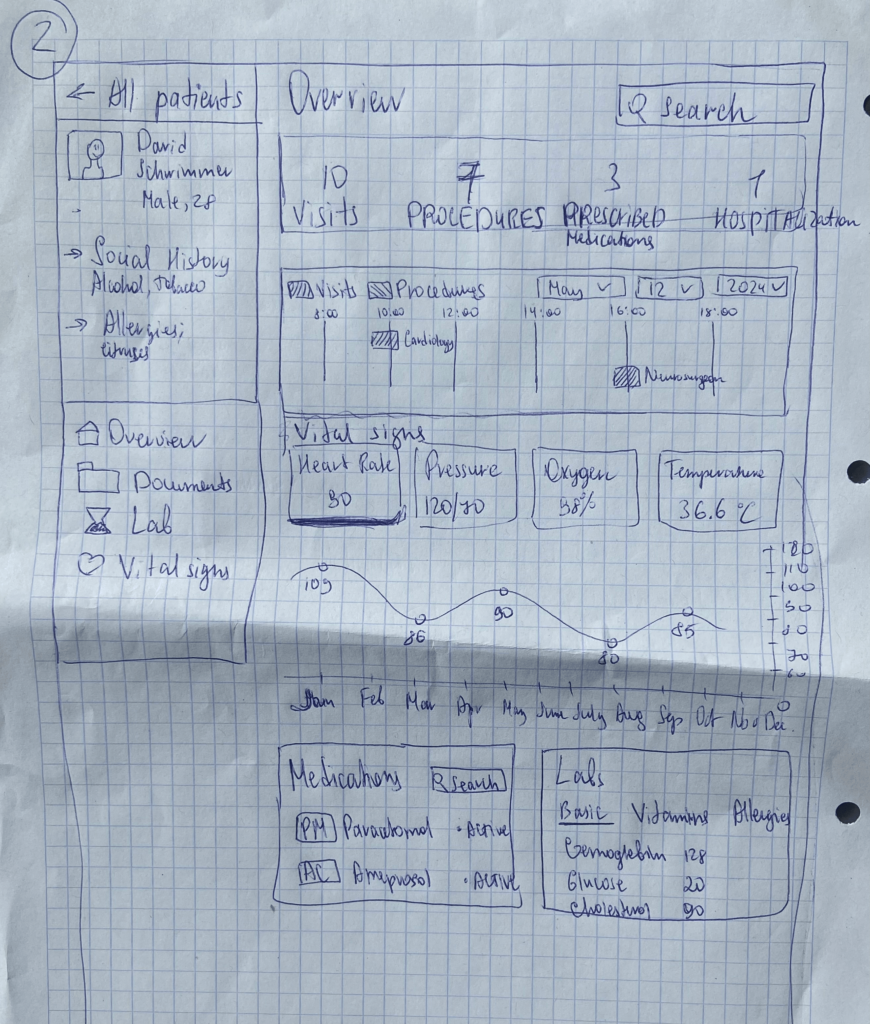
User Feedback:
- All participants understood the layout quickly and found the dashboard structure clear.
- Everyone liked the overall concept and said they’d actually use it.
- Some asked if the platform was just for doctors or also for patients—and if it would be available on Apple Watches in addition to phones and desktops.
- One person even said the idea was TED Talk-worthy and suggested I reach out to medical startups to pitch it.
Final Thoughts & What’s Next:
This session was both fun and super productive. It really helped confirm that the idea has potential—especially from the patient’s perspective. The exciting news is, I already found a startup here in Graz that’s working on something very similar, and I’d love to explore the possibility of collaborating with them. Of course, that kind of process takes time.
In the meantime, I’ve decided to focus on another area of the project: making it easier for non-German speakers to book doctor appointments. In my next blog post, I’ll share more about this idea and how I plan to move forward with it.
10. Summary and Conclusion
Preventing health problems before they happen is one of the best ways to stay healthy. However, many people don’t know much about preventive healthcare, which can help avoid serious diseases like heart attacks and strokes. The good news is that technology and design can help make preventive healthcare easier and more interesting for everyone.
In my blog posts, I explored how adding fun and engaging features, like gamification, can encourage people to take better care of their health. Gamification uses things like rewards, challenges, and progress tracking to keep people motivated. For example, fitness apps that give points for daily steps or health platforms that offer badges for completing check-ups.
One of the most important things we need to consider is how to make sure people’s personal health information stays safe. If we want people to trust and use healthcare apps, we must protect their data with strong security measures and clear privacy policies.
We also need to find the best ways to use gamification to promote healthy habits. Simple features like goal tracking and reminders can be very effective, while more complex systems might include personalized health challenges and rewards that fit each person’s lifestyle.
Building a healthcare platform that works for both doctors and patients can be challenging. It requires a balance between providing useful medical advice and keeping users engaged without overwhelming them. Some of the benefits of such a system include better communication with doctors, improved health tracking, and easier access to preventive care information. However, challenges include making the system easy to use and ensuring that it meets medical standards.
Key Research Questions and Answers
- What gamification strategies can make preventive healthcare more popular?
Strategies like setting achievable goals, offering rewards, using progress tracking, and providing social support can make preventive healthcare more engaging and encourage long-term commitment.
2. How can we ensure that people’s health data stays private and secure?
By implementing strong encryption methods, secure user authentication, clear privacy policies, and regular security audits, we can protect user data and build trust.
3. What are the benefits and challenges of creating a healthcare system that works for both patients and doctors?
The benefits include better communication, personalized health recommendations, and improved health monitoring. However, challenges involve ensuring ease of use, maintaining data security, and aligning with healthcare regulations.
Conclusion
Preventive healthcare has the power to save lives and improve well-being, but it needs to be more accessible and engaging for people. By using gamification and smart design, we can encourage healthy habits and make healthcare more enjoyable. The journey towards better preventive healthcare is ongoing, and with the right tools and strategies, we can create a healthier future for everyone.