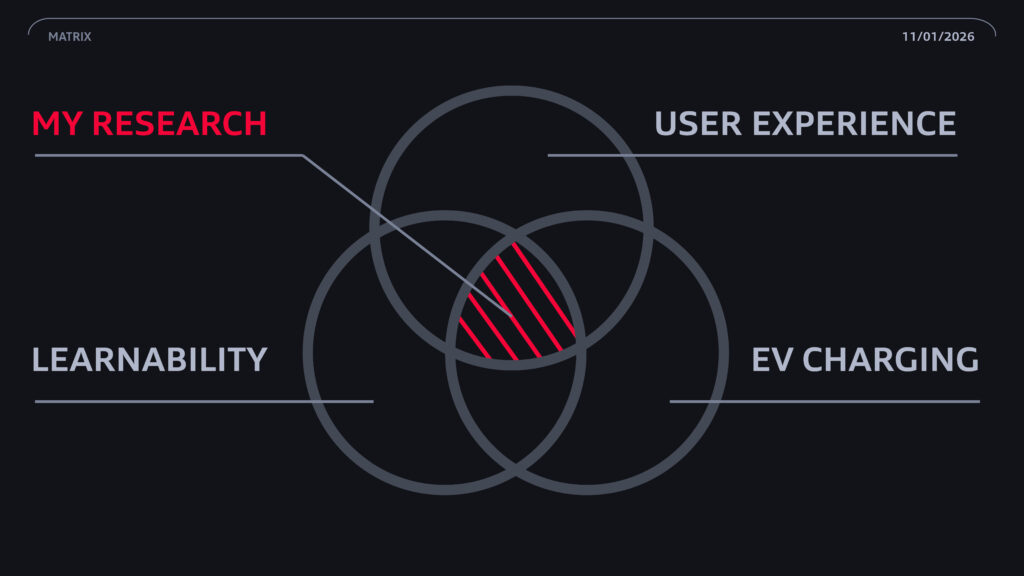
Before I really dive into my master thesis research, I wanted to meet my supervisor FH‑Prof. Baumann one more time. This was a two‑hour talk where we went through everything: my plan, possible contacts, how to start and also some real‑life stories. It felt like a good send‑off before I move back to Vienna and start the fieldwork.
We first talked about contacts and experts. I told him about the UX Graz Speed Dating the evening before. I spoke with an employee from AVL, the company that builds parts for Audi and has specialists in e‑mobility. Since my girlfriend’s father has an Audi e‑tron, we decided to focus my thesis on Audi. It makes sense – I can test real Audi systems and interfaces. Baumann liked that and said it gives my work a clear focus.
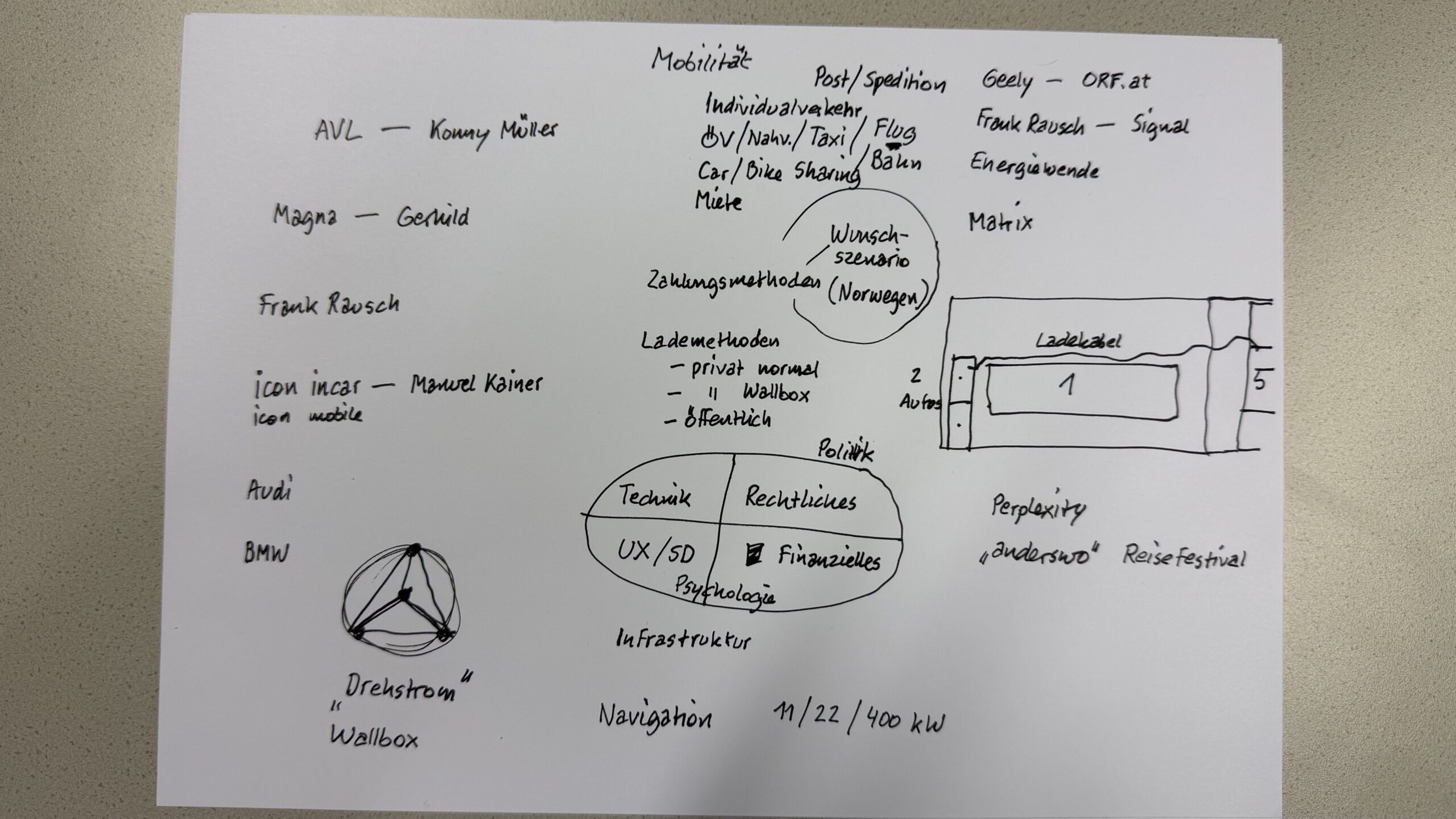
Then he shared a personal story that stuck with me. His neighbours bought an electric car, but they live in an apartment without their own wallbox or garage. So he offered them the extra parking spot at his house. They run a long extension cable from their apartment, through his garden, to the car. He showed me a photo – it looks like a DIY solution, but it works for now. This story shows the infrastructure gap: people want EVs, but the system is not ready yet. You still have to get creative or struggle.
We also discussed different charging types, which I want to explain early in my thesis. There are private options like normal sockets (slow, 2.3 kW) or wallboxes (up to 22 kW AC). Then public chargers: slow AC (Type 2, up to 22 kW), fast DC (CCS2 up to 350 kW), and some older ones like CHAdeMO. Audi uses CCS2, which is standard in Europe for fast charging. Cables look different – home ones are thinner, fast chargers thicker and heavier. I will make a simple table for this.https://ev-orientrise.com/blogs/blog-1/complete-adapter-guide-for-european-ev-owners-from-ccs-to-chademo
https://evniculus.eu/de-fr/pages/ev-charging-adapters-1
Looking to the future, we talked about Plug & Charge, where you just plug in and the car app handles payment automatically. EU rules (AFIR) will make this standard soon – all new public chargers must support ISO 15118 by 2025, and Plug & Charge by 2027. We also mentioned inductive charging (wireless on the street), but that is still speculative. These visions show where onboarding could go: seamless, no cards, no apps needed.https://alternative-fuels-observatory.ec.europa.eu/general-information/news/european-commission-publishes-delegated-acts-afir-open-consultation
The big discussion was about the whole system. Charging is not just one thing. It depends on technology (connectors, power), legal rules (contracts, roaming), UX and service design (apps, instructions, psychology of trust), money (prices, tariffs), and infrastructure (parking, cables). We drew a quick diagram: all parts connect, and if one fails, the whole experience breaks. This system thinking fits perfectly with my service blueprint plan.
This talk was important because it gave me confidence. We prepared interview questions and who to contact next (AVL, Audi experts). Baumann’s neighbour story reminded me: my research is not abstract – it solves real problems people have today. Now I feel ready to start: first the literature and system analysis, then interviews with first‑time users. The Audi focus makes it concrete. I am excited to see what happens when I test these touchpoints myself.
Disclaimer: This post was written with help from AI for structure and grammar, but all content, stories and reflections are from my own experience and conversation with my supervisor.