A couple of months ago I stumbled on the Book “Good Services – How to design Services that work” by Lou Downe (see Impulse.02). I finally came around to reading it!
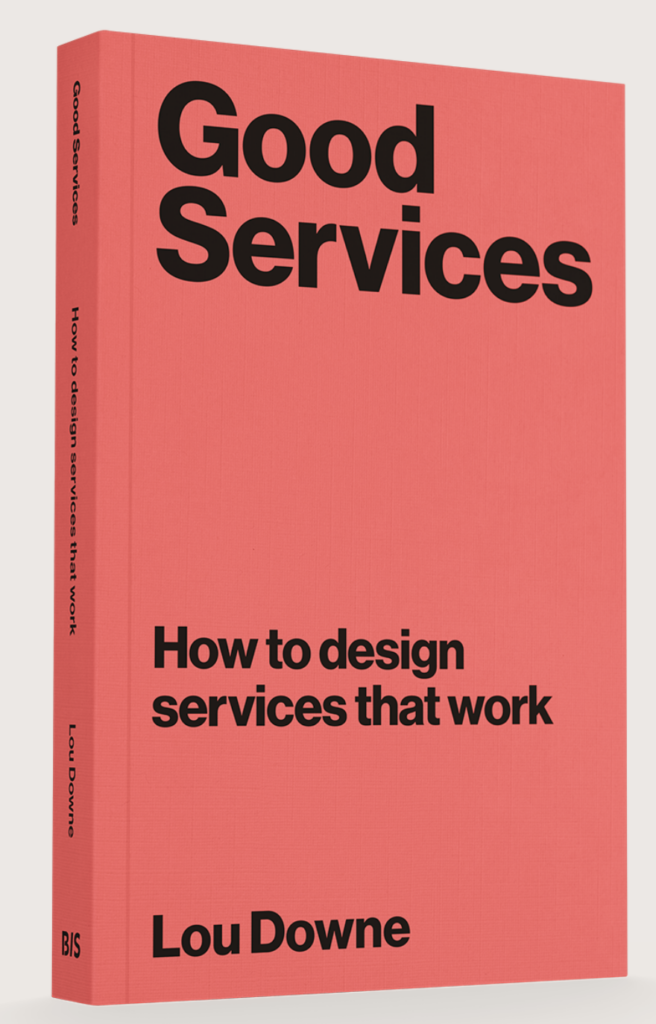
In this Blog post I want to provide an excerpt of the 15 principles of good service design according to Downe. I chose 5 principles I learned the most from or thought were the most relevant for my research. Additionally, I add a paragraph of reflection on my Thesis to add personal context to the topic.
The 15 Principles
Disclaimer: Instead of repeating repeating “A good service” before every principle statement, this section will imitate the formulation of the book’s chapters.
3.1 Is easy to find
This chapter emphasizes that the name of a service is crucial for user accessibility, as it acts as the primary entry point. Providing a good service is ensuring that users can easily find it, which is often more challenging than it seems.
To improve service discoverability, organizations should prioritize user-friendly names that reflect what users are trying to achieve. This involves:
- Understanding users’ goals.
- Recognizing their knowledge level regarding available services.
Names should avoid legal or technical jargon and instead describe tasks in straightforward language. Ultimately, service names should bridge the gap between user intent and organizational terminology, facilitating easier access to necessary services.
While I appreciate the importance of making a service easily discoverable, I don’t see naming my e-health platform as my first priority. Since I intend for it to be a nationwide government initiative—similar to ELGA, (amusingly, is an acronym, a no-go according to the book) my focus will initially be on developing the platform itself. I do want the name to be catchy and perhaps even personal, like a first name, to create a sense of connection. However, my immediate priority will be on the platform’s functionality and user experience rather than on the name itself.
3.2 Enables a user to complete the outcome they set out to do
Designing services with the entire user journey in mind is essential. This approach not only enhances user experience but also improves service effectiveness and efficiency. If users understand what they need before reaching your service, they are more likely to succeed in their goals.
Failing to recognize and design for users’ true objectives can have severe consequences. The issue of homelessness illustrates this well; Malcolm Gladwell’s article “Million-Dollar Murray” showcases how inadequate responses to homelessness are often more costly than comprehensive solutions. It highlights the importance of addressing the full scope of user needs rather than piecemeal solutions.
Designing services within the context of a wider user journey can lead to more effective service delivery and reveal gaps in existing offerings. For example, using the wording “Get me home” in a navigation service instead of offering input fields to manually write your destination. When designing services, it’s crucial to ask whether you’re starting at the right point for users and if your service effectively helps them reach their goals.
This chapter is particularly interesting for my design process because the tasks my users should be able to do with my e-health application are very broad and highly dependent on the context the user is in. Ultimately the application should cover all things health related in one place. My plan right now is to have the user set up the front page of their application according to their needs during the onboarding process. This might help with creating a more custom experience while still keeping all possibilities open.
3.3 Clearly explains it’s purpose
To effectively manage user expectations when designing a service, it’s crucial to first understand what those expectations are. Users often base their expectations on past experiences with similar services, so their assumptions may not align with what your service actually provides. There are three types of expectations to consider:
- Universal Expectations: These are fundamental service features that most users expect, such as the ability to withdraw money from an ATM at a bank. These expectations are widely recognized and should not need explicit explanation.
- Assumed Expectations: These arise when users lack knowledge about a service, leading them to make assumptions that may not be accurate. For example, new users may assume they can open a bank account with minimal documentation. It’s essential to clarify these expectations upfront, either by simplifying the service or clearly communicating what users should expect.
- Outlier Expectations: These are unique expectations based on individual users’ previous experiences. For instance, some users might expect instant notifications for transactions based on their experience with app-based banks. While you may not need to address these right away, it’s important to monitor them, as they can evolve into universal expectations over time.
Managing these expectations involves different strategies. Universal expectations should be met without explicit mention, while assumed expectations require clear communication. Outlier expectations should be observed for potential future relevance. A balanced approach that addresses all three types will ensure that your service remains valuable and user-friendly, preventing potential pitfalls from unmet expectations.
This chapter reinforced the importance of having a clear plan for what my users will want to accomplish within my application. To effectively manage expectations for my thesis, I aim to limit options and possibilities. Specifically, I plan to develop around five distinct scenarios and personas, which will allow me to measure how effectively users can complete their desired tasks.
3.4 Require no prior knowledge to use
To ensure a service is usable without prior knowledge, the following strategies should be considered:
- Ensure the Service is Findable: Understand when and how users might seek support, along with the language they use during their search. Refer to Principle 1 for more details.
- Clearly Define the Service’s Purpose: Users may not be familiar with your organization, but they likely know what they need. Your service should quickly convey what it does and how it can help them achieve their goals. More information can be found in Principle 2.
- Avoid Making Assumptions About User Knowledge: Do not assume any prior knowledge or experience with your service or similar offerings. Conduct a thorough review to identify any assumptions within your service. Create a list of these assumptions and determine which ones need to be adjusted or clearly explained to users.
- Utilize Familiar Methods: Some approaches are so common that deviating from them can cause confusion. To identify these methods, conduct user research with a diverse group to understand which ones are widely recognized. See Principle 5 for additional insights.
- Design Independently of Organizational Structures: Navigating organizational frameworks can be challenging for users unfamiliar with your service. Ensure that your service is easy to use without requiring users to understand who is providing it.
I have given considerable thought to how my e-health application must be user-friendly for the broadest possible audience: essentially everyone in Austria over the age of 18. This diverse user group encompasses varying technological backgrounds, social differences, financial situations, health conditions, and age ranges. That’s why Point 3 of this chapter, “Avoid Making Assumptions About User Knowledge,” really resonated with me; I need to design with all potential users in mind. However, given the rapid pace of technological advancement and my intention to utilize speculative design methods, I will establish some foundational guidelines regarding users’ tech affinity.
Regarding Point 5, “Design Independently of Organizational Structures,” I recognize that the health sector often operates differently. People (at least nowadays) are very critical when it comes to “hiding” where information is coming from or with which part of the service they are currently in contact with. This is an area where I need to engage in deeper research to fully understand the differences in healthcare information.
3.5 Is agnostic of organizational structures
In 2016, British company Thriva was established to allow users to conduct health checks discreetly at home through at-home blood tests for various conditions like diabetes and hormone imbalances. While it has transformed health monitoring, Thriva’s true innovation lies in its integration of multiple components from various organizations, notably utilizing the nationwide network of NHS pathology labs. These labs operate under strict regulations, and Thriva has effectively incorporated these rules into its service.
This type of seamless service, involving collaboration across organizational boundaries, is not typical in many sectors. In today’s digital landscape, users seek services based on their needs rather than the limitations of individual organizations. The focus should be on helping users achieve their goals, even when those goals extend beyond what a single organization can provide.
Traditional services often struggle with fragmentation and siloed experiences due to outdated organizational structures designed for a slower-paced world. These rigid systems tend to specialize in specific tasks, making it challenging to provide cohesive user experiences.
Four key issues contribute to this fragmentation:
- Separation of Data: User data is often not shared across organizations, requiring users to repeatedly provide the same information.
- Incompatible Processes: Misalignment between the processes of different organizations can disrupt the user journey.
- Incompatible Criteria of Use: Different rules across service components can create confusion for users.
- Inconsistent Language: Variations in terminology can disorient users trying to navigate the service.
To address these issues, it’s important to understand the historical context of organizational silos. Melvin Conway’s theory suggests that an organization’s structure directly influences its service design. If teams within an organization are siloed, their services will likely be fragmented.
As organizations face increasing demands to integrate services, a new model of experience integration is emerging. This approach involves collaborating across multiple organizations to provide a cohesive user experience, often without altering the individual organizations involved.
However, fostering effective communication and collaboration is challenging. Organizations may have different objectives, paces, and incentives that can hinder cooperation. To support collaboration on shared services, consider these four strategies:
- Permission: Create an environment that encourages collaboration beyond day-to-day roles.
- Shared Standards: Establish common practices that facilitate teamwork without stifling creativity.
- Shared Goals: Develop a unified vision that everyone can support and work towards.
- Shared Incentives: Align financial incentives to ensure that collaboration is prioritized over individual agendas.
The most important takeaway here is to be able to recognize potential silos within an organization or with external partners, and if you can’t change the operating model, shift how you communicate and collaborate. Implementing shared standards, goals, and incentives can foster a more collaborative environment, ultimately enhancing the user experience.
I really enjoyed this chapter of the book because it used a healthcare service as an example, which helped me relate this principle even more to my thesis. Considering the insights on organizational silos, it’s clear that my thesis on a nationwide e-health application in Austria must address specific barriers that could hinder its effectiveness. Potential silos might exist between various healthcare providers, such as hospitals, general practitioners, and specialist clinics, all of which may have different systems for managing patient data. Additionally, there could be inconsistencies between public health organizations and private healthcare entities, complicating data sharing and collaboration.
Regulatory frameworks may also create silos, as differing compliance requirements could prevent seamless integration of services across platforms. Also, varying levels of technological adoption among healthcare professionals and patients could lead to fragmentation in user experience. By identifying and addressing these specific silos, I can design an e-health application that not only facilitates communication and data sharing among these diverse stakeholders but also ensures a cohesive and user-friendly experience for all Austrians seeking healthcare services.
