I visited the exhibition “DU SOLLST DIR EIN BILD MACHEN – Contemporary Art and the Religious Experience” at the Künstlerhaus in Vienna with a certain expectation: to encounter contemporary artistic positions that critically engage with religion without falling into pure provocation. What I found was a carefully curated exhibition that neither defends nor attacks religion outright, but instead opens up a complex space for reflection, ambiguity, humor, and critique.
The exhibition brings together works by 42 contemporary artists who approach Christian iconography from different perspectives—critical, loving, feminist, ironic, and deeply personal. Rather than aiming for scandal or shock, the exhibition focuses on dialogue: between past and present, faith and doubt, institution and individual experience. This approach resonated strongly with my own research interests, which revolve around distance, reflection, and the role of mediation in religious experience.
The exhibition is structured into seven thematic chapters—Icon, (False) Holiness, Cross, Resurrection, Divinity, Madonna, and The Last Supper—each framing how traditional religious motifs are reinterpreted today. What becomes immediately clear is that religious imagery still holds immense imaginative power, even in a largely secularized context. Art, much like religion, deals with fundamental questions of existence, meaning, and uncertainty. While religion often seeks to make the unfamiliar familiar, contemporary art does the opposite: it destabilizes what we think we know.
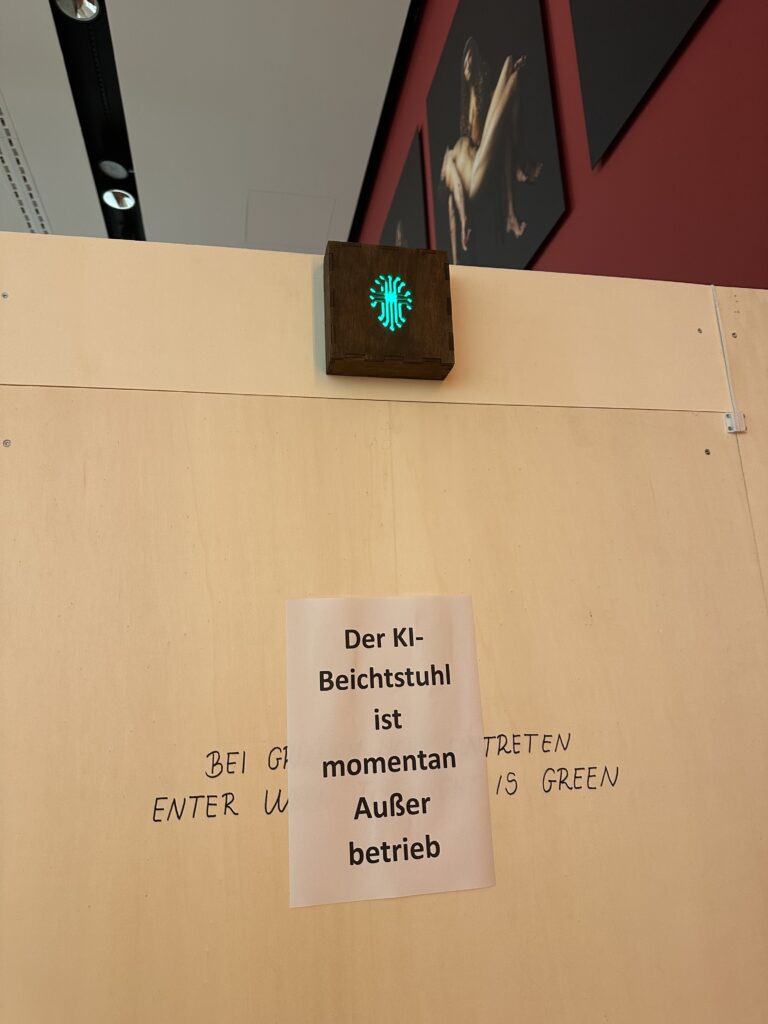
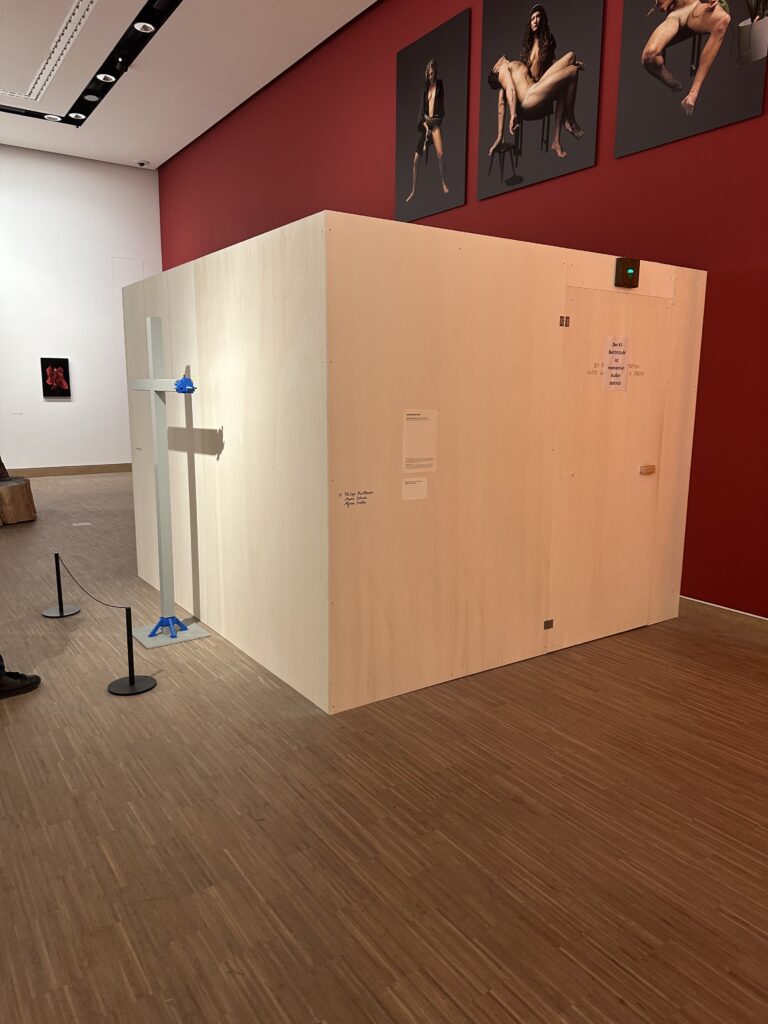
I was actually visited it on the recommendation of Martin Kaltenbrunner with whom I talked about my Master Thesis. One work I was particularly interested in seeing was Deus in Machina (2024/2025) by Philipp Haslbauer, Marco Schmid, and Aljosa Smolic—an AI-based installation that invites visitors to engage in a dialogue with a digital Jesus. Unfortunately, the installation was out of order during my visit. Still, its conceptual framing alone is highly relevant to my research. The work raises the question of whether artificial intelligence can become a spiritual interlocutor—not as a gimmick, but as a serious conversational partner. This idea sits uncomfortably between curiosity and unease, echoing many of my concerns about digital mediation of spirituality: Where does support end and simulation begin?
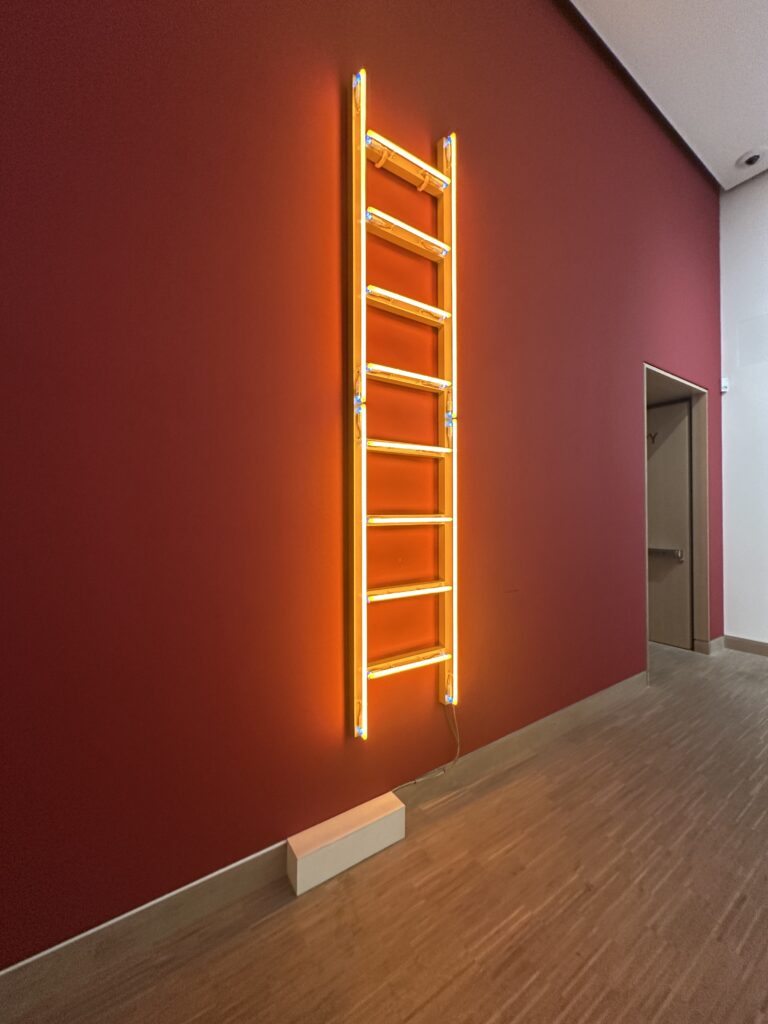
Seeing Himmelsleiter again—originally created for St. Stephen’s Cathedral—reinforced my sense of how strongly site, context, and memory shape religious experience. Removed from its original location, the work still carried symbolic weight, but its meaning shifted. This highlighted how religious and spiritual experiences are not fixed, but deeply relational and contextual.
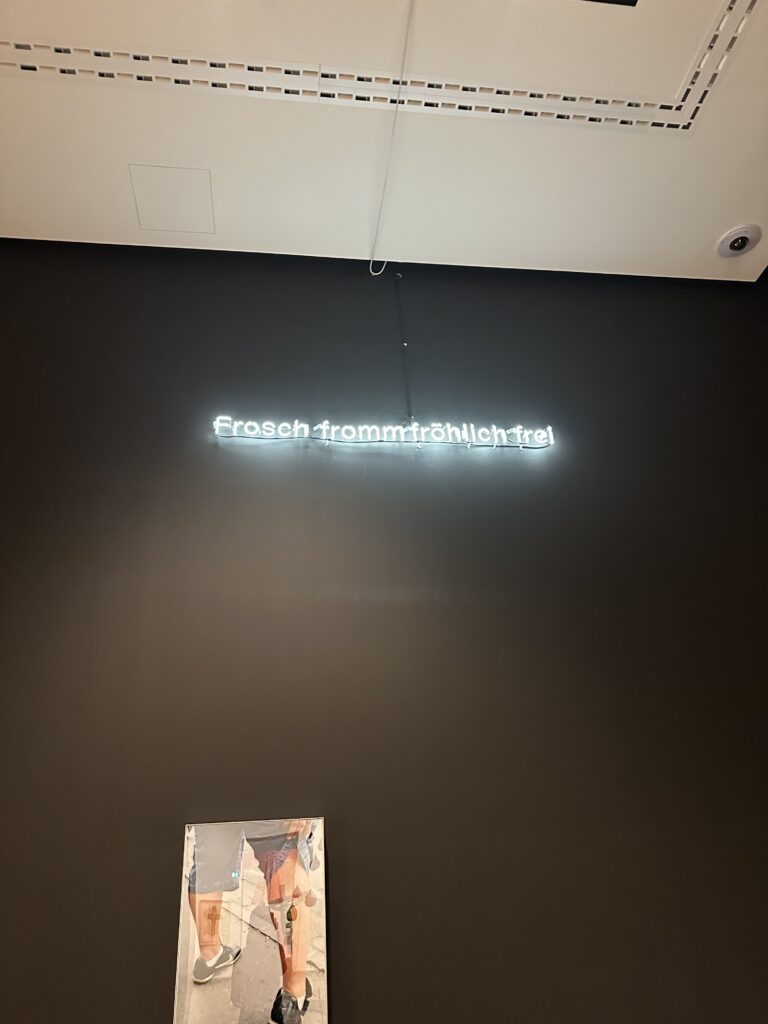
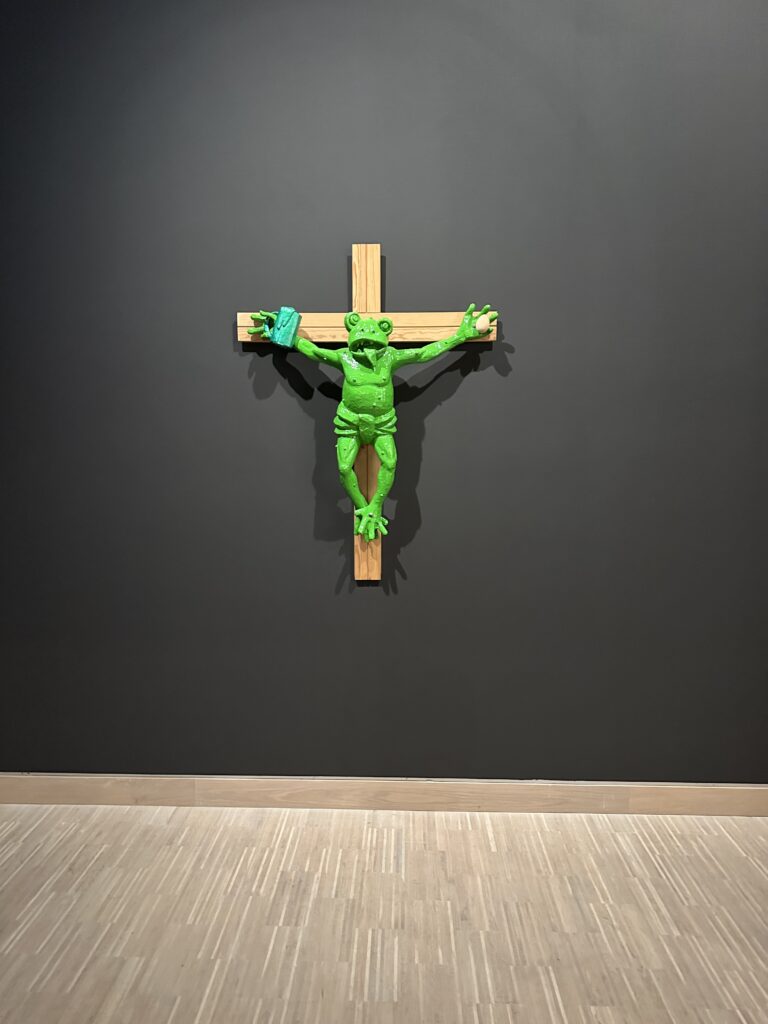
Perhaps the most striking moment of the exhibition was encountering Martin Kippenberger’s Fred the Frog Rings the Bell (1990), the infamous crucified frog. Knowing its history—the public outrage, accusations of blasphemy, political pressure, and even papal commentary—added another layer to the experience. What fascinated me was not the provocation itself, but the failure of mediation. The scandal revealed less about the artwork and more about the inability of institutions to foster dialogue. Instead of enabling theological or cultural discussion, the work was hidden, relocated, and silenced. This reaction mirrors many of the mechanisms that contribute to people distancing themselves from the Church: defensiveness, lack of dialogue, and fear of ambiguity.
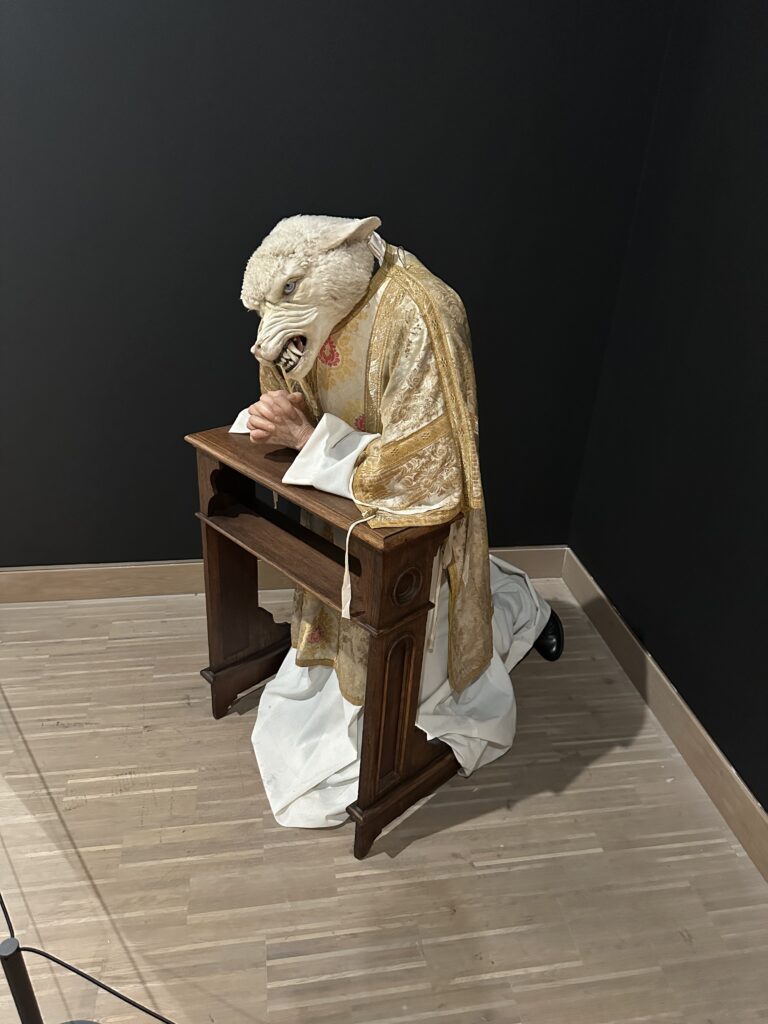
Other works, such as Deborah Sengl’s Of Sheep and Wolves, critically examine hierarchy, power, and institutional structures within the Church. These pieces do not reject faith outright but question authority and obedience—issues that are central to contemporary critiques of organized religion.
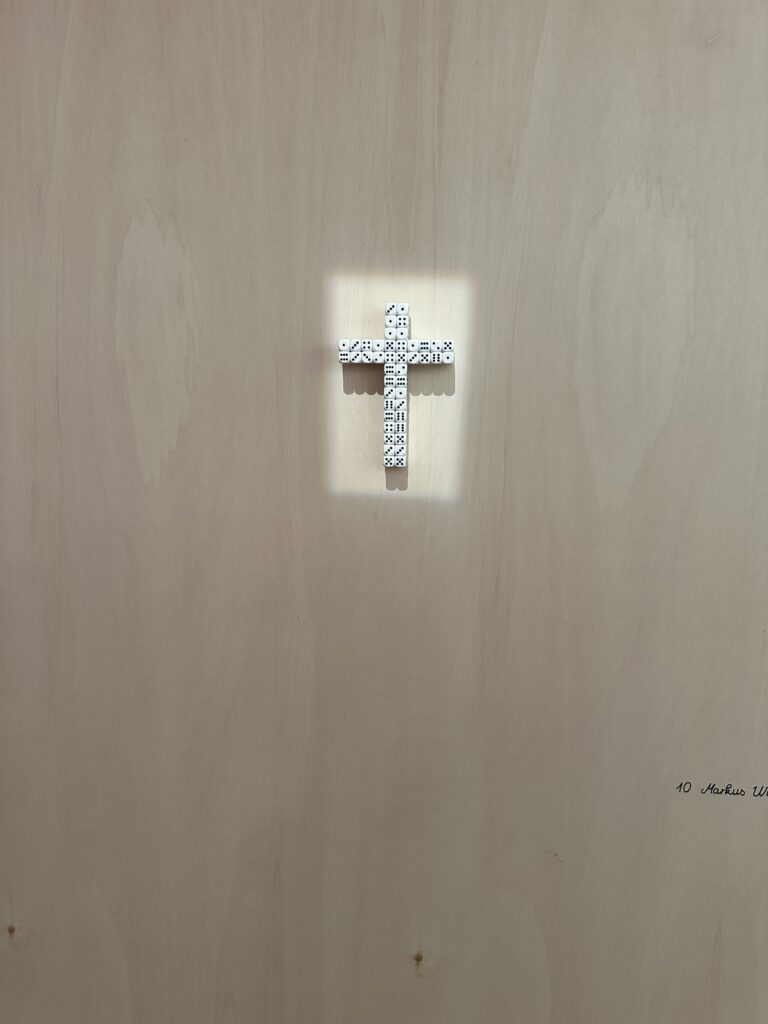
Markus Wilfling’s minimalist sculpture O.T. (God Does Not Play Dice) offered a quieter, more contemplative counterpoint. Referencing Albert Einstein, the work balances order and randomness, belief and doubt. The dice-cross simultaneously suggests structure and mystery, reminding viewers that faith is not about certainty, but about navigating the unknown.
This exhibition was a powerful impulse for my master’s research. It demonstrated how religious themes can be addressed critically without cynicism, and how distance itself can become a productive space for reflection. Most importantly, it showed that engagement with religion does not require affirmation or rejection—it can exist in between. As an interaction designer, this reinforces my interest in creating spaces that allow for ambiguity, critique, and personal interpretation, rather than clear answers or prescribed meanings.
Links:
https://www.nitsch-foundation.com/exhibition/du-sollst-dir-ein-bild-machen
https://religion.orf.at/stories/3232748
Dissclaimer: AI was used here for a better wording and structuring
