As part of my ongoing master’s thesis research, I returned to the National Museum in Ulan‑Ude to explore another permanent exhibition, this time dedicated to the broader history of Buryatia. My focus remained the same: to observe how (and if) interactive elements are being used to support learning and engagement.
What I encountered quickly challenged my remaining doubts. This exhibition, larger in scale and historical scope, revealed a noticeably richer layer of interactivity than I expected and, importantly, much of it felt intentionally designed for younger audiences.
Because the historical scope was broader and the exhibition itself larger, the curators had clearly invested in multiple interactive touchpoints throughout the space. And importantly many of them were clearly designed with younger audiences in mind.
The Interactive Map: A Strong First Impression
Right at the entrance, visitors are greeted by a large interactive map of the republic created with projection mapping. It immediately draws attention, both visually and spatially, and works as an inviting gateway into the exhibition.
Visitors can press on different years or regions of the republic to reveal more information. This simple mechanic is extremely effective: it transforms what could have been a static geographic overview into an exploratory learning tool.
But the real cherry on top is the built-in game at the end of the interaction. Visitors can test their knowledge by trying to correctly locate all 22 regions of the republic on the map.
From a design perspective, this is a very strong move. It shifts the experience from passive consumption to active recall, one of the most powerful mechanisms for learning. It is informative, playful, and highly suitable for school-age visitors. I could immediately imagine groups of children gathered around it, competing and learning at the same time.
Distributed Interactivity Across the Hall
Further into the exhibition, the same interaction logic appears in other formats. There is a large interactive screen where visitors can tap on objects and locations to learn more about them.
While technically simpler than the VR experience from the Buddhist exhibition, this type of interface plays an important role. Not every educational moment needs full immersion. Sometimes clarity, accessibility, and speed of interaction are exactly what is needed especially in historically dense exhibitions.
The exhibition also integrates:
- audio guide stations in selected areas
- additional projection mapping moments
- and other small interactive touchpoints
Together, these elements create a layered experience that supports different learning styles: visual, auditory, and tactile.
The Yurt: Learning Through Touch
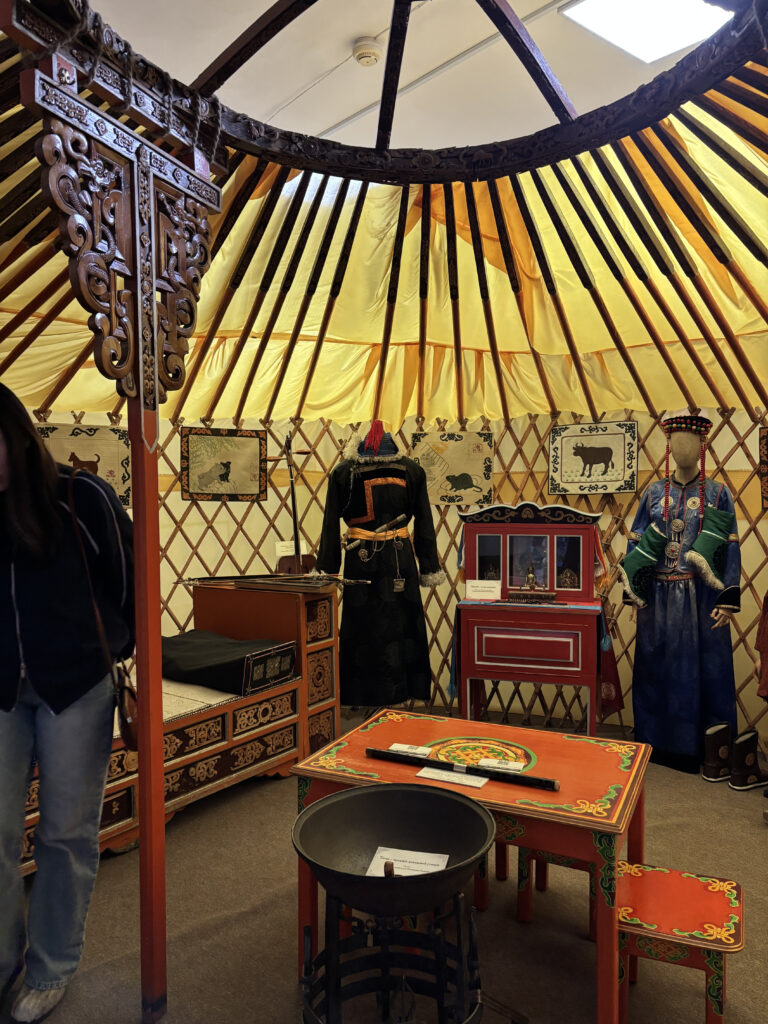
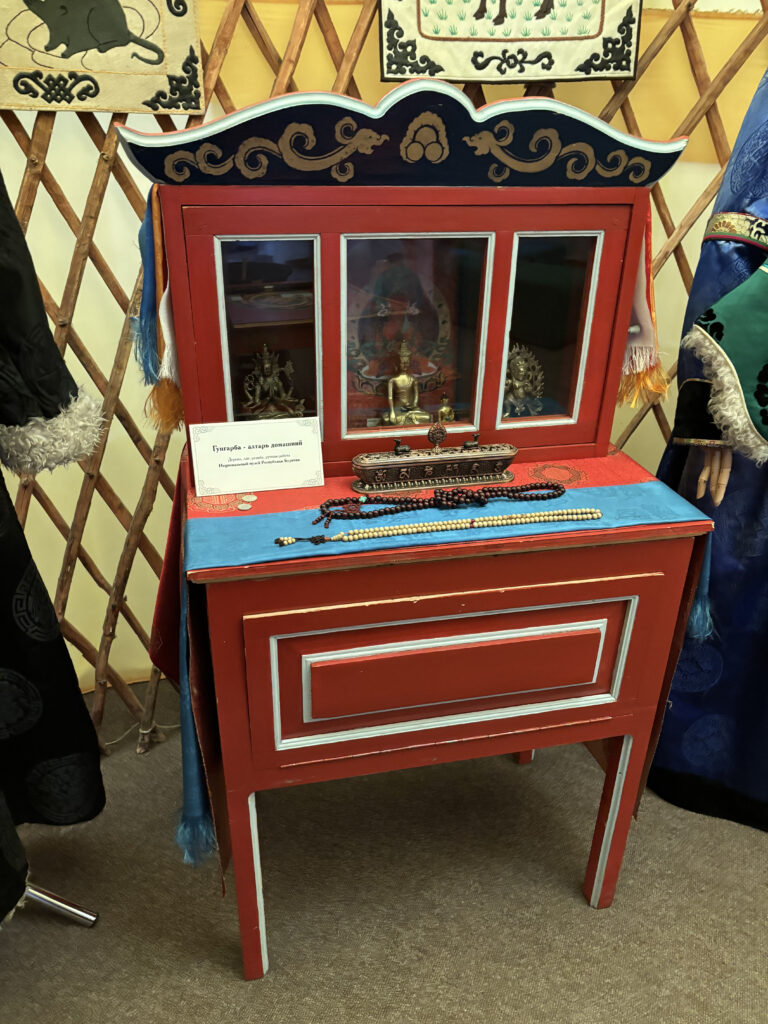
One of the most engaging moments comes at the end of the exhibition: a full-scale traditional Buryat-Mongolian yurt that visitors can physically enter.
Inside, visitors are encouraged to touch and explore objects of the traditional household. This tactile permission is extremely important. After many museum experiences defined by “do not touch,” this moment creates a sense of openness and embodied learning.
For younger visitors especially, this is likely one of the most memorable parts of the exhibition. It transforms cultural knowledge from something distant into something physically relatable.
A Personal Reflection
I have to admit something honestly.
Before this visit, I carried a slightly arrogant assumption that museums in my hometown would lack contemporary interactive approaches, that they would feel outdated or purely static. This exhibition proved me wrong in the best possible way.
And it genuinely made me happy.
Not because everything was perfect, there is always room for growth but because the intention is clearly there. The museum is trying. It is experimenting. It is thinking about engagement, about younger audiences, about accessibility.
And perhaps most importantly: it shows that meaningful interactive design is not limited to large Western institutions. It is emerging thoughtfully and contextually, in Buryatia as well.
For my master’s research, this visit became an important checkpoint. It helped me better understand the current state of museum interactivity in my republic and positioned my own project within a real, evolving landscape rather than an imagined vacuum.
Sometimes field research does exactly what it should do: it challenges your assumptions and replaces them with something much more valuable, grounded optimism.
