In my first four blog posts, I was still experimenting and trying out different directions for my thesis topic. I deliberately explored a wide range of activities and formats, not because I was unsure of what I liked, but because I wanted to understand what could meaningfully connect to my field of Interaction Design. Instead of committing too early, I tested ideas, interests, and approaches to see where a consistent theme might emerge.
In December, I finally made a decision about my thesis topic. I realized that many of the things I had been drawn to: books, talks, presentations, videos, and digital experiences, had one thing in common: strong storytelling. This led me to focus on Narrative UX & Interactive Web Storytelling. Looking back, the connection seems obvious, but it took time to translate a general interest in stories into a concrete design-related research direction.
During the Christmas break, I visited an escape room with friends and unexpectedly found a clear connection to this topic.
The Event
The escape room was called Top Secret. The scenario was introduced with the following description:
“You are locked inside a high-security military facility with the mission to steal the plans for a revolutionary weapon. Every step you take is monitored by advanced systems and security traps, so you must act quietly, swiftly, and with precision. Only the best spies can successfully complete this deadly mission and escape without a trace.”
The room had a difficulty rating of 10/10. We had one hour to complete the mission and managed to escape in the very last minute. The puzzles were demanding and required close attention, logical thinking, and collaboration. What stood out to me was not only the complexity of the tasks, but the way every clue, object, and interaction was integrated into the narrative setting.
Escape Rooms as a Form of Storytelling
Escape rooms rely on storytelling in a specific way. Unlike films or books, they do not present a linear narrative. Instead, participants experience the story through interaction with space, objects, and systems. The narrative is gradually revealed through actions rather than explanations.
While playing, I began to see parallels to Interaction Design. The escape room functioned like an interactive system in which users navigate a designed experience. Storytelling was embedded in spatial design, visual cues, sound, and physical interfaces. Each interaction revealed a fragment of the story, similar to how users explore and interpret content in interactive digital environments.
From this perspective, escape rooms can be understood as physical examples of Narrative UX. They demonstrate how narratives can be structured through interaction rather than through traditional storytelling formats.
Why This Was an Impulse for My Research
This experience helped me reconsider how storytelling operates within design. It showed that narratives can emerge from interaction, structure, and user decisions, not only from text or visuals.
For my thesis, this impulse is relevant because it highlights how storytelling principles function across different media. It encourages me to examine how narrative strategies in physical interactive spaces can inform the design of interactive web experiences. Instead of treating storytelling as an additional layer, I now see it as an integral part of interaction design.
The escape room therefore became more than just a leisure activity. It provided a concrete example of how narrative and interaction intersect, which directly relates to my research focus on narrative UX and interactive web storytelling.
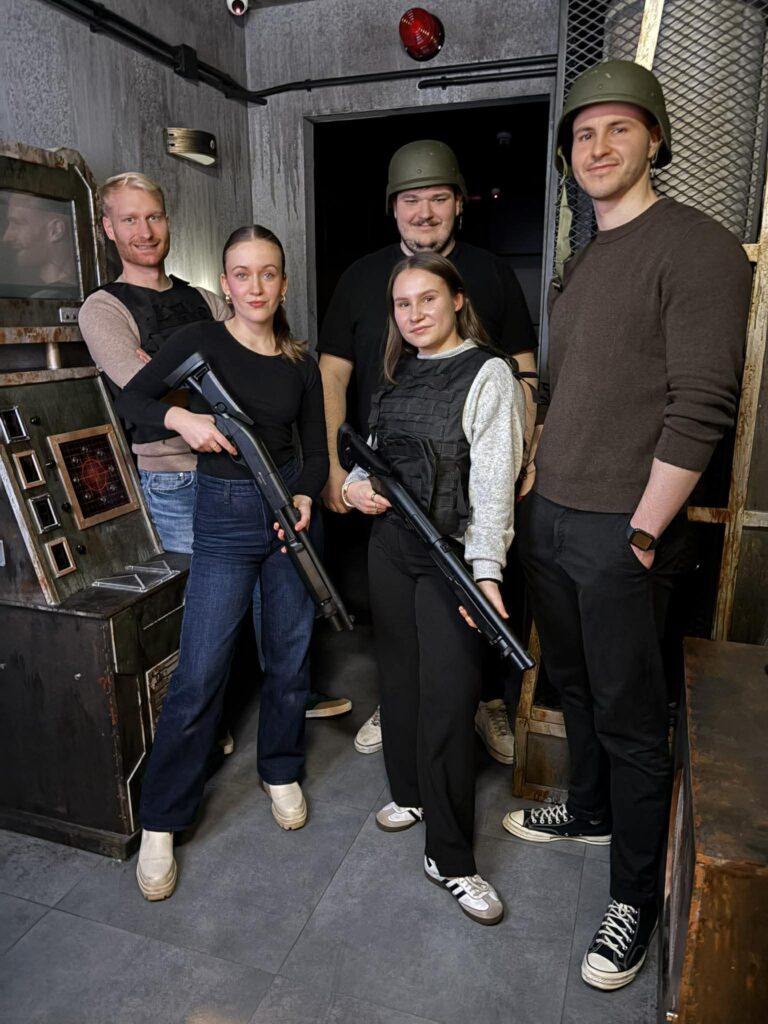
And a cringe photo as a proof that I was there:
Stuff Worth Clicking A.K.A. Accompanying Links
- Escape Rooms in WOOP! Graz – wide selection, really good, worth visiting, worth the money (in German and English)
- The Role of Storytelling in Creating an Engaging Escape Room – an interesting article about immersive storytelling in escape rooms
- Podcast: Victor van Doorn: How to Design an Escape Room – haven’t listened to the whole thing yet, but it’s on my to-do now
Disclaimer: This blog post was written with the help of AI for better grammar and correct spelling.
