Learning How to Ask the Right Questions and Document it
Rather than relying solely on secondary sources, I wanted to gain expert insight through a qualitative interview. With this in mind, I prepared and sent a formal interview request to AKH Vienna, hoping to have the opportunity to speak with a specialist. I am not aiming for a long or demanding interview session; even 10–15 minutes would already provide valuable perspectives that could meaningfully inform my research. I drafted a formal interview request to AKH Vienna, in which I briefly introduce myself as a master’s student at FH JOANNEUM and outline the research motivation behind my project. The email explains my interest in gaining psychological insights.
Using Academic Input from FH Joanneum: Design & Research
A major influence on my preparation process was the Design & Research course at FH Joanneum, taught by U. Lagger. One of the key takeaways from the course was that interviewing is not just about asking questions, but about creating a structured, respectful, and open conversational space.
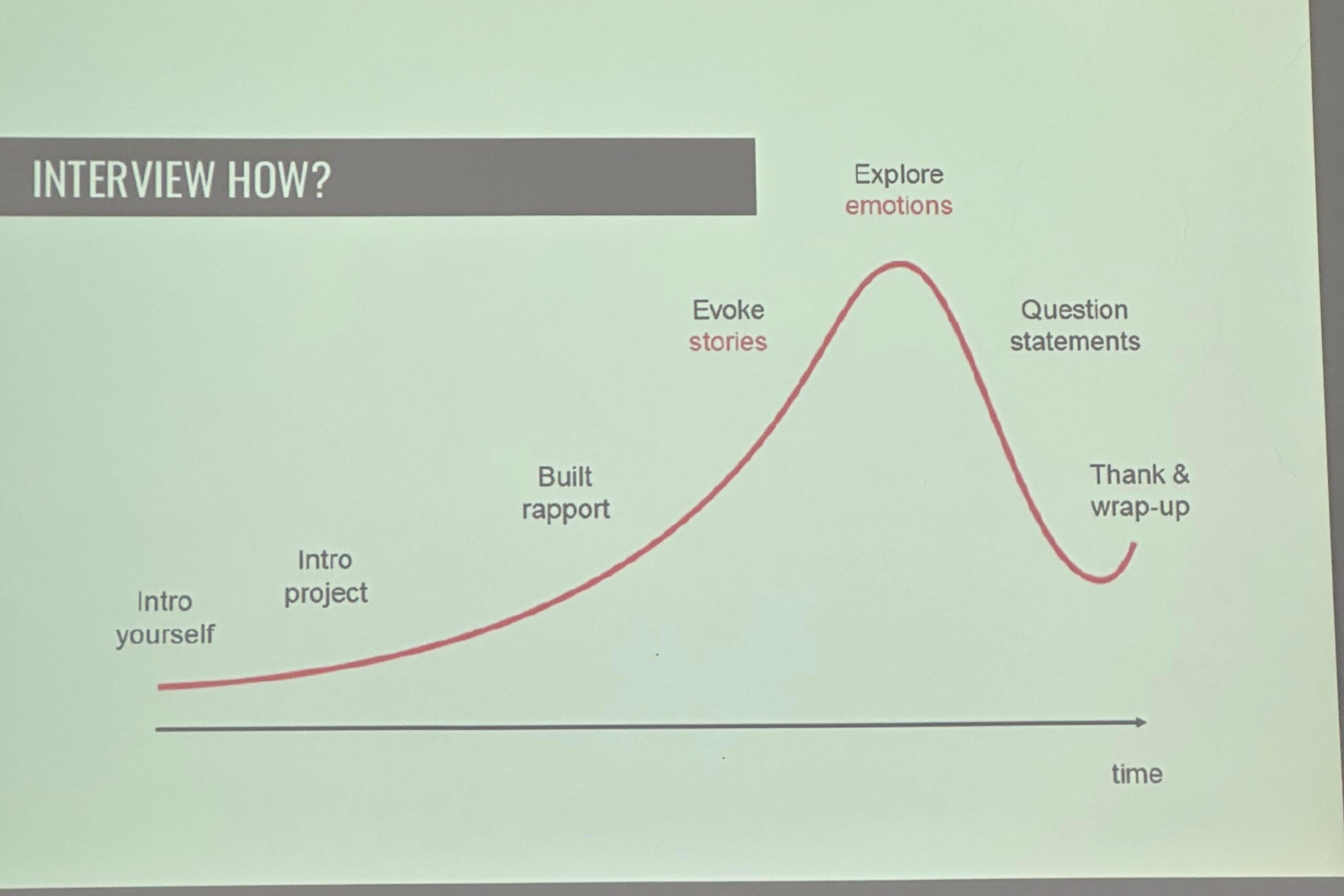
From the lecture input (see Image 1: “Interview How?”), the interview process was presented as a timeline rather than a rigid script. It begins with introducing oneself and the project, followed by building rapport, encouraging storytelling, exploring emotions and experiences, and only then moving into more focused questions. The interview should end with a clear wrap-up and expression of gratitude. This visual structure helped me understand that a good interview has an emotional rhythm and that trust and openness develop over time, not instantly.
Practical Interview Conduct: What to Keep in Mind
In addition to the course material, I researched general best practices for qualitative interviews and identified several key principles that I plan to follow during the interview:
- Do not interrupt the interviewee
- Accept pauses, as they give space for reflection and thought
- Convey neutral attention through body language and tone
- Avoid suggestive or leading questions
- Ask follow-up (probing) questions to better understand meanings
These points align closely with the recommendations from qualitative research literature and reinforce the importance of listening rather than directing the conversation.
Documentation and Transcription Strategy
If the interview takes place, I plan to record it (with explicit consent) and transcribe it afterwards. For transcription support, I intend to use AmberScript, a tool that assists with speech-to-text transcription and can significantly reduce the technical workload.
However, I am aware that automatic transcription tools are not perfect and always require careful review and correction. The final transcript will therefore be manually checked and refined to ensure accuracy and clarity.
Insights from the PDF: Interview, Transkription & Analyse
Based on the article Interview, Transkription & Analyse by Dresing and Pehl, several important methodological points stand out Praxisbuch_Transkription-2:
- Interviews should be planned according to the research question, not convenience
- Transcription rules must be defined before starting the transcription
- A transcript is not neutral; it is always a reduction and interpretation of spoken language
- Simple, content-focused transcription systems are often sufficient for design and media research
- Time planning is crucial: transcription can take 5–10 times longer than the interview itself
Format and Structure: How the Interview Should Be Written
Based on the examples shown in class and materials, the interview documentation should follow a clear and transparent structure:
- Participant Information (age, profession, location, anonymised)
- Consent Confirmation and recording notice
- Dialogue Format (Interviewer: / Participant:)
- Clear chronological flow
- Postscript, describing how, when, and under which conditions the interview was conducted
This format not only improves readability but also ensures academic traceability and ethical clarity.
Even if the interview does not take place immediately, this preparation process has already deepened my understanding of qualitative research and strengthened my ability to approach complex human-centered topics with care and structure. Lets hope for the best.
Course & Class Literature
- Dresing, T., & Pehl, T. (2018). Praxisbuch Interview, Transkription & Analyse (8th ed., PDF). Course material, FH JOANNEUM, Graz.
- Lagger, U. (2024). Design & Research: Interview Methods [Lecture slides]. FH JOANNEUM – University of Applied Sciences, Graz.
- Institution / Interview Context
Allgemeines Krankenhaus der Stadt Wien (AKH Wien). (n.d.). Universitätskliniken & Fachbereiche. Retrieved from
https://www.akhwien.at
Tools I may use
AmberScript. (n.d.). Audio- und Video-Transkription. Retrieved from
https://www.amberscript.com/de/transkription/
Supplementary Learning Resources
YouTube. (n.d.). Qualitative research interview tutorials. Various creators. Used for general understanding of interview preparation, conduct, and documentation.
Disclosure
In the development of this blogpost, AI (ChatGPT) was used as a supportive writing and structuring tool. I provided the conceptual content, research direction, theoretical preferences, and methodological decisions, while the AI assisted in translating it to English, refining the wording, organising the material and generating coherent academic formulations based on my input. The AI did not produce research or arguments but helped transform my ideas into a clear and well-structured text draft.
