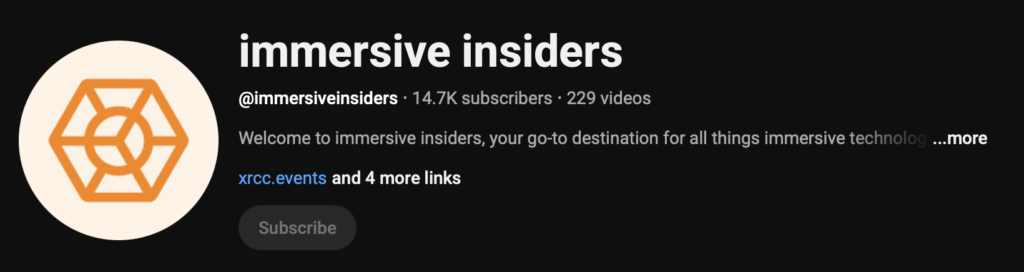
I came across a YouTube channel called Immersive Insiders, I stumbled upon a YouTube channel called Immersive Insiders, and I had no idea it would give me even more hope that AR is not that challenging. He’s not one of those huge, widely known tech YouTubers, and maybe that’s exactly why I found his content so interesting. It feels focused, on point, and honest — less about advertisements or useless information and more about actually understanding immersive technology. I’ve been interested in AR and VR for a while, mostly from a design and experience perspective, but there has always been one thought in the back of my mind: I’m not a programmer. Because of that, immersive technology often felt exciting, but also slightly out of reach.
Watching Immersive Insiders gave me hope.
The channel focuses mainly on augmented reality, virtual reality, and immersive technologies, but without the pressure of sounding overly technical or exclusive. Instead of making things feel complicated, the creator explains ideas step by step, in a way that feels realistic and human. It feels less like a polished tech show and more like someone genuinely sharing what they’ve learned.
For me, this was important. Many AR and VR resources online assume that you already code or that you’re comfortable in complex development environments. Immersive Insiders feels different. It communicates the idea that you don’t need to know everything from the beginning —curiosity and willingness to experiment are enough to start.
One video from Immersive Insiders that I may genuinely use and test is about “AR Indoor Navigation Using MultiSet Quest SDK.” In this tutorial, he walks through the whole process of building an indoor AR navigation application — from scanning the environment to mapping it and finally deploying it on a Meta Quest 3 device.
What struck me about this video wasn’t just the topic — indoor navigation — but how he explained it. The video breaks the process down into clear, approachable steps:
- building the final app for testing.
- setting up a developer account
- mapping the physical environment
- creating a Unity project for the AR scene
- adding navigation points and logic
What I appreciate most about this channel is that it doesn’t pretend AR and VR are effortless. There is still learning involved, still problem-solving, still mistakes. But the fear of “not being technical enough” slowly fades away. The content shows that immersive technologies are not only for programmers or engineers, but also for designers, artists, storytellers, and people who think visually and conceptually.
This really resonated with me. I don’t see AR as a technical achievement alone, but as a tool for shaping perception, interaction, and experience. Seeing someone approach it in a grounded and accessible way made me feel more confident about my own direction. It reminded me that it’s okay to learn slowly and to grow into a tool rather than mastering it instantly.
This Impulse post is mainly dedicated to how important it is to find the source that works for you. It all about how presentation and tone can change the way we approach learning.
I still don’t consider myself a programmer, and that hasn’t changed. What has changed is the feeling that immersive technology is something I can explore, step by step, without needing to hire someone. And sometimes, that quiet encouragement is exactly what makes a difference.
Links
- Immersive Insiders YouTube Channel:
https://www.youtube.com/@immersiveinsiders - Video that inspired this post:
https://www.youtube.com/watch?v=01OzcPWAGH4
In the development of this impulse post, AI (ChatGPT) was used as a supportive writing and structuring tool. I provided the conceptual content, research direction, theoretical preferences, and methodological decisions, while the AI assisted in translating it to English, refining the wording, organising the material, and generating a coherent text draft based on my input. The AI did not produce research or arguments but helped transform my ideas into a clear and well-structured text draft.
