Tolkien in Triest
I recently had the opportunity to visit the Tolkien exhibition in Trieste. The exhibition was dedicated to the life and work of J. R. R. Tolkien and showcased not only his literary world, but also the huge cultural impact his stories have had to this day. I was particularly impressed by three large walls that were completely covered with bookshelves. They contained numerous editions of The Lord of the Rings and The Hobbit from all over the world in a wide variety of formats and designs. (It would be interesting to look at the book covers from different countries and analyze the background and cultural influences on the illustrations.)
At the end of the exhibition, there were also many illustrations by artists and fans who were inspired by Tolkien’s stories. These works ranged from classic drawings to modern interpretations and impressively showed how differently the same world can be visualized.
And again Books
All of this reminded me of a bookshelf at my parents house. For years, it has held several illustrated books dealing with conceptual art and illustrations for the Lord of the Rings and Hobbit films (of course Harry Potter as well). Now, during the Christmas holidays, while I am back at my parents’ house, I went to this shelf and took another look at the books.
One book in particular caught my attention: “The Hobbit: The Desolation of Smaug Chronicles – Concept Art and Design,” published by Hobbit Press. The first edition was published in London in 2013. The main author is Daniel Falconer, supplemented by forewords and texts by other authors and contributors who were directly involved in the film production.
Concept Art at Middle-earth
Conceptual art plays a central role, especially in film adaptations of books. As already mentioned in the blog post about the Harry Potter exhibition in London, conceptual art forms the visual bridge between text and film and helps to translate abstract descriptions, moods, and places into specific images. This work is particularly sensitive and challenging when it comes to a literary source such as The Hobbit, which many readers already associate with their own inner images.
In the case of The Hobbit films, the screenwriters provided numerous ideas that were strongly based on the book. At the same time, The Lord of the Rings already provided existing locations, characters, and visual rules that had to be followed. This made it all the more important to develop the new locations that play a major role in The Hobbit for the first time including Mirkwood (Düsterwald), Esgaroth the lake-town (Seestadt), and Erebor, the Lonely Mountain.
Weta Workshop, which also co-published this book, played a central role in this process. Weta Workshop is a New Zealand special effects company founded in 1987 and based in Wellington. It provides services for film productions, including design drafts, makeup effects, props, creatures, puppets, miniatures, models, and large sculptures. The company also produces merchandising items. For The Hobbit trilogy, Weta Workshop was instrumental in the visual development of characters, costumes, environments, and fantastical creatures, working closely with the director, screenwriters, and other creative departments.
Back to the Book
The illustrated book is structured along the sections of the film and shows the concept art for specific scenes, locations, characters, costumes, and mythical creatures. At the time of publication, many of the artists involved had already been working on The Hobbit trilogy for four to five years. Every day brought new challenges, as concept designer Alan Lee describes in the book’s introduction.
“The book shows only a relatively small part of the enormous amount of work that went into the visualization and production of The Hobbit: The Desolation of Smaug,” says Lee.
The creation of Beorn
The first section of the book is about Beorn’s house. Beorn is a man who can transform himself into a bear. According to the author, this character posed a particular challenge, as he had to be portrayed convincingly in both human and animal form, visually credible but at the same time consistent with Tolkien’s description and the existing imagery of Middle-earth.
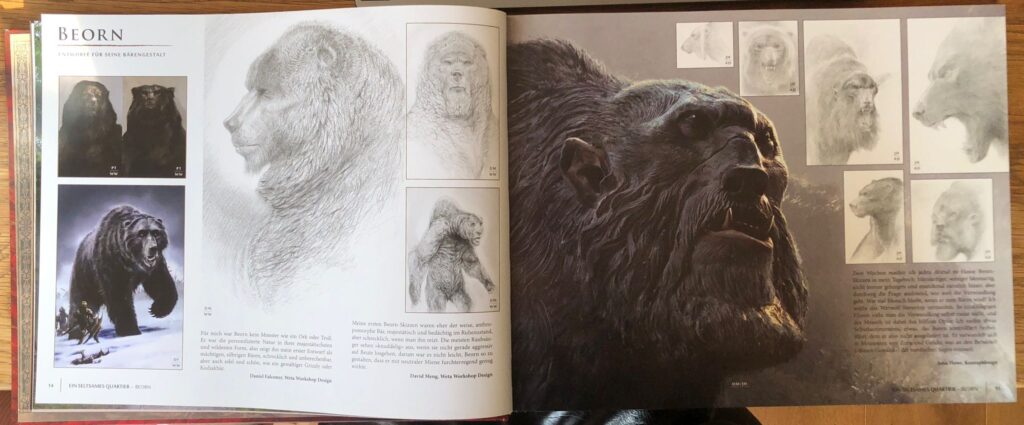
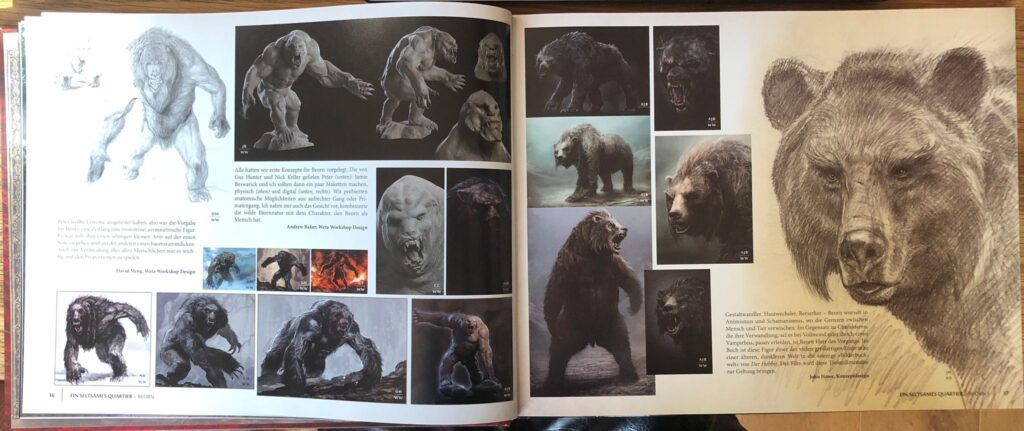
I am particulary interested in how artists create fantasy characters, especially those with an ambiguous or hard-to-define personality. Having read the book as well, I can imagine that Boern was one of the most difficult figures to design, because its never entirly clear wheater he is good or bad. His bear form in particular needed to appear frightening and monstrous.
The many pictures in the book are showing how difficult is was, and how many attempts they needed to finding a clear direction. I think its always really calming when you see that talanted artist like the one who contributed here in the films are also struggeling sometimes. Its interesting to see how it works on big sets like this. Many artists work on the same subject at once, each starting with a different vision, and then gradually discussing, refining, and combining these ideas.
John Howe mentoined that for two weeks he made a scribble of boern on his diary every evening. Each day he tried a new approach. Some of these drawings can be seen on the right side of the upper image. For me, this highlights how important it is to keep going, to think differently, and to have the courage to experiment and try things out.
After large number of artworks had been created and presented to the Weta Workshop, the team began developing 3D Modells and exploring anatomical possibilities. Their aim was to push the design in a bit more brutal and extreme direction, which can be seen on the left page of the lower image. In the end, all these ideas come together, resulting in the creation of a truly unforgettable character.
The Elevnking’s Hall
Besides character design, I can imagine designing settings almost as difficult, maybe even more so. Because, as mentioned in the book, you have to think about so many things like light setting, perspective and the story behind it. Across eleven pages, the book shows how the Elvenkings Hall and the Throne room were created. These are two of my favorite locations in the movie because they combine a sense of magic with a darker atmosphere. According to the Conceptartists, one one the Challanges was to continue the Mirkwood but in a more magic way. They wanted to build an entire cave system out of trees that looks very natural.
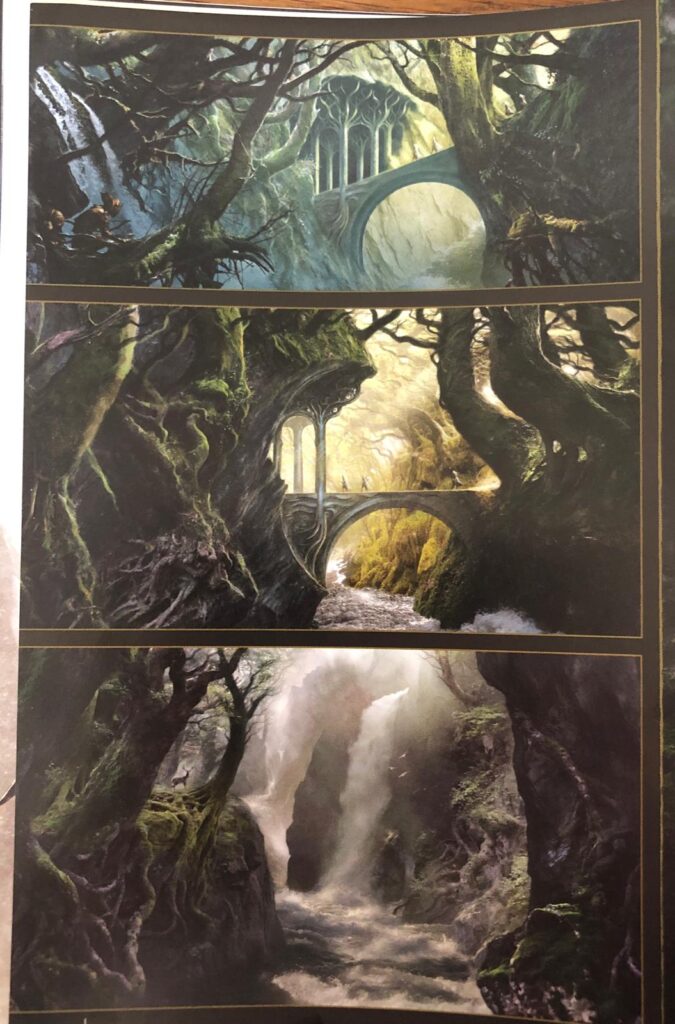
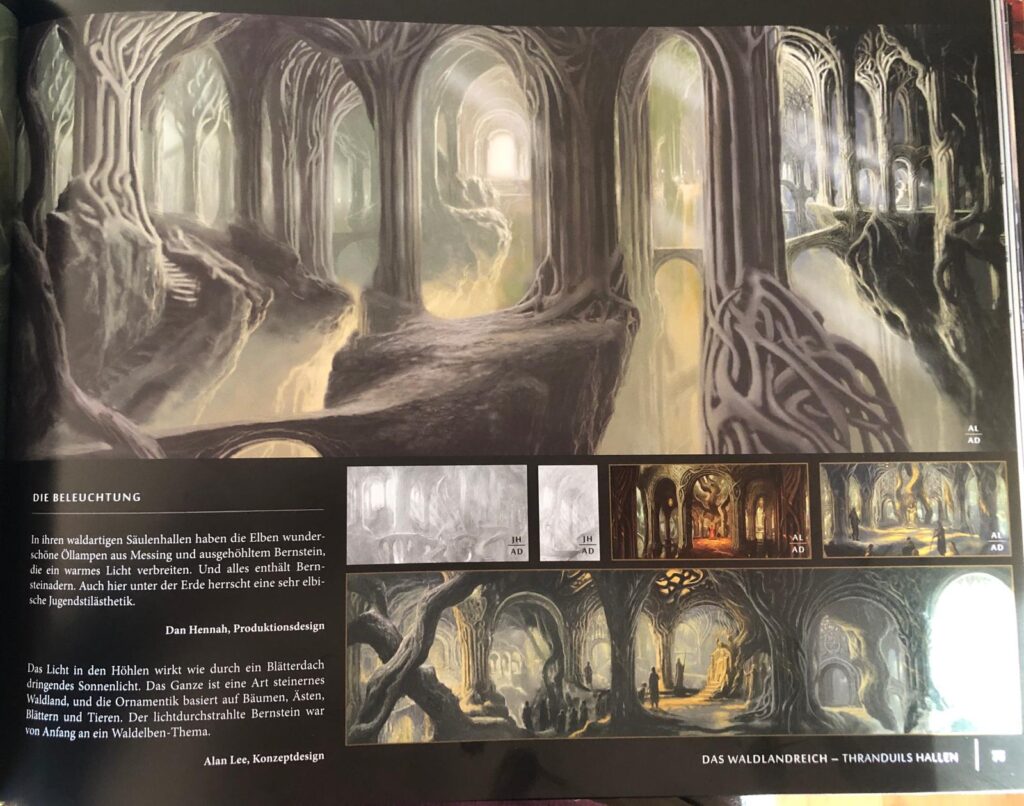
In the images above you can see a few of the artworks they did. Another important thing in the creation was the deepth the rooms should have. Gus Hunter, one of the designers at Weta Workshop, worked with many columns, trees, and roots to shape the space. When thinking about the lighting of the hall, he came up with the idea of using stalactites in which the elves could place oil lamps. In addition, he used water reflections to help illuminate the entire setting.
To come to an End
Overall, it is incredibly interesting to see how these different departments and artists work together to bring such complex worlds to life. What I have written about here is only a very small glimpse into the book, which itself is just one part of a much larger series documenting the creative process behind The Hobbit. Once again, it highlights how essential concept art and strong visual storytelling are for building believable and immersive worlds. This topic is especially important for my future academic work, as it directly connects to my interest in the visualization of storytelling and in creative development processes more broadly both of which I eventually plan to explore further in my master’s thesis.
Sources:
Falconer, Daniel (Hrsg.): Der Hobbit: Smaugs Einöde – Chroniken. Kunst und Gestaltung. Hobbit Presse, London, 2013
