Visiting the Kunsthistorisches Museum Wien felt almost the opposite of my thesis topic. It’s a very “analog” space: heavy architecture, old masters, quiet rooms, and almost no visible technology. Apart from the optional audio guide device, there are no screens, no projections, no interactive installations. You move from room to room, read the small wall texts and simply look.
That contrast is exactly what made the visit so valuable for me as an interaction design student. I wasn’t impressed by high-tech features. I was impressed by how much potential there is for technology to quietly support the experience without taking attention away from the art itself. The museum became a kind of mental sandbox where I could imagine how AR and IoT might be implemented in a very delicate context: history, culture, and learning.
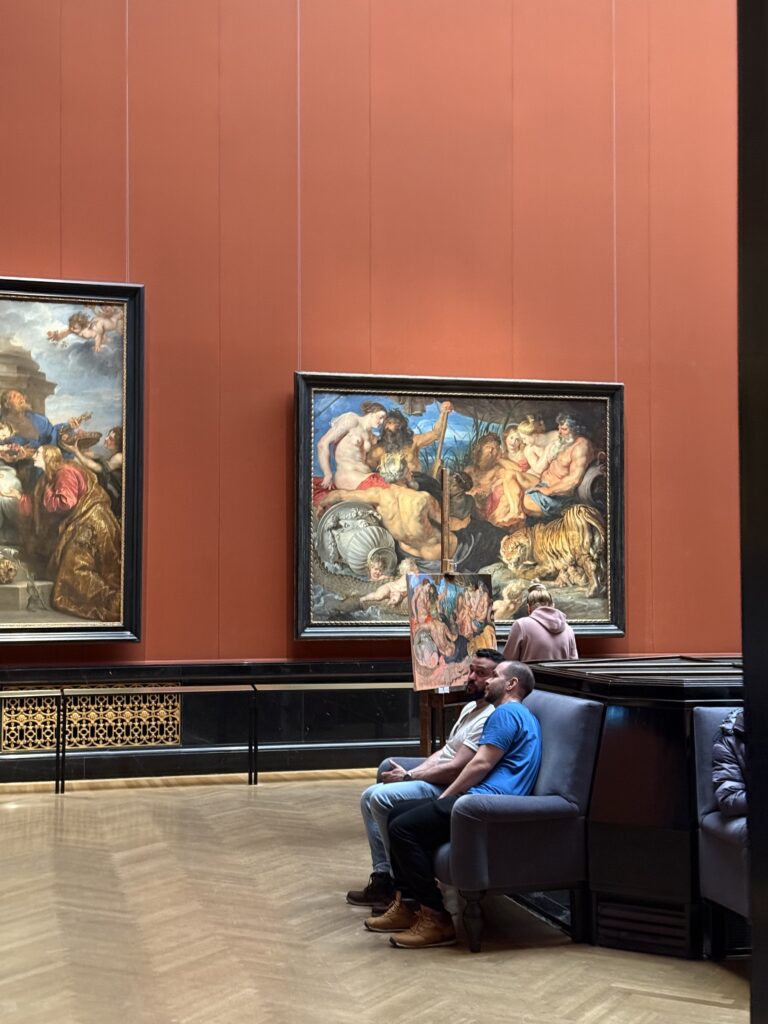
Observations: A Classical Museum with a Small Digital Layer
My main observation was how traditional the user journey still is. You enter, pick a wing, and mostly navigate by room numbers, map and intuition. The only digital touchpoint I used was the handheld audio guide. Even that already shows the basics of what I work with in my thesis: an extra information layer on top of the physical space. You enter a painting number, press play, and suddenly you get context, story and meaning instead of just title, date and artist.
But the interaction is linear and passive. You always get the same story, no matter who you are, how much you already know, or what caught your eye. There is no way for the system to “notice” that you are fascinated by one detail and want to go deeper, or that you are in a hurry and only want a short summary. It made me see very clearly where today’s museum tech stops and where AR and IoT could start.
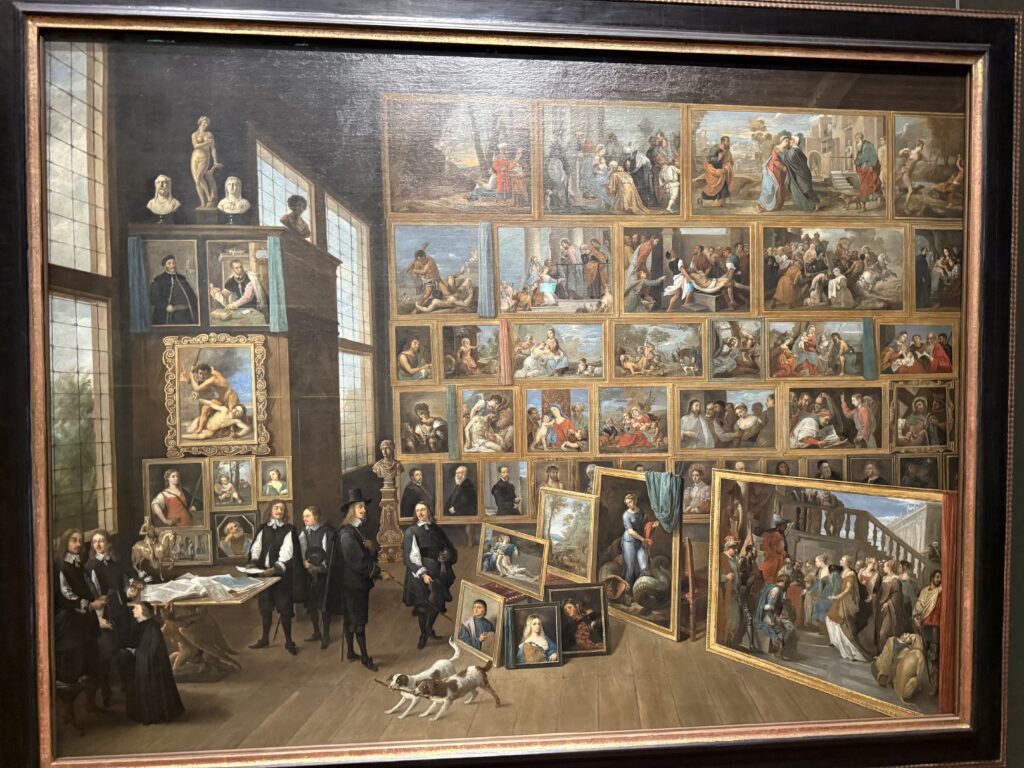
Understanding: Technology Should Support the Artwork, Not Compete with It
Standing in front of paintings, I tried to imagine AR in the room. The danger is obvious: if we fill the space with too many digital elements, the painting becomes a background for the interface. That’s exactly what I do not want, and it connects strongly to my thesis: technology must serve the human and the content, not distract from it.
So my understanding is that any AR or IoT system in a museum like this would have to be extremely calm, subtle and respectful. The artwork stays the main actor. AR is just a transparent layer that appears only when the visitor asks for it. IoT devices like small beacons near the frame could be completely invisible, only there to let the system know where you are and what you’re looking at. The goal is not to “modernise” the museum for its own sake, but to deepen the connection between visitor and artwork.
Main Concept: A Future AR & IoT Guidance Layer for Museums
The main concept that came out of this visit is to treat the museum as a potential case study for the same principles I explore in smart retail: guided navigation, contextual information, and personalised journeys, all powered by AR and IoT.
I imagined wearing AR glasses instead of holding an audio guide. When I look at a painting for more than a few seconds, a small icon could appear next to it in my field of view. If I confirm, the system overlays very minimal hints: a highlight around a specific detail, a short caption, or the option to see a brief animation explaining the story behind the scene. If I want more, I can dig deeper maybe see a reconstruction of how the painting originally looked, or how it was restored. If I don’t, nothing changes; I just keep looking with my own eyes.
The same system could also redesign the wayfinding experience. Instead of a fixed predefined tour, AR could show me a route that matches my interests and time: “Show me five highlights from the Renaissance in 45 minutes,” or “Guide me only to works that relate to mythology.” IoT sensors in rooms could provide live information about crowding, so the path avoids the most packed galleries and keeps the experience more relaxed.
What mattered most for me in this museum visit was not what technology was already installed, but the mental exercise of placing my thesis ideas into this setting. It helped me see that the principles I am developing for AR and IoT could have wider use case from the intended one and give a perspective for a retail subtle guidance, context-aware information, and respect for the physical environment also make sense in a cultural space.
Links
Official museum site
Kunsthistorisches Museum Wien – Official Website KHM.at
Visitor overview and highlights in English
Kunsthistorisches Museum – Overview & Highlights (visitingvienna.com) Visiting Vienna
Background and history of the building
Kunsthistorisches Museum Wien – Wikipedia
AI Disclaimer
This blog post was polished with the assistance of AI.
