Two weeks ago, we had a class with Konrad Baumann where he brought some of his books. This big yellow book caught called “Nea Machina. Die Kreativmaschine” caught my attention. At this time, the idea for my Master’s Thesis slowly starting to grow, focusing on creativity. So, I was very curious about what the “Kreativmaschine” could be.
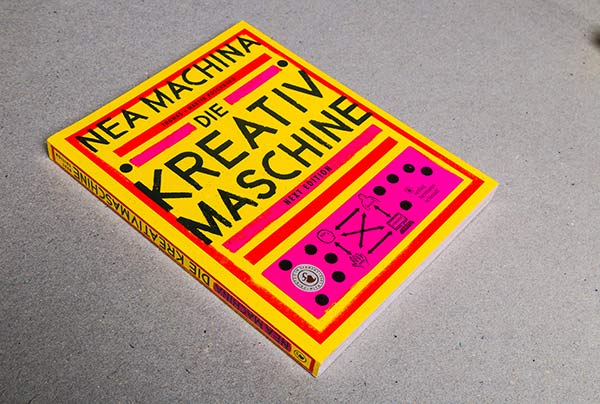
The book is a work of Thomas and Martin Poschauko, two multidisciplinary creative professionals whose work goes from fine art, design, creativity research and academic teaching. It is based on an experiment they did: They wanted to see how many different art pieces they could create within four months. The core constraint or template was that each art piece had to be a portrait with the title “Nea Machina”. In those four months they created 1000 different variants. The book showcases the results of the experiment. However, while working on the variations they started to analyze their work and also the process, which led them to their own creative methodology: Die Kreativmaschine. Therefore, the book not only displays their work, but also gives an insight into the theoretical essence and principles.
The core idea of the Kreativmaschine
The Kreativmaschine consists of four components: head, gut, hand and computer. Those four elements are further separated into two different levels:
- Idea Level: Head and Gut
- Tool Level: Hand and Computer

The idea level represents the origin of an idea, which is essential for any creative work. It addresses the question: “From which inner drive does design emerge?”
* The head refers to a planned, conceptual approach that relies on clear structures of thought. Logic plays an important role here.
* The gut, by contrast, is emotional and non-rational. It involves intuitive action and is associated with playful, unsystematic, and not immediately logical approaches.
The tool level describes the technical realization of an idea.
* The hand stands for all manual techniques, such as painting or constructing installations – anything that involves real, physical materials.
* The computer, on the other hand, represents digital design carried out on the computer using graphic software.
The authors shared their observation: they realized that every time they created a variation on the computer, their next inspiring idea involved creating something by hand. They stated that the rotation of the four elements in both levels is what kept them going and gave them inspiration for the next variation that kept the whole experiment running.
While the Kreativmaschine is the central concept of the book, they also cover several other core topics:
* Independence from the computer
* Letting go of control leads to higher quality
* Escape the everyday
* Do first – think later
* The good feeling as a creative force
* Artist or designer
* The special tool “hand”
* Free perception
This book, and specially the concept of the Kreativmaschine provide a good theoretical framework for my Master’s Thesis on encouraging playful, low-pressure creativity as counter to productivity culture.
One thing that stuck with me was the core topic “Do first – think later”, because I feel like we are so used to the opposite. We think before we do, we want to plan everything before we start to be as efficient as possible when working on the project. I think it is generally a good approach in life, but maybe not always the best approach for creative projects. The authors said that sometimes the good ideas come from just starting and seeing where it leads you. So, starting with your gut instead of with your head. The book shows that spontaneous, non-rational and imperfection can be the key to breaking creative blocks and foster real inspiration.
Link to their website:
https://www.poschauko.de/neamachina
AI was used to check spelling and grammar and better clarity.
