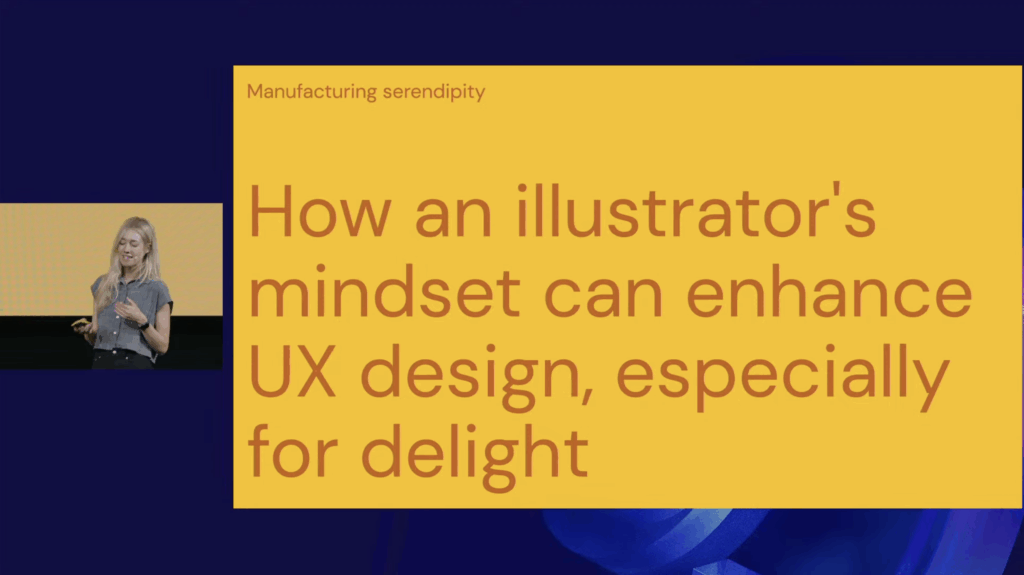
Even though I couldn’t attend the George UX Conference in Vienna on 5th of November, I watched the recorded talks afterward. One immediately stood out: “Manufacturing Serendipity: Designing Delight at Scale with a Little Help from AI” by Mick Champayne, an illustrator-designer from Google. The talk unexpectedly resonated with the direction my master’s thesis is slowly taking: multidisciplinary design identity, AI as a creative bridge, staying calm amidst many skills, and the psychology of being a generalist designer.
At first, I wasn’t excited about revisiting AI in my research. Lately, it has felt overwhelming, and I even thought: “Let’s move away from AI this semester.” But then… the talk reminded me: AI is the elephant in the room. You can’t escape it, and its presence has moved from novelty to ubiquity. Mick presented it not as a threat, but as a playful, human tool, a spark for creativity.
Mick shared how being both an illustrator and a UX designer initially felt like living in two worlds: order equals UX, chaos equals illustration. This resonated deeply with me because I’ve often felt split between multiple design selves: UI/UX, visual storytelling, graphic design, motion design, interaction design … Her experience reassured me that embracing these differences doesn’t dilute identity, it can strengthen it.
A particularly fascinating part was how she trained her own AI model using her illustration work. She fed the machine her best pieces as a data set, and the results at first were bizarre: strange proportions, odd humor. Instead of rejecting the accidents, she embraced them, now using AI mostly for first drafts. She redraws and reinterprets the outputs, extending her own style rather than replacing it. This combination of machine draft and human reinterpretation felt directly relevant to my thesis: AI can act as a bridge connecting skills, not a replacement.
Mick also described using AI as a “creative spark factory”, particularly for projects outside her expertise. For example, she helped design Google easter eggs for Swifties (Taylor Swift fans), creating a playful scavenger-hunt-like experience that blended illustration, pop culture, storytelling, and UX. Her principles for creativity, translating feelings, fostering curiosity, and looking for happy accidents, felt like rules for surviving and thriving as a generalist.
Another highlight was her process of “vibe coding” in Gemini, moving rapidly from idea to tiny playable prototype. Her team even holds DGIF: Delightful Generation of Ideas and Features every Friday. And her definition of delight, shifting something from “it works” to “I love it”, captured something essential about creating meaningful experiences. I also appreciated her humor: her illustrations are playful, sometimes chaotic, often feminine, incorporating absurdities like butts, boobs, and farts, showing how personality and joy can coexist in professional design.
Watching this talk sparked a personal realization: I want to start digital illustration. One of my “other design selves” seems ready to be explored. More importantly, it reassured me that exploring multiple creative paths isn’t a distraction, it’s central to my identity as a designer. For my thesis, it clarified something vital: it’s not about choosing a single design identity, but understanding how multiple identities can coexist and fuel creativity. Mick’s work demonstrates a real-world example of blending art, UX, and AI into a coherent practice, showing that curiosity, experimentation, and calm engagement with chaos can be a source of innovation.
Stuff Worth Clicking A.K.A. Accompanying Links
- All the talks from George Conf 2025
- George Conf website (really nice website to check out)
- Mick Champayne’s personal portfolio
Disclaimer: This blog post was written with the help of AI for better grammar and correct spelling.
