When we talk about aesthetics, most people immediately think of art, design, or familiar objects. Things that we recognize and know. Things that carry memories and meaning. That’s why it feels almost strange to learn that an entire field of research focuses on the opposite: abstract, meaningless shapes. No symbolism and. No cultural context.
In Abstract Shape Aesthetics: Contour, Complexity, Motion, and Individual Variability (Soranzo et al., 2024), the authors highlight why such stripped-down stimuli are so powerful. They write that studying shapes “devoid of meaning or familiarity” helps us understand how visual perception can work and how we experience art on a basic level. To me, this hints at something fundamental, that we might not need cultural knowledge to experience beauty. Some aesthetic responses might be built into how our visual system works.
Abstract Shapes as a Window Into “Raw” Perception
Abstract shapes let researches look at how we react to visuals before meaning steps in. For example, the moment we recognize a face, an animal, or a symbol, our brains automatically activate memories, emotions, and cultural knowledge. That’s also why psychologists often try to remove context, to find out what features alone can trigger an aesthetic preference.
This study took that idea and looked at it more closely. The researchers used abstract, meaningless shapes presented on a computer screen, ensuring that nothing could be interpreted as a known object. This creates a laboratory-like condition: a clean space where only visual properties matter.
And even when shapes have no meaning they can still influence us:
- Curves often feel soft, friendly, or organic
- Angles can feel sharp, dynamic, or even threatening
- Simple shapes can feel calm or elegant
- Complex shapes can feel chaotic or energetic
- Motion — expansion, rotation — can feel looming, playful, or mechanical
We respond emotionally to form long before meaning steps in.
A Long Tradition: Fechner and the Quest to Measure Aesthetics
What I find fascinating is this very modern study can be connected to something very old. Already in 1876, Gustav Fechner believed that aesthetics could be studied scientifically and that the best way to do this was through neutral stimuli. Here the authors explicitly link their work to Fechner’s idea that studies of beauty should start with simple, context-free shapes.
This does leave me torn. On one hand, it’s exciting to think that beauty isn’t purely subjective. On the other hand, I love the messy, emotional, culturally shaped side of aesthetics. Beauty is not only “perception”; it’s also memory, narrative, and identity.
New Insights: Individual Differences Matter
One of the most interesting results becomes visible when looking at individuals instead of a whole group of averages. The overall trends were very clear:
- People preferred curved over angular shapes
- Simple over complex shapes
- And within this experiment movement didn’t create a strong preference
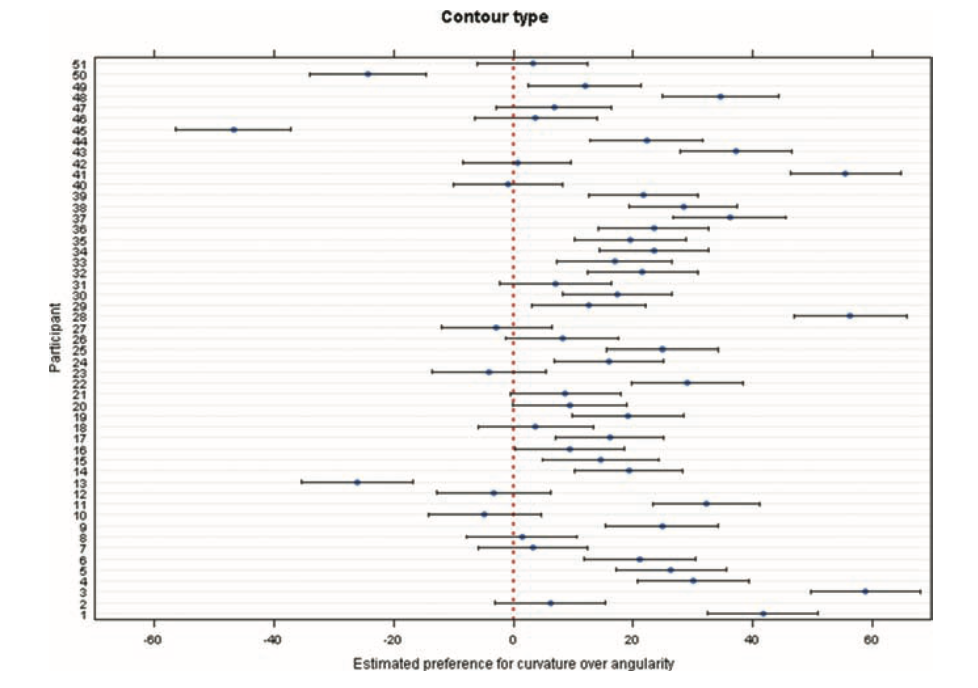
But when researches looked at each individual the results changed. Especially when contour type and complexity interacted the preferences varied a lot from person to person. This reminds us that even the most basic perceptual preferences are not universal. Even before meaning enters the picture, humans differ.
The study shows that many of our aesthetic responses may be deeply rooted in the visual system itself. Abstract shapes make these foundations visible. But for me, abstract shapes standing alone are not fully satisfying. They reveal mechanisms, not emotions. Perception, not meaning. Preference, not experience. However what I can take away form this is that abstract shapes help us understand how we process beauty, but only context explains why something truly touches us.
Bibliography:
Soranzo, A., Bertacchini, F., & Bertamini, M. (2024). Abstract Shape Aesthetics: Contour, Complexity, Motion, and Individual Variability. Art & Perception, 12(3), 240–263. https://doi.org/10.1163/22134913-bja10057
