Reframing My Focus: Designing Phygital Interactions for Cultural Spaces
In my first post, I shared the process behind three pencil holder prototypes I designed. While that exercise helped me develop hands-on design skills, I’ve realized that the topic didn’t truly excite me. What does drive my curiosity is how phygital interactions, those that blend the physical and digital, can reshape the way we experience museums and cultural spaces.
Last semester, I began exploring this direction and outlined some guiding categories for my research:
- Define the audience
- Select an area of content interest
- Explore physical + tangible interactions in depth
While these categories helped structure my thinking early on, I now find the idea of defining a target audience too limiting, especially for museum contexts, where visitors come from a wide range of backgrounds and ages. So, I’ve decided to narrow my focus to content, interaction methods, technology, and prototyping.
My New Direction
For this course, my goal is to develop a physical prototype that investigates how phygital approaches can make themes like history and cultural heritage more engaging, playful, and emotionally resonant. I’m especially interested in designing interactions that draw in people who might not typically connect with traditional exhibits.
To inform my design process, I’ve been researching successful case studies of museum installations focusing particularly on phygital projects. Each of these case studies provides valuable insights into how various interaction modes influence the visitor experience.
Phygital Experiences related to history and cultural heritage
“Longbow & Quarterstaff” (Tangible Interaction)
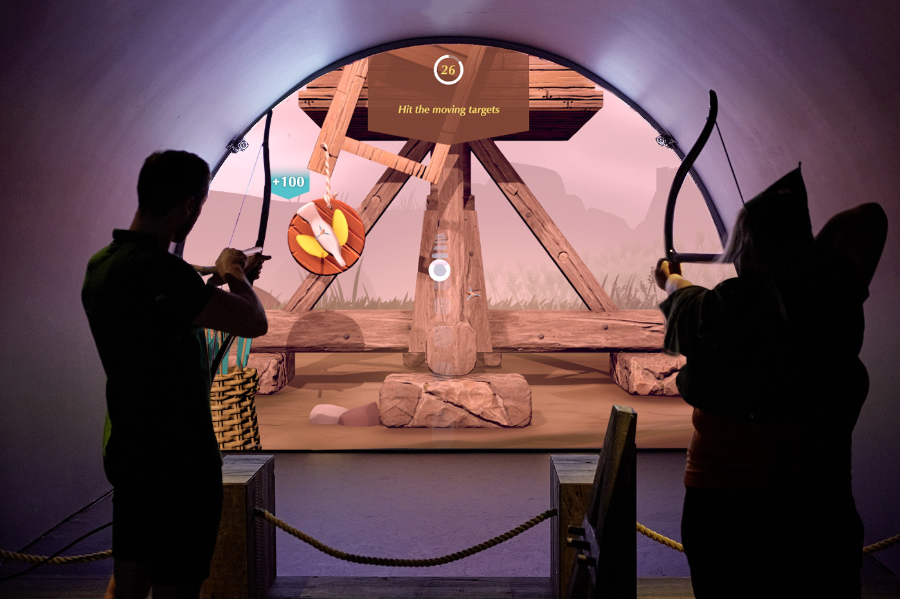
The Longbow & Quarterstaff [1],[2] experience is a phygital, motion-tracked exhibit that blends physical play with digital storytelling to bring Nottingham Castle’s Robin Hood legends to life. It’s a full-body interactive game where visitors use real medieval-style weapons, safely reimagined, to trigger digital reactions on-screen, learning skills and stories as they go.
Key Characteristics
- Visitors physically draw a longbow or wield a quarterstaff, mimicking medieval training exercises.
- Responds in real time. Sensors track movement and trigger animated, story-driven challenges like dueling Little John or mastering archery.
- Teaches by doing. Combines fun with history. No reading panels, just action-based learning.
- Inclusive and intuitive. Designed for all ages and abilities, no prior gaming experience needed.
- Blends heritage and innovation. Reframes historical content through immersive, hands-on play.
- Keeps visitors engaged longer, encouraging exploration and return visits.
- Makes memories. Creates moments of laughter, achievement, and embodied storytelling.
- Durable hardware and responsive tech withstand high traffic without compromising experience quality.
“Sen” (Virtural Reality)
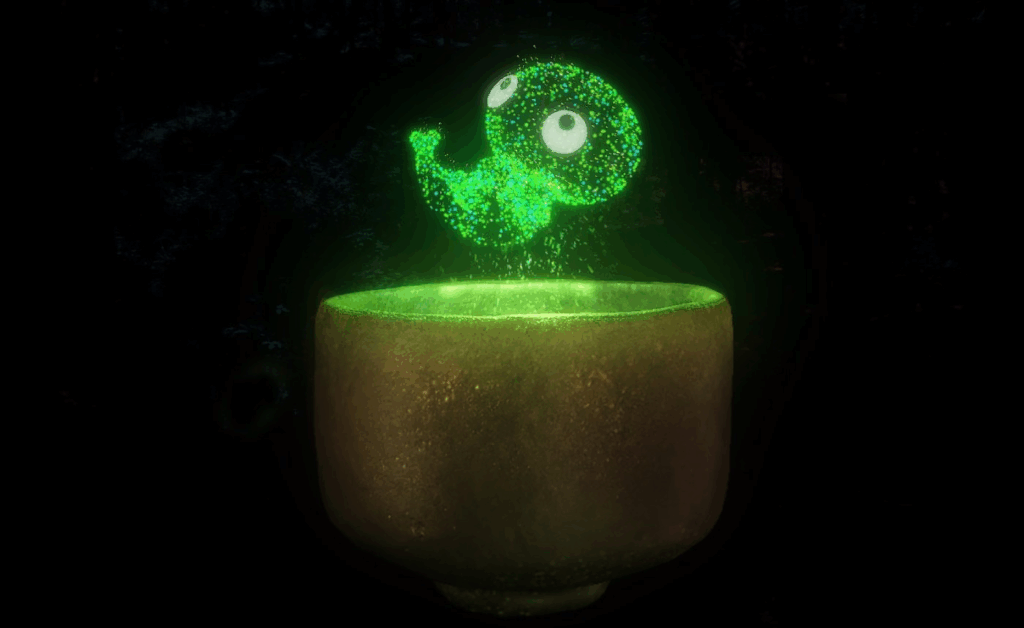
Sen [3], [4] is an immersive virtual reality experience that reimagines the Japanese tea ceremony through the perspective of a tea spirit. Created by Japanese VR artist Keisuke Itoh and produced by Cinemaleap, the 15-minute experience invites participants to embody “Sen,” a tiny lifeform born from within a handcrafted Raku tea bowl. As the spirit, the viewer observes and drifts through a poetic world, experiencing cycles of life, death, and rebirth—symbolizing the transience of existence and the meditative essence of Chado (the Way of Tea).
Key characteristics:
- Meditative tone inspired by the Japanese tea ceremony and Zen philosophy
- Non-verbal storytelling that emphasizes emotion, atmosphere, and symbolism
- Themes of reincarnation, impermanence, and spiritual connection to nature
- Handcrafted visual style, blending traditional Japanese aesthetics with digital craftsmanship
- Technology: High-resolution Virtual Reality using a VR headset and spatial audio for full sensory immersion
- Viewers hold a physical replica of the tea bowl while in VR, which becomes the central object in the experience triggering Sen’s journey and deepening tactile connection without buttons or controllers
A Forest Where Gods Live (Projection Mapping)
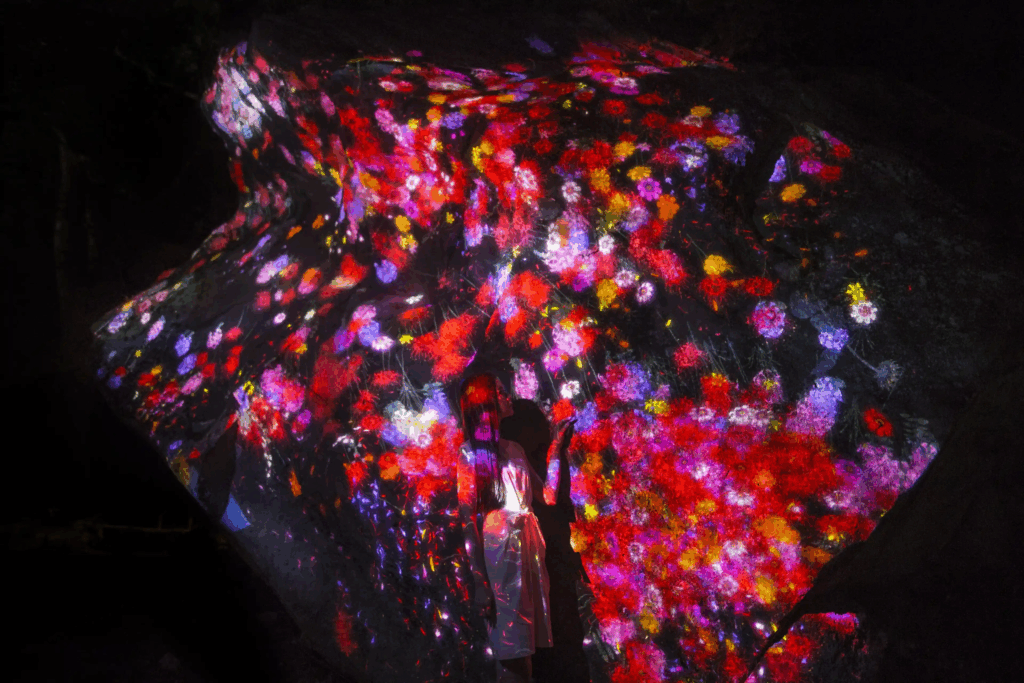
teamLab’s A Forest Where Gods Live [5] is an immersive digital art exhibition set in Mifuneyama Rakuen, an ancient Japanese forest and garden with deep spiritual significance. The project blends interactive technology with cultural heritage and nature, creating a respectful dialogue between the past and the present.
Key Characteristics
- Digital artworks are projected onto real trees, rocks, and ruins, transforming the natural environment without altering it. The forest becomes the canvas.
- The experience changes based on where you walk, how you move, and even the time of day. Flowers bloom, animals appear, and lights shift in real time.
- The project honors Shinto beliefs that spirits inhabit nature. Instead of overwhelming the site, the art quietly coexists with its sacred atmosphere.
- The visuals evolve with weather, seasons, and time, offering a different experience with every visit, echoing the Japanese idea of impermanence (wabi-sabi).
- Carefully placed soundscapes and ambient lighting deepen the sense of wonder and connection with the natural surroundings.
“Experience Guide” (Environmental Sensing + Feedback)
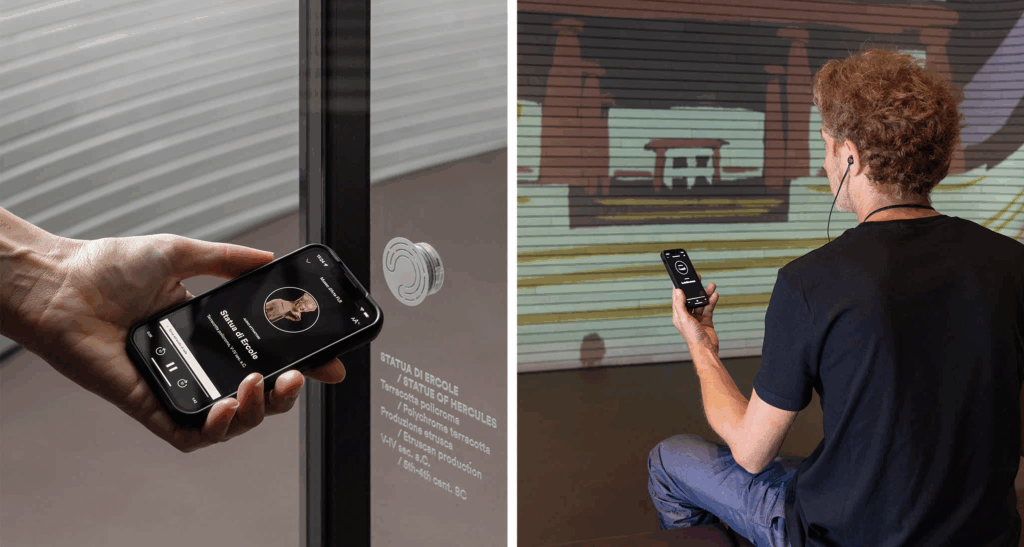
The Experience Guide [6] is a fully integrated digital system designed to enhance both visitor engagement and museum operations. It’s a smart platform that uses indoor positioning technology to deliver personalized, real-time content to visitors’ smartphones as they move through a museum. It also helps museum staff manage and analyze visitor behavior and exhibit conditions from a single system.
Key Characteristics
- Acts like a smart, invisible guide. Delivers personalized, location-based audio-visual content to visitors’ smartphones.
- Automatically plays relevant audio and visual content based on where you are in the museum.
- Replaces the need for QR codes, physical guides, or borrowed devices.
- Includes features like ticketing, real-time updates, and accessibility support.
- Continues the experience post-visit with summaries or reports.
- Centralizes data on visitor flow, exhibit usage, and system performance.
- Integrates with CRM, ticketing, and content management.
- Supports staff in planning, maintaining, and improving the visitor journey.
“Botanical Atlas” (Digital)
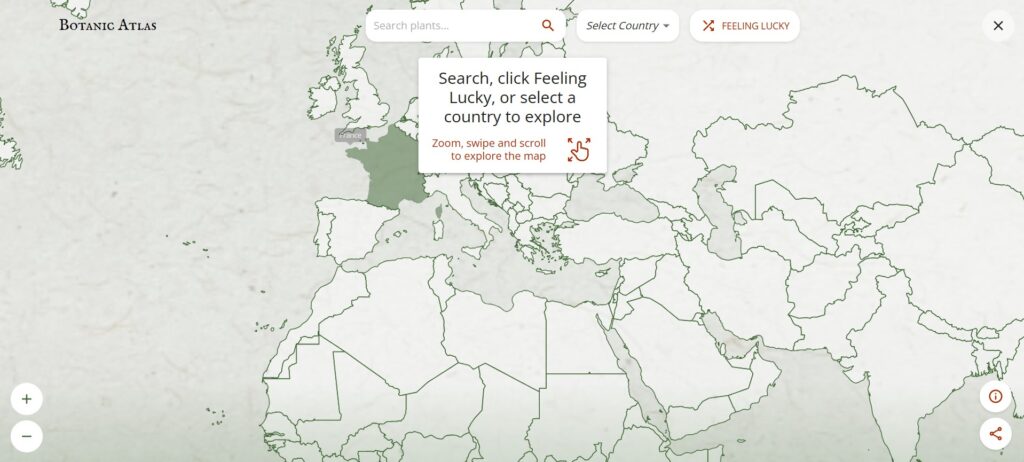
The Botanic Atlas [7] is an interactive online platform developed by Google Arts & Culture in collaboration with institutions like the Botanical Research Institute of Texas, CRIA in Brazil, and the University Herbarium of Cambridge. It showcases over 30,000 plant species through a dynamic world map powered by Google AI, allowing users to explore botanical specimens from various regions.
Key Characteristics
- Purely Digital Platform: Accessible online via Google Arts & Culture, with no physical component—fully immersive and interactive.
- Uses Google AI to showcase over 30,000 plant species from around the world on a dynamic map.
- Combines scientific research (botanical specimens, taxonomy) with cultural heritage (historical and artistic stories).
- Users can select different perspectives like Woodland Explorer, Botanical Scientist, Forest Activist, or Tree Historian to customize their experience.
- Highlights the cultural significance of plants, botanical art history, and regional forest stories.
- Designed to educate a global audience through immersive storytelling, interactive exploration, and rich multimedia content.
- Covers diverse ecosystems and plants from many countries, emphasizing the global importance of botanical knowledge.
Common Aspects of Interaction Methods and Technology
- Emotion-driven storytelling: Focus on playful, memorable learning rather than info delivery.
- Seamless physical-digital integration: Tangible actions directly trigger digital responses.
- Real-time responsiveness: Sensors and tracking enable immediate, dynamic feedback.
- Multisensory engagement: Combines touch, visuals, and sound for immersive experiences.
- Context-aware design: Respects and enhances cultural and physical settings.
- Inclusive and intuitive: Easy to use for all ages and abilities, minimizing barriers.
- Personalized content: Adapts to visitor location, interests, or pace via smart tech.
- Robust technology: Durable hardware/software for consistent, high-quality use.
What’s Next
This framework can help guide me in developing my prototype by emphasizing the following key areas:
- Creating physical touchpoints that trigger rich digital responses.
- Ensuring interactions feel natural and immediate.
- Designing for diverse visitors with simple, engaging interfaces.
- Embedding experiences meaningfully within a cultural context
The upcoming blog post will focus on selecting a topic related to history and cultural heritage, as well as researching technology and making choices for my prototype.
Sources
[1] PRELOADED, “Longbow & Quarterstaff – Nottingham Castle,” PRELOADED, 2025. [Online]. Available: https://preloaded.com/work/longbow-quarterstaff/
[2] K. A. Oliver, “Nottingham Castle,” kaioliver.co.uk, Portfolio. [Online]. Available: https://kaioliver.co.uk/?portfolio=nottingham-castle.
[3] ArtScience Museum, “SEN,” Marina Bay Sands, ArtScience Museum Exhibitions. [Online]. Available: https://www.marinabaysands.com/museum/exhibitions/sen.html.
[4] MuseumNext, “SEN: A transcendent virtual tea ceremony exploring reincarnation,” MuseumNext. [Online]. Available: https://www.museumnext.com/article/sen-a-transcendent-virtual-tea-ceremony-exploring-reincarnation/.
[5] teamLab, “teamLab: A Forest Where Gods Live,” teamLab Exhibitions. [Online]. Available: https://www.teamlab.art/e/mifuneyamarakuen/.
[6] Dotdotdot_it, “The first fully integrated digital system customised to visitor and museum needs,” Medium, Oct. 27, 2022. [Online]. Available: https://dotdotdot-it.medium.com/the-first-fully-integrated-digital-system-customised-to-visitor-and-museum-needs-a2661079dfce
[7] Google Arts & Culture, “Botanic Atlas,” 2025. [Online]. Available: https://artsandculture.google.com/experiment/botanic-atlas/xwFwFQ2goojMUw.
