During the interaction design classes with Josef “Seppo” Gründler, we discovered different ways of creating sound. Put simply, we explored how interactions can shape sounds. As part of the course, we were tasked to deepen our knowledge in this domain and check out one NIME Project Paper plus write a review.
What’s NIME?
NIME (New Interfaces for Musical Expression) is a research community exploring innovative ways to create and interact with sound. It brings together artists, designers, engineers, and researchers who develop new musical instruments, interactive sound systems, and experimental performance tools. They blend technology, interaction design, and artistic expression, often incorporating DIY hardware, software, and unconventional interfaces to push the boundaries of musical experience.
The Magical Music Mat (MMM)
The paper I read was about the Magical Music Mat (MMM), a prototype of two yoga mats, lined with foil, that are connected to an Arduino, which sends MIDI signals to a laptop. The laptop then plays pre determined sound samples or generates sound waves. The idea is, to have two dancers perform on top of the mats, which generates sound, if they touch each other. This way unique performances, connecting sound creation and choreography together, can be created. (see picture below)
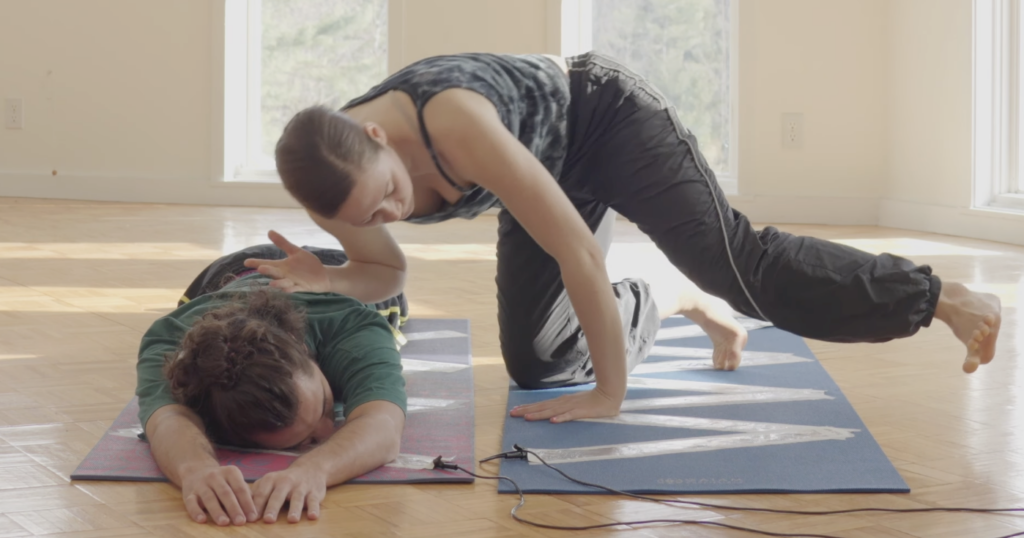
To make it easier to understand and comprehend, what the two dancers actually did using the MMM, check out the video below.
The two dancers were given complete freedom when “playing” with the mats and sound. They didn’t know each other nor the sound samples, that were played, beforehand. They made up everything on the spot, letting the sound influence their ideas on how to work with the sounds, they created them selves. The researchers highlighted four key themes:
- Choreographer as Composer – Dancers take on a compositional role, treating movement and sound as intertwined creative expressions.For example one dancer played the MMM while the another moved outside.
- Playfulness – Play becomes a tool for exploration, breaking rigid structures. The dancers engaged in playful activities like a thumb war or feigning surprise at static sounds, which allows them to discover new movement qualities.
- Finding Origins of Movement – Instead of seeking predetermined movements, dancers explore how movement emerges naturally from contact. One dancer positions another’s limbs by touching joints, while another example involves dancers shifting their bodies away from contact points.
- Partnering – Interaction and connection between dancers are key. Mirroring movements and communicating through touch (even with closed eyes) deepens their sense of collaboration.
If you want to learn more, her is the link to the Project.
Considerations
In the video it seems like the prototype of the MMM functions more like a button, basically stopping and starting the playback of different sound samples or playing a one shot sound effect. For a performance, that includes dancers influencing sound and being influenced by sound, this should be more “responsive”. Like different levels of sound depending where on the mat a performer stands or how many touch points there are. In the video you can see a performer brushing along the foil, which doesn’t seem to influence the sound that is being generated. Additionally the zig-zag pattern of foil on the mat lead to the performers stepping on a non conductive spot, not creating a sound. For further exploration, this would have to be addressed. Since this is a prototype after all, those “problems” can be surely be fixed.
Thinking about possible uses for this technology I consider this to be an excellent pice of tech to use during a dance performance. I could imagine a whole floor made from MMMs with different connections between performers make different sounds. This could even be used as a new form of instrument to create a new type of orchestra, that uses them selves as instruments. Also this could be incorporated into an acrobatic choreography, with multiple people creating a connection across a long distance, by stacking on top of each other. This could also enable people, who aren’t able to make music with their hands, to make music just using their feet.
