There are various approaches that interaction designers can take to help combat loneliness. It is not only important to tackle loneliness itself, but also to focus on strengthen interpersonal connections and relationships. Since a large part of our lives already takes place online and we spend a lot of time in front of our phones, I would like to pursue an approach that focuses more on the real and analog world – but still does not forego a digital aspect.
I would like to investigate whether and how interactive installations can contribute to strengthening social interactions in public spaces. Interactive installations have established themselves as an increasingly important medium for combining technology, art and user experience. 1 Such installations not only fascinate but also create a unique experience through active participation and interaction. As noted by Edmonds “interactive art is distinguished by its dynamic behaviour in response to external stimuli, such as people moving and speaking.” Art becomes interactive when audience participation plays a central role in the work. The audience’s actions can influence and alter the artwork itself. When creating interactive art, the artist focuses not only on the visual or auditory aspects of the piece but also on how it engages and interacts with the audience, making this interaction a vital part of its nature. 2 For example, an installation could:
- Alter the lights, sounds, or visual aspects in response to the people’s presence.
- Support teamwork, where several users would have to physically and digitally interact with each other in order to activate particular features.
- Change and improve according to the behavior of a whole audience, which may cause a dynamic and unpredictable outcome.
How interactive installations work
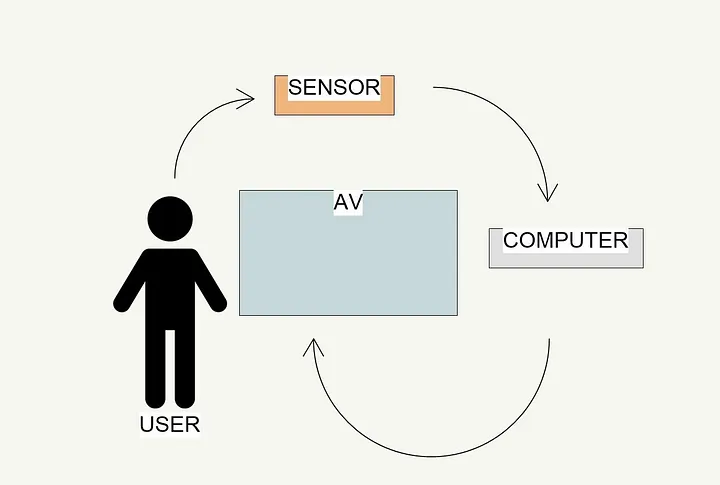
Interactive installations work through input from the audience or the environment. Interaction is achieved through a combination of sensors, software, physical elements or hardware that recognizes and processes the input. These inputs can include:
- Movement: Motion sensors and cameras record audience movements, triggering the pre-set reactions.
- Touch: Pressure-sensitive surface or touchscreens allow for interaction through touch.
- Sound: Microphones record and / or respond to volume, pitch, or specific voice commands.
- Proximity: Ultrasonic or infrared detectors observe the proximity of a viewer to the installation.
- Input Data: Several installations incorporate data from external sources, such as weather, social network trends, or live web feeds. 4
The system takes these inputs and turns them into responses like changes in lights, visuals, sounds, or even mechanical movements. This creates a dynamic, interactive experience where the audience’s actions directly influence how they engage with the piece.
Types of Immersive and Interactive Art Installations
Digital Projections
The projection of digital content is the cornerstone of immersive and interactive art. Advanced projection mapping can transform walls, floors and ceilings into interactive screens and environments and therefore bring the surrounding to life. By incorporating motion graphics and real-time visuals, these installations create multi-sensory environments that transport audiences into new and imaginative worlds.
Sensor-based Installations
The nature of sensor-based installations is that they use motion, touch, or sound sensors to react to human interaction in real-time. Thus, visual elements may change with movement, or perhaps a touch may turn on a certain light. These installations can range from pressure pads to some long-distance proximity sensors or maybe even facial recognition, which can cultivate an intimate space that reacts individually to each individual encounter.
Sound and Lighting Installations
Combining surround soundscapes with synchronized lighting systems, the sound and light installations attain a stunning effect. Through the interplay of contrasts, rhythms, and spatial audio, these installations evoke emotions and draw audiences into a compelling sensory world.
Virtual Reality Installations
Virtual reality installations bring interactivity to a new level by immersing participants in fully digital 3D environments. With the VR headsets viewers can navigate through this digital environment, interact with virtual object or even become part of the artwork. These experiences connect storytelling with interactivity, aggregating in deeply personalized experiences for the visitors. Those installations can be used for entertainment or even educational purposes – virtual museums or immersive stories that let people experience scenarios firsthand.
Participatory Installations
Participatory installations directly involves the audience in the creation or completion of the artwork, often through simple, intuitive interfaces that ensure broad accessibility. These installations may feature collaborative elements, where multiple participants work together to contribute to a piece. Examples include digital graffiti walls or crowd-sourced sculptures, which challenge traditional ideas of authorship and create a sense of community within the artwork. This type of interactive installation blurs the lines between artist and viewer, encouraging collective creativity. 4 5 Designing an installation that requires collaboration not only encourages interaction between people and the interface, but also the connection between people and their environment – and above all connection between the people themselves. 1
Interactive installations have the potential to ease feelings of loneliness and strengthen social ties by combining art, technology, and user participation. By combining the physical and digital worlds, these experiences offer new approaches to encouraging meaningful interactions and tackling isolation in shared public areas.
Sources
[1] S. U. Ahmed, „Interaction and Interactivity: In the Context of Digital Interactive Art Installation“, in Lecture notes in computer science, 2018, S. 241–257. doi: 10.1007/978-3-319-91244-8_20.
[2] E. Edmonds, “Interactive Art,” in Interacting: Art, Research and the Creative Practitioner, L. Candy and E. Edmonds, Eds. Faringdon: Libri Publishing Ltd., 2011, pp. 18–32.
[3] T. Emb, „The Intersection of Art and Technology in Interactive Installations“, EMB Blogs, 16. April 2024. https://blog.emb.global/art-and-technology-in-interactive-installations/#:~:text=Technology%20is%20crucial%20for%20interactive,%2C%20sound%2C%20or%20other%20inputs.
[4] S. Zafeiriou, „The Role of Technology in Interactive Installations: How Sensors, Computers, and More Shape Modern Art |“, Steve Zafeiriou, 11. November 2024. https://stevezafeiriou.com/technology-in-interactive-installations/
[5] Fiveable, “Interactive Installations: Study Guide,” Fiveable, 2025. [Online]. Available: https://library.fiveable.me/installation-art/unit-6/interactive-installations/study-guide/rdqjbQtvUFtb8qto. [Accessed: Jan. 25, 2025].
