In this blog post, I want to explore the portrayal of feminism in pop culture, with a particular focus on how it is utilized within communication design and visual media. Specifically, I will look at the two major perspectives: the “Male Gaze” and the emerging concept of the “Female Gaze, which are also trending and often used in social media (twssmagazine, 2022). Is the increasing presence of feminist themes in pop culture a genuine allyship or merely an opportunistic exploitation?
Pop Culture and Feminism
Pop culture has undeniably contributed to the visibility of feminist ideals. From blockbuster films featuring strong female protagonists to high-profile ad campaigns promoting women’s empowerment, feminism seems to have become a marketable trend. For instance, movies like Wonder Woman or campaigns such as Dove’s “Real Beauty” aim to celebrate women and challenge outdated norms (Danziger Halperin & Mellon, 2020). However, this visibility often comes with strings attached. The question remains: Are these portrayals genuine efforts to support gender equality, or are they commodifying feminism for profit?
Allyship: In its best form, pop culture can amplify feminist voices, educate audiences, and foster meaningful discussions. Campaigns that challenge stereotypes or highlight intersectional struggles contribute to a broader understanding of gender equality.
Exploitation: On the flip side, the co-opting of feminist themes without substance risks reducing a complex movement to a mere aesthetic. Terms like “femvertising” describe how companies use empowerment messaging to sell products without enacting meaningful change within their organizations or society at large and therefore uphold gender binaries (Le, 2022).
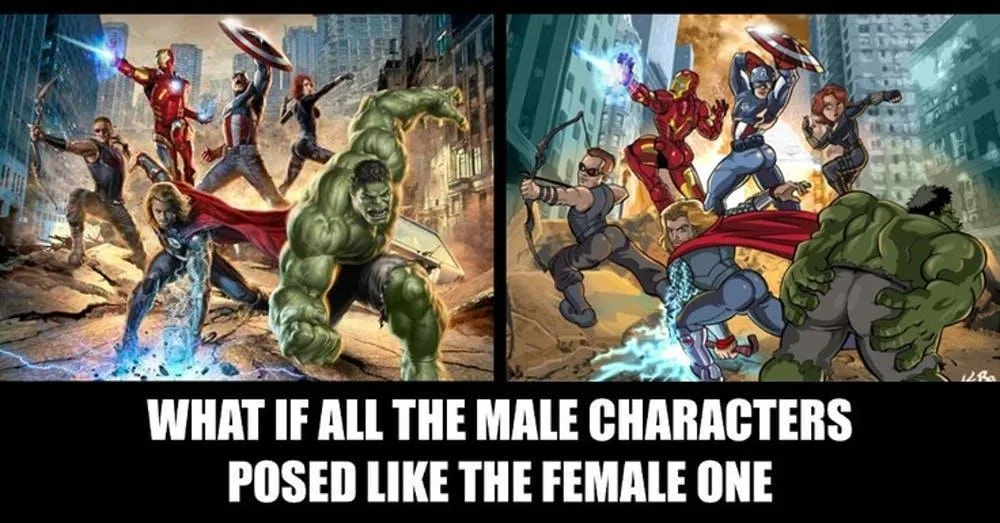
Decoding the Male Gaze in Visual Media
The “Male Gaze,” a term popularized by film theorist Laura Mulvey in 1975, refers to the depiction of women in media as objects of male desire (Sassatelli, 2011). This perspective dominates much of visual media, from advertising to movies, shaping how women are portrayed and perceived. In communication design, this manifests in ways such as:
- Objectification: Women are often shown as passive, decorative figures meant to appeal to heterosexual male audiences (Vanbuskirk, 2022).
- Fragmentation: Advertisements frequently isolate parts of a woman’s body, such as her legs or lips, reducing her to a collection of desirable features.
- Narrative Control: Stories in visual media often prioritize male perspectives, with female characters serving as supporting roles rather than autonomous agents (Jackson, 2023).
A classic example is the portrayal of women in perfume ads, where they’re often shown in submissive or hypersexualized poses, reinforcing traditional gender roles. When women, men, girls, and boys consistently see women and girls portrayed in such narrow and sexualized ways, it inevitably shapes their expectations, influences cultural norms, and affects how they understand their own identities (Vanbuskirk, 2022).
The Emergence of the Female Gaze
In contrast, the “Female Gaze” aims to reclaim agency and portray women’s experiences authentically. This perspective is not merely a reversal of the Male Gaze but rather a shift towards empathetic and nuanced storytelling. (Forster, 2019) Key characteristics of the female gaze are:
- Agency: Women are depicted as active participants with complex emotions and desires, rather than objects to be consumed.
- Subjectivity: The focus is on how women experience the world, showcasing their perspective rather than how they are viewed by others.
- Empowerment: Visuals often challenge traditional norms and celebrate diversity in gender expression and body types.
Examples of the Female Gaze can be seen in films like Portrait of a Lady on Fire, which prioritizes female subjectivity and intimacy, or in campaigns like Aerie’s “#AerieReal,” which features unretouched images of diverse models to promote body positivity (Scateni, 2020).


Though, one could argue that #AerieReal is also part of a femvertising campaign. But how can one differentiate?
Navigating the Line within Feminism in Communication Design
For communication designers, the challenge lies in creating visuals that genuinely support feminist ideals without falling into the trap of superficiality (Cook, 2016).
- Authenticity: Ensure that messaging aligns with meaningful actions. For example, if a company promotes gender equality in ads, it should also reflect that commitment internally through equal pay and diverse leadership (Alfaro-Ibáñez & Gallardo-Echenique, 2023).
- Intersectionality: Feminism is not one-size-fits-all. Campaigns should consider the experiences of women across different races, classes, sexualities, and abilities (Sobande, 2019).
- Avoiding Tropes: Challenge traditional stereotypes by portraying women in varied roles and narratives, moving beyond the binary of hypersexualized objects or virtuous caretakers.
Shifting the Gaze
As feminism continues to intersect with pop culture, its representation will remain a contentious issue. The concept of the Female Gaze is becoming a transformative force in challenging traditional norms. Inclusive and authentic advertising has the potential to reshape industry practices, offering a blueprint for meaningful allyship rather than superficial exploitation. While the commodification of feminist ideals is problematic, the potential to reach mass audiences and inspire change cannot be overlooked. By critically engaging with the Male Gaze and advocating for the Female Gaze, designers and creators can contribute to a more equitable and empowering media landscape (Rangles, 2023).
So, is feminism in pop culture allyship or exploitation? Maybe it’s both. The answer lies in our ability to differentiate between genuine efforts and hollow marketing—and to demand more from the media we consume and create.
Sources
Alfaro-Ibáñez, B., & Gallardo-Echenique, E. (2023). Femwashing or Femvertising? A Look at Advertising Authenticity. Atlantis Highlights in Social Sciences, Education and Humanities, 111–121. https://doi.org/10.2991/978-94-6463-254-5_12
Cook, E. (2016, April 10). 4 Femvertising Video Ads That Teach You How To Do It Right. Venture Videos; Venture. https://www.venturevideos.com/insight/femvertising
Danziger Halperin, A., & Mellon, A. W. (2020). Wonder Woman: Feminist Icon? | New-York Historical Society. Www.nyhistory.org. https://www.nyhistory.org/blogs/wonder-woman-feminist-icon
Forster, S. (2019, September 12). Yes, there’s such a thing as a “female gaze.” But it’s not what you think. Medium. https://medium.com/truly-social/yes-theres-such-a-thing-as-a-female-gaze-but-it-s-not-what-you-think-d27be6fc2fed
Jackson, L. M. (2023, July 14). The Invention of “the Male Gaze.” The New Yorker. https://www.newyorker.com/books/second-read/the-invention-of-the-male-gaze
Le, C. (2022, March 26). Femvertising: How Marketing Can Uphold the Gender Binary. The Quirky Pineapple Studio. https://thequirkypineapple.com/blog/2022/03/26/femvertising-how-marketing-can-uphold-the-gender-binary/
Mulvey, L. (1975). Visual Pleasure and Narrative Cinema. Screen, 16(3), 6–18.
Rangles, C. M. (2023). Female Gaze for Every Gaze. Google.com. https://www.google.com/url?sa=t&source=web&rct=j&opi=89978449&url=https://www.diva-portal.org/smash/get/diva2:1777975/FULLTEXT01.pdf&ved=2ahUKEwilqYfPnoeLAxVx-QIHHexuFxY4ChAWegQIExAB&usg=AOvVaw3qE4aSAfhUWI9YwqO9411f
Sassatelli, R. (2011). Interview with Laura Mulvey: Gender, Gaze and Technology in Film Culture. Theory, Culture & Society, 28(5), 123–143. https://journals.sagepub.com/doi/epdf/10.1177/0263276411398278
Scateni, R. (2020, February 26). How Portrait of a Lady on Fire celebrates the female gaze. BFI. https://www.bfi.org.uk/features/portrait-lady-fire-female-gaze
Sobande, F. (2019). Woke-washing: “intersectional” femvertising and branding “woke” bravery. European Journal of Marketing, 54(11), 2723–2745. https://doi.org/10.1108/ejm-02-2019-0134
twssmagazine. (2022, June 9). The Female Gaze: The Theory Behind the TikTok Trend. That’s What She Said. https://twssmagazine.com/2022/06/09/the-female-gaze-the-theory-behind-the-tiktok-trend/
Vanbuskirk, S. (2022, November 14). What Is the Male Gaze? Verywell Mind. https://www.verywellmind.com/what-is-the-male-gaze-5118422
