Taking a little detour from my actual topic, I wanted to explore an issue of our time, bias in Ai. A topic that comes up a lot, when reading about Ai. I wanted to know, what can be done about it and how it could be avoided. Could this have an additional impact on our society?
Artificial Intelligence (AI) is transforming industries, and (UX) Design is no exception. Ai already has the ability to deliver high quality design work and is going to continue to evolve. It’s reshaping how we approach design, offering tools that enhance efficiency, streamline workflows, and even generate creative outputs, it’s already capable to deliver high quality design work. While AI excels at analyzing data, creating prototypes, and even predicting user behavior, the heart of UX design lies in empathy, problem-solving, and collaboration, skills uniquely human in nature. (cf. Medium A)
Ai can analyze vast amounts of user data to uncover patterns and insights that inform design decisions, helping designers better understand their audience. It can also generate initial design drafts or prototypes, saving time and allowing designers to focus on refining creative and strategic elements. Predictive algorithms powered by AI can anticipate user behavior, enabling the creation of more intuitive and personalized experiences. By automating repetitive tasks and offering data-driven insights, AI empowers designers to elevate their craft while maintaining a human-centered approach. (cf. Medium A)
But what if the data the Ai gets is already biased towards a certain user group, making it’s outputs biased as well a therefore influencing UX work. Addressing bias in AI is not just a technical challenge; it’s an ethical imperative that impacts the lives of millions.
Examples of Bias in Ai
- Healthcare Disparities:
An algorithm used in U.S. hospitals was found to favor white patients over black patients when predicting the need for additional medical care. This bias arose because the algorithm relied on past healthcare expenditures, which were lower for black patients with similar conditions, leading to unequal treatment recommendations. - Gender Stereotyping in Search Results
A study revealed that only 11% of individuals appearing in Google image searches for “CEO” were women, despite women constituting 27% of CEOs in the U.S. This discrepancy highlights how Ai can perpetuate gender stereotypes. - Amazon’s Hiring Algorithm
Amazon’s experimental recruiting tool was found to be biased against female applicants. The Ai, trained on resumes submitted over a decade, favored male candidates, reflecting the industry’s male dominance and leading to discriminatory hiring practices. (cf. Levity)
How does bias in Ai form?
Bias in Ai often forms due to the way data is collected, processed, and interpreted during the development cycle. Training datasets, which are meant to teach AI models how to make decisions, may not adequately represent all demographics, leading to underrepresentation of minority groups. Historical inequities embedded in this data can reinforce stereotypes or amplify disparities. Additionally, the way problems are defined at the outset can introduce bias; for instance, using cost-saving measures as a proxy for patient care needs can disproportionately affect underserved communities. Furthermore, design choices in algorithms, such as prioritizing overall accuracy over subgroup performance, can lead to inequitable outcomes. These biases, when unchecked, become deeply ingrained in AI systems, affecting their real-world applications.
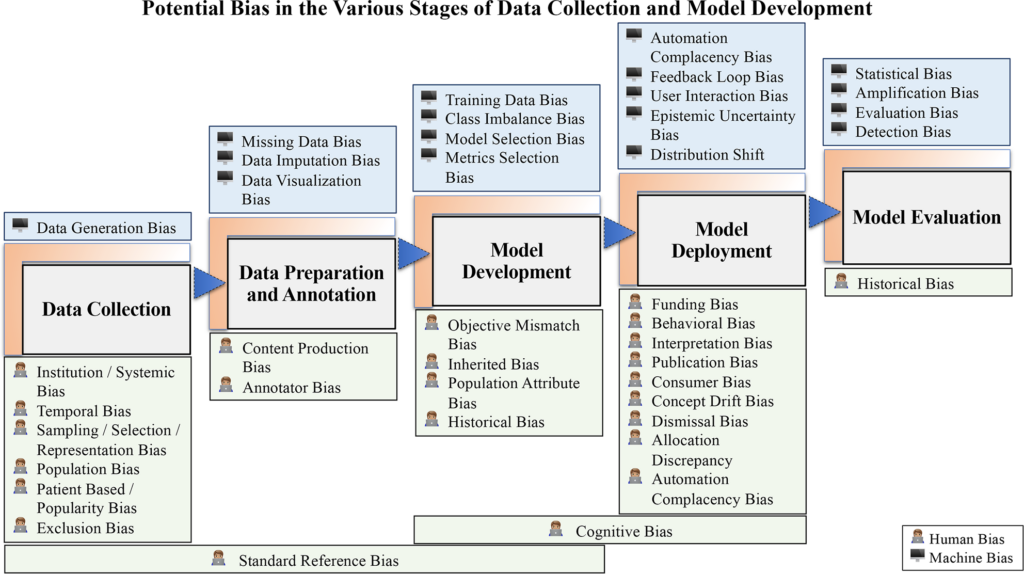
Sometimes, the problem the Ai is supposed to solve is framed using flawed metrics. For instance, one widely used healthcare algorithm prioritized reducing costs over patient needs, disproportionately disadvantaging Black patients who required higher acuity care. (cf. Nature) When training datasets lack of diversity or reflect on historical inequities, Ai models learn to replicate these biases. Also, a well-designed system can fail in real-world settings if deployed in wrong environments it wasn’t optimized for. (cf. IBM) Decisions made during model training, like ignoring subgroup performance—can result in inequitable outcomes. (cf. Levity)
How to address bias in Ai
To avoid bias in Ai thoughtful planning and governance is important. Many organizations rush Ai efforts, leading to costly issues later. Ai governance establishes policies, practices, and frameworks for responsible development, balancing benefits for businesses, customers, employees, and society. Key components of governance include methods to ensure fairness, equity, and inclusion. Counterfactual fairness for example addresses bias in decision-making even with sensitive attributes like gender or race. Transparency practices help ensure unbiased data and build trustworthy systems. Furthermore a “human-in-the-loop” system can be incorporated to allow human oversight to approve or refine Ai-generated recommendations. (cf. IBM)
Reforming science and technology education to emphasize ethics and interdisciplinary collaboration is also crucial, alongside establishing global and local regulatory frameworks to standardize fairness and transparency. However, some challenges demand broader ethical and societal deliberation, highlighting the need for multidisciplinary input beyond technological solutions. (cf. Levity)
