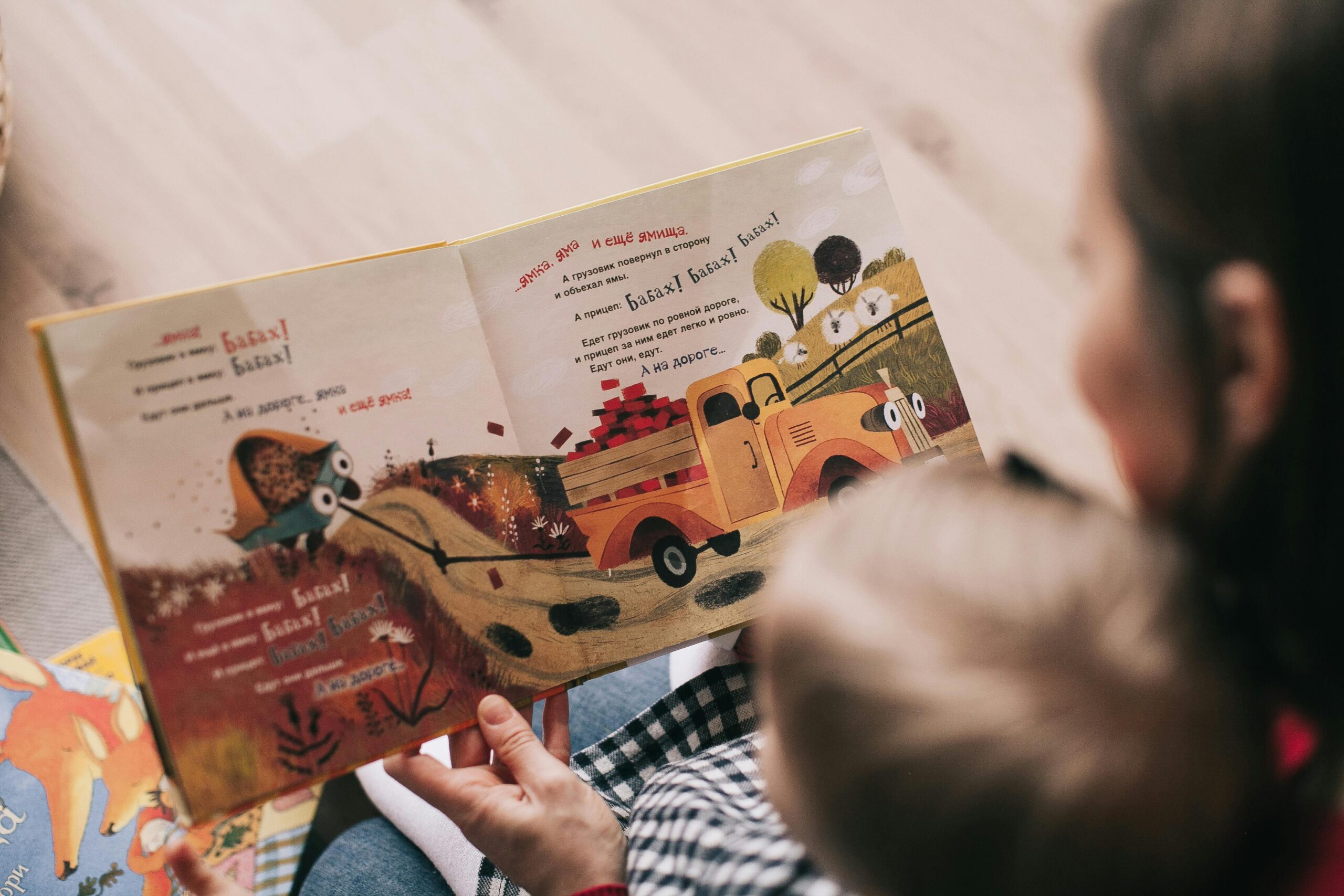
Children learn to read in distinct stages that reflect the development of their ability to translate written symbols into spoken language. These stages build upon one another, with each child progressing at their own pace. The developments are not linear. Sometimes kids also go back in a stage when they encounter new vocabularies and they should be supported accordingly. Based on the german developmental psychologist Uta Frith’s model (1985), three central stages can be identified: the logographic, alphabetic, and orthographic phase.
1.Logographic Phase
In this early stage, children recognize words and letters primarily through visual cues, much like identifying pictures or symbols. They rely on visual features such as the length of a word, the shape of certain letters, or logos to identify familiar words. There is no real connection between letters and sounds at this point. Mostly, they recognize specific words because they remember what it is. For example they recognize the milk carton in comparison to orange juice cartons. They seem to read the word “milk” but usually they just remember the basic information of the product.
This stage is typical for preschoolers and early readers. Encouraged through visual recognition activities (e.g., flashcards, pictograms, memory cards etc.). Focus on frequently used words or personal names (e.g. writing their own name and “reading” it back).

2.Alphabetic Phase
In the alphabetic phase, children begin to understand the relationship between letters (graphemes) and sounds (phonemes). A letter is not always spoken in the way it is written. For example in Spanish sounds are really dependent on the following letter combinations, which could change the pronunciation. They learn to decode words by blending sounds (synthetic reading). Recognizing new words increasingly involves applying letter-sound rules. A child sees the word „cat“ and pronounces it by connecting the individual letters c-a-t.
This stage typically corresponds to the start of formal reading instruction (around first grade). Methods like syllable reading and phonological exercises help children internalize the letter-sound principle. Additionally, in this stage, challenges can be addressed with targeted interventions for children with dyslexia.


3.Orthographic Phase
In this phase, children increasingly recognize words automatically, without decoding each letter. They internalize orthographic patterns and rules, allowing them to quickly identify word components (morphemes) or familiar words. Spelling and reading fluency improve significantly during this stage. They get better at reading words instantly without spelling it out, as they recognize known structures. Finally they arrive at the known phenomenon that they can read word “automatically”, without having to read the full word.*
This phase usually occurs in late elementary school or later, as children develop a broader vocabulary. Reading comprehension and fluency are encouraged through more complex texts (e.g., stories, factual texts) and spelling or grammatical rules.
*Die Bcuhstbaenrehenifloge ist eagl
Words can resemble a colorful jumble of letters and still be readable; only the first and last letters have to be in the right place. This is due to the brain‘s ability to recognize words as a whole. This skill shows that you are a fluent reader.

