A few months ago, I came across a TikTok where someone discussed the Theory of the Third Place and argued that Generation Z no longer has a true Third Place. Instead, he suggested, our phones have become the new “third place.” I briefly got stuck on this TikTok because I had never heard of it before but found the topic really interesting. Now that I’ve started researching the topic of loneliness and social isolation, I’m realizing how important these third places are for people, especially young people and their mental health.
What is a Third Place?
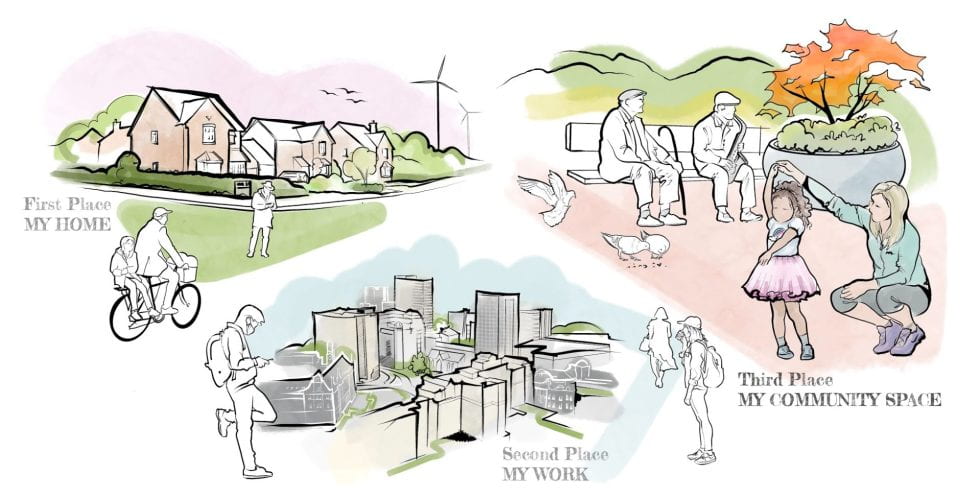
The term Third Places originates in the book “The Great Good Place” (1989) by the sociologist Ray Oldenburg. His Third Place Theory revolves around the concept that our lives are shaped by three key environments: the first place, the second place, and the third place. 1
The first place: HOME
The first place refers to where individuals live and develop their private lives. It is typically associated with privacy, a sense of solitude, and personal ownership. A home serves as a crucial foundation, offering stability, comfort, and a space for shaping one’s identity. 2
The second place: WORK
The second place refers to the workplace, where people spend a substantial part of their time. It is characterized by productivity, professional responsibilities, and a structured setting. Workplaces play a vital role in providing financial security and fostering career growth. 2
The third place: COMMUNITY
A third place is distinct from both home and work, serving as a space where people can regularly gather and connect with friends, neighbors, coworkers, or even strangers. 3 Oldenburg states it as a “a space for informal, free social interaction, essential to democracy” 1 It encompasses locations such as cafes, libraries, parks, community hubs, and other shared spaces. These environments foster social connections, open dialogue, and a sense of community. 2 Some even call the third places the living room of society. 4
Oldenburg identifies the following nine characteristics for third places:
- “Neutral ground: In a third place people can easily join in or disengage from the conversation.
- Leveler: All people, regardless of class and status, are welcome and intermingle.
- Engaging Conversation: Talk is the main activity and provides the greatest value. The rules are simple: Don’t dominate the conversation, be sensitive to others’ feelings, speak on topics of general interest, and avoid trying to instruct.
- Accessibility and accommodation: People can wander in almost any time of day or night and find someone to talk to.
- Regulars: The people who frequent the place give it character, set the tone, and welcome both old timers and newcomers.
- Low profile: The decor is plain and unimpressive, discouraging pretension and self-consciousness.
- Playful mood: Displays of wit are encouraged. The congenial environment makes it feel like a home away from home.” 1
Why are they so important?
Third places are more than just physical spaces — they are vital social hubs that contribute significantly to individual well-being and the strength of society as a whole. Here are the functions they serve:
Encouraging Social Interaction
These spaces offer an inviting setting where individuals can come together, engage in conversation, and build meaningful relationships outside their typical social networks.
Inspiring Creativity
Third places bring together individuals from different backgrounds, creating dynamic environments that encourage the sharing of ideas and inspire creativity and innovation.
Cultivating a Sense of Belonging
Third places help individuals feel valued and accepted, creating a strong sense of belonging that enhances community bonds.
Supporting Personal Development
Through shared experiences, exposure to new perspectives, and opportunities for learning, these spaces contribute to personal growth and self-improvement.
Building Stronger Communities
By hosting gatherings and events, third places act as pillars for community cohesion, helping to create more resilient and united neighborhoods. 2
Third places play a crucial role in promoting health and well-being across all stages of life by providing essential social support. Despite often being overlooked, they are key to addressing pressing societal challenges like isolation, crime, education, addiction, physical inactivity, malnutrition, and sociopolitical polarization. Strengthening these spaces in both cities and suburbs could help rebuild social connections, foster a sense of community and offering opportunities for meaningful in-person interactions, dialogue, and shared experiences. 5 6 7
Examples of Third Places
Oodi Library in Helsinki
“Helsinki Central Library Oodi is a living meeting place at Kansalaistori square, right at the heart of Helsinki. Oodi provides its users with knowledge, new skills and stories, and is an easy place to access for learning, story immersion, work and relaxation. It is a library of a new era, a living and functional meeting place open for all.” 8

The Highline in New York
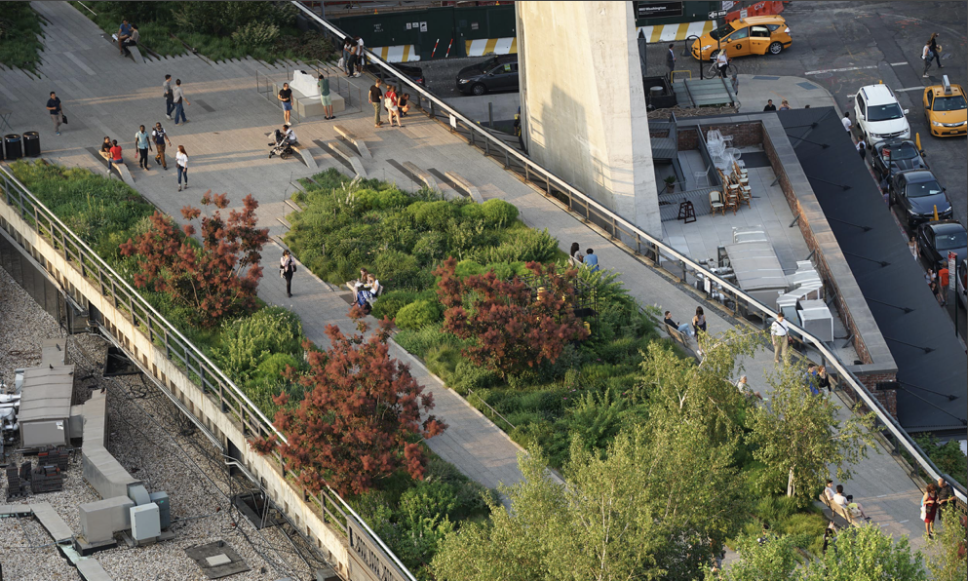
“The High Line is both a nonprofit organization and a public park on the West Side of Manhattan. Through our work with communities on and off the High Line, we’re devoted to reimagining the role public spaces have in creating connected, healthy neighborhoods and cities. Built on a historic, elevated rail line, the High Line was always intended to be more than a park. You can walk through gardens, view art, experience a performance, savor delicious food, or connect with friends and neighbors-all while enjoying a unique perspective of New York City.” 9
Third places at risk
Unfortunately, limited public transportation, suburban zoning laws, and rising real estate costs often place these spaces far from residential areas, making car access a necessity and reducing their accessibility. The shift to digital interactions has further diminished these community-focused spaces, leaving many isolated.
But especially in today’s fast-paced digital age, third places are more essential than ever as a counterbalance to the isolating effects of technology, the relentless pace of modern life, and the growing emphasis on work and productivity. 5 6
Video
I also found this interesting YouTube Video from Elliot Sang explaining the issue with Third Places also in a historical context:
Sources:
[1] R. Oldenburg, The Great Good Place: Cafes, Coffee Shops, Bookstores, Bars, Hair Salons and Other Hangouts at the Heart of a Community, New York: Marlowe & Company, 1999.
[2] N. G. Er, „The Third Place Theory – Nazlı Gizem Er – medium“, Medium, 11. September 2023. [Online]. Verfügbar unter: https://medium.com/@gzm.err/the-third-place-theory-ae0dcee927b6#:~:text=The%20Third%20Place%20Theory%20reminds,to%20our%20overall%20well%2Dbeing.
[3] V. Mehta und J. K. Bosson, „Third Places and the Social Life of Streets“, SAGE Publications, 2010. doi: 10.1177/0013916509344677.
[4] A. Mondry, “In praise of loud, stinky bars,” Shelterforce, May 24, 2012. [Online]. Available: https://shelterforce.org/2012/05/24/in_praise_of_loud_stinky_bars/. [Accessed: Jan. 13, 2025].
[5] E. Klinenberg, Palaces for the People: How Social Infrastructure Can Help Fight Inequality, Polarization, and the Decline of Civic Life, New York, NY: Crown Publishing Group, 2018.
[6] Aquizoncolquitt, „Third Places: What Are They and Why Are They Important to American Culture? | English Language Institute“, 1. November 2023. https://esl.uchicago.edu/2023/11/01/third-places-what-are-they-and-why-are-they-important-to-american-culture/
[7] C. Diaz und S. M. Butler, „“Third places” as community builders“, Brookings, 14. September 2016. [Online]. Verfügbar unter: https://www.brookings.edu/articles/third-places-as-community-builders/
[8] „What is Oodi? – Oodi“, Oodi, 25. Januar 2024. https://oodihelsinki.fi/en/what-is-oodi/
[9] The High Line, „Overview | The High Line“, The High Line, 15. Januar 2025. https://www.thehighline.org/about/