2.3 Sketching and Developing the Breathing Circle

What kinds of interactions actually support mental focus in everyday life? And how can something as simple as a small, analog object stand up to the constant pull of digital notifications?

These questions guided me as I moved from concept into the practical development of the Breathing Circle. This was the moment where abstract ideas started becoming real: sketching, measuring, refining. But it wasn’t just about making a “nice object”, it was about intentionally designing a pause. A pause that resists the speed and urgency of digital life.

Here’s how I started shaping that pause into form.

Sketch of the Breathing Circle
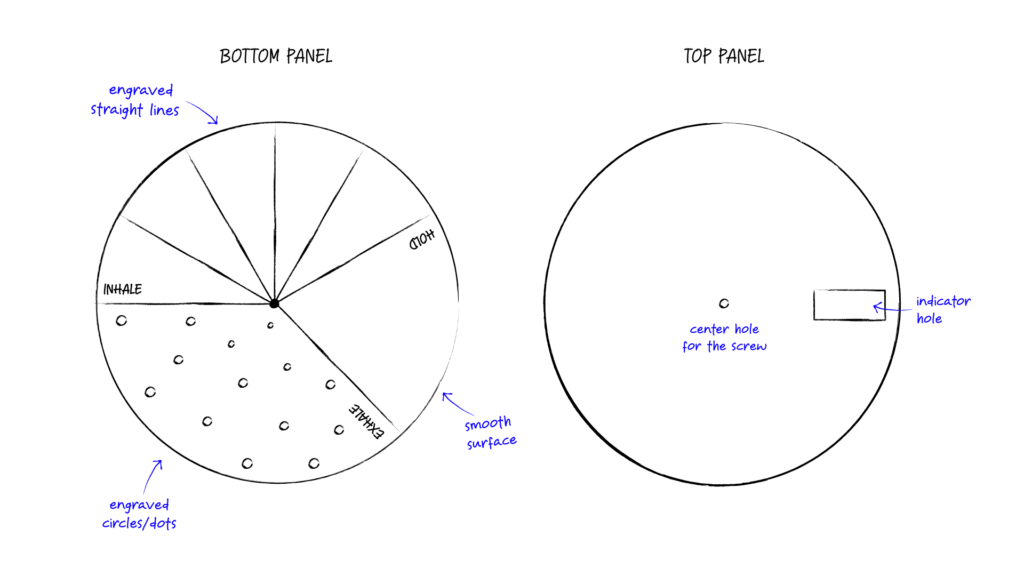
Turning Breath into Form

I wanted each part of the breathing process to feel different, so that people don’t have to think about what comes next, they can simply follow the texture with their fingers and focus on their breath. Since the prototype will be laser-cut, I chose engraved textures over raised ones. The engraved patterns are subtle but distinct, providing just enough tactile guidance without being distracting or overstimulating.

The Three Phases of Breath
  1. INHALE – Straight Lines – Why? Inhaling feels like steadily drawing in air, filling the lungs. The lines guide the fingers steadily inward, like gathering energy.
  2. HOLD – Smooth / Flat – Why? Holding the breath is a still moment. By removing texture, I’m reinforcing that pause, offering tactile neutrality to match the emotional neutrality of holding.
  3. EXHALE – Engraved Dots – Why? Exhaling is about release. The dotted texture creates a gentle sense of dispersal, like bubbles or soft particles letting go.
Proportions of the Circle

2/5 inhale, 1/5 hold, 2/5 exhale – Why? This ratio reflects a calming breathing rhythm, with enough space for a longer exhale to naturally relax the body.

Other Functional Details
  • Center hole for screwing together both plates, allowing rotation.
  • Indicator hole to show which breathing phase you’re currently on (“inhale,” “hold,” or “exhale”).
  • Text engravings to match, visible through the moving layer, guiding the flow.

Why Analog? Why This?

Screens offer too much speed. This small, analog tool offers something different: focus through simplicity. For me, this isn’t just a prototype, it’s a way to answer a frustration I’ve experienced myself: forgetting to breathe properly in stressful, digital spaces. Making this helps turn that small frustration into a thoughtful pause.

Next, I’ll bring this sketch into reality through laser cutting, testing proportions and feel. In the following blogposts, I’ll reflect on that process, and eventually create a video that brings the whole journey together.

#11 Prototyping – Trial and Error

Prototyping Multisensory Data – From Spaghetti Mountains to Shadowed Insights

The task was to create three quick lo-fi prototypes related to our Master’s research—ideally 5–10 minutes each, with a maximum of 20. The goal was to sketch out ideas, test tangible concepts, and move away from screen-based representations. I managed to create two prototypes. Neither went exactly as planned—but both taught me something valuable.


Prototype #1 – The Spaghetti Schlossberg

For this prototype, I attempted to reconstruct the topography of Graz’s Schlossberg using spaghetti. I had a map with Höhenlinien (contour lines) and snapped pieces of spaghetti to match the elevation levels. The plan was to poke them through holes in a cardboard base to create a physical, touchable model of the hill.

The idea:

To offer a tactile experience of elevation, allowing users to feel the form of the mountain. My long-term vision included vibration feedback: depending on which level the user touches, the surface could respond with different intensities or patterns of vibration—giving sensory feedback about height, slope, or perhaps historical or environmental data.

What didn’t work:

  • The holes had to be the exact right size—too big, and the spaghetti would fall through; too small, and it would snap trying to insert it.
  • The spaghetti broke. A lot.
  • I only managed about half the model before deciding to stop.

What I learned:

  • Spaghetti is a fragile material—not ideal for tactile prototyping.
  • Still, the concept of a vibrotactile elevation model is worth pursuing, maybe with more durable materials like wires, foam, or layered acrylic.
  • There’s something powerful about physically feeling data—especially when it’s enhanced with feedback.

Prototype #2 – The Cardboard Box of Shadows

This idea was more experimental. I took a cardboard box, cut one side open, and inserted a slot for sliding a sheet of paper inside. I placed a light behind it, allowing shadows to appear on the back wall of the box.

The idea:

To explore how data can be made visible through shadows—revealing patterns not through direct representation, but through effect and contrast. Initially abstract, the idea grew into something more tactile and layered.

I then thought: what if you could slide two pieces of paper inside the box—each with different shapes, data patterns, or cutouts? Their overlapping shadows would form a dynamic visual, representing the interaction between two datasets.

What this could evolve into:

  • A lo-fi ambient display where the position and layering of paper affects the final output.
  • A metaphor for data complexity—how meaning emerges not from a single source, but from relationships, intersections, and light.

What I learned:

  • Sometimes we build without a clear purpose, and ideas emerge through doing.
  • Light and layering can be compelling tools in multisensory data design—especially when paired with motion, tactility, or time-based changes.

Reflections

These fast prototypes pushed me to translate data into form—without overthinking or refining too early. Both attempts reminded me that multisensory design is not about perfection—it’s about perception. What does data feel like? Sound like? Look like when it hides, flickers, or resists being seen?

Even though I didn’t finish all three, I left with two ideas I might revisit, refine, or completely rethink—successes in their own right.