What are Fourth Spaces?

After discussing the concept of third places (informal gathering spots like cafes, libraries, and parks) I would now like to shine light on a relatively new idea that has emerged in the recent years: fourth spaces. While third places serve as a “home away from home,” fourth spaces are (depending on the definition) a response to the increasing blurring of physical and digital boundaries in our lives. They go beyond the physicality of third places, incorporating hybrid, inclusive, and adaptive elements to address the evolving ways people connect and build community today. But what exactly are fourth spaces, and how can they shape a sense of belonging?

Definition
Like with loneliness and Third Places there isn’t one single definition for fourth spaces. Some interpretations focus on the physical world and informal interactions in places that are undefined, similar to third places, while others place more emphasis on the digital world [3] and how it interacts with physical spaces. Fourth spaces can be seen as in-between places, blending traditional environments with digital layers. Not all definitions consider the digital aspect in the same way, but all highlight the role of these spaces in fostering spontaneous, casual connections that contribute to shared public life. [1, 2]
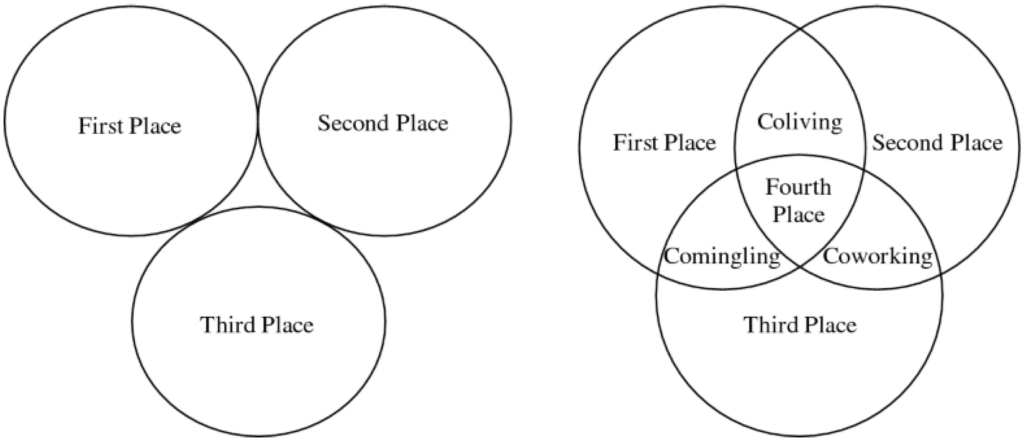
Fouth Places as the “in-between” [3]
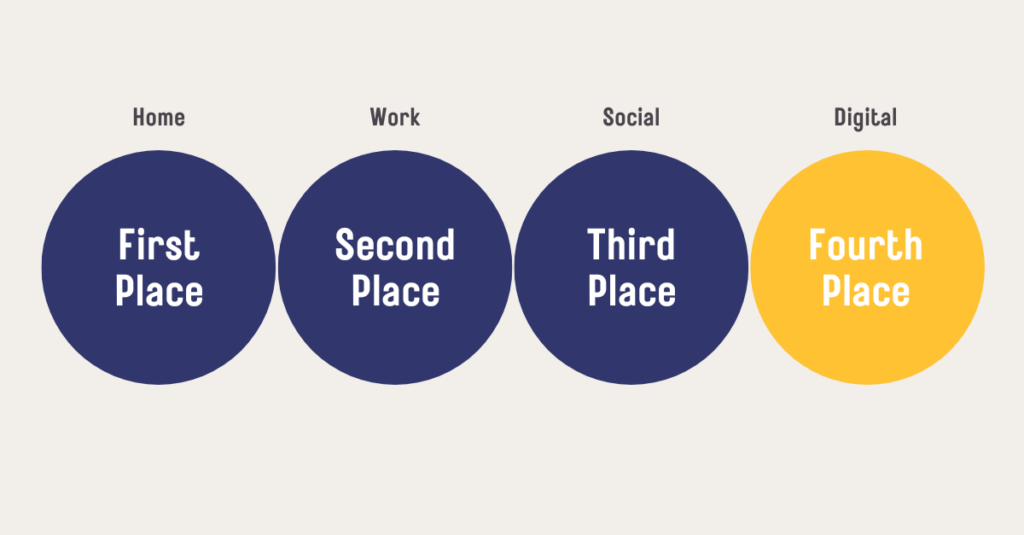
Fourth Spaces as the digital realm [5]

Fourth spaces can counteract the impersonal aspects of “non-places” by embracing in-betweenness and publicness in their design. These spaces often include open, diverse layouts that are intentionally flexible, allowing people to adapt them for various uses that encourage spontaneous interactions.

Novel typologies – new forms of spatial design

Fourth space frameworks blend elements from traditional public spaces with modern innovations, such as integrating green spaces into urban environments or combining digital and physical interactions. In the context of fourth spaces, typology focuses on creating new forms of environments that encourage interaction, creativity, and adaptability to meet modern societal needs. These strategies ensure inclusivity and dynamic social interactions, creating environments where diverse individuals can connect and feel a sense of shared experience. By doing so, fourth spaces move beyond sterile functionality, fostering creativity, community, and belonging. [3]

An example approach to actively creating a fourth space is a project called „The Commons“. It is described as: „A modern-day town square for communal meaning-making, personal discovery, and self-expression in the heart of San Francisco.“ This concept focuses mostly on creating a place that is versatile and open in its functionality and can become whatever it needs to be at any given time. So in reference to the earlier definition, this is less an approach of combining digital and real world places, and follows more the idea of in-between places and meaning-making. They themselves define Fourth spaces as follows: „A physical space that facilitates meaning-making through intentional programming and pluralistic discussion, where individuals explore questions of ultimate concern without seeking conclusive answers. It honors the authenticity and uniqueness of each person’s path while fostering deeper bonds through consistent encounters in a supportive holding environment.“ [4]

Designing Fourth spaces is not an easy task, since it is quite hard to grasp what exactly fourth places are and how they fit into our lives. In terms of digital Fourth spaces the concept is just now emerging and changing constantly. It is important to clearly define the Fourth space in order to utilize it for designing in the context of loneliness. Is a fourth space an in-between place with unlimited potential that needs to be programmed and directed? Or is it the digital world that has emerged in the past few years? And if so, do we integrate it into the real world and try to find ways to combine the two? Or is it maybe even those places where the two meet?


Sources

  1. P. S. Aelbrecht, “‘Fourth places’: the contemporary public settings for informal social interaction among strangers,” Journal of Urban Design, vol. 21, no. 1, pp. 124–152, Jan. 2016, doi: 10.1080/13574809.2015.1106920.
  2. “The fourth place and re-imagining the city | Urbanarium.” https://urbanarium.org/journal/fourth-place-and-re-imagining-city
  3. D. Hardegger, “A First Holistic ‘4th Space’ Concept,” Mdpi, p. 72, Mar. 2022, doi: 10.3390/proceedings2022081072.
  4. “The Commons” https://www.thesfcommons.com/
  5. T. Masuku, “The fourth place,” Showit Blog, Jun. 15, 2024. https://ticamasuku.com/the-fourth-place/

Loneliness as a human experience

Having already defined and analyzed loneliness I will now take a phenomenological approach in order to gain a more rounded and holistic understanding of the concept. This means looking at the actual experience of what it means, feels and looks like for individuals to be lonely.
This can mean asking how loneliness is experienced physically, how it shapes our experience of time and sense of space, how it affects our relationships with others, our attitude towards other experiences or how loneliness is approached in general (negatively or positively).

Barbara Schellhammer initially sees loneliness as a structural problem and criticizes measures such as the ministry of loneliness as an approach against the loneliness epidemic. They simply treat a symptom, however the fundamental problem and one of the the origins of society’s increasing loneliness lies primarily in the fact that in recent years politicians have cut back on the funding of communal spaces that are essential for community and connection (more on this in Post 5 on Third Places). It raises the question of which loneliness should be addressed at all and clearly shows how loneliness can be a completely different experience for different people in different scenarios: From the lonely senior citizen who is only cared for by robots, to single households who almost exclusively virtually search the internet for a partner or the homeless, uprooted refugee separated from their family [1].

Nicht-Orte (Non-Places)
“Loneliness never exists in itself, but only for someone who experiences it in a very unique way. It results from a history that extends far beyond one’s own, it is rooted in lived time, in specific cultural structures and nests itself stubbornly in certain places” [1]

„[The] weakening of the identity of places to the point where they not only look alike but feel alike and offer the same bland possibilities for experience“ – Edward Relph

The phenomenon of non-places was first described by Marc Augé and describes places, especially in urban areas, that are used monofunctionally (train stations, airports, shopping centers), which is in stark contrast to traditional anthropological places that are full of culture, history, identity, communication and relation [see also: Heterotopia – places with predetermined experience that are restrictive in experience and access, such as retirement homes or hospitals]. These places are often characterized by a functionality that does not promote social contact or interpersonal interaction. They offer little space for the development of individual identity or for genuine connections between people. One reason why non-places are associated with loneliness lies in their temporary and functional nature. They are designed to be transit places where people generally only stay for a short time. This fast-paced, anonymous atmosphere can reinforce feelings of isolation [2]. As a counterpart to this, there is the idea of „in-between places“ (Zwischenorte) that promote community and open up spaces for encounters. The aim is to create spaces that promote openness, dialog and emotional contact, something that is often lost in everyday life [1,4].

Loneliness as a negative experience
Loneliness is often perceived as strange, wrong, shameful, or even taboo. Society frequently associates it with lower status or a personal deficit, creating pressure to avoid being alone. Many feel the need to justify their solitude with excuses like being unwell or having work, as if simply choosing to be alone is unacceptable. This societal stigma stems from deeply ingrained childhood experiences and cultural norms, making it difficult for some to embrace solitude. It’s not just being alone but feeling unwanted, forgotten, or unnecessary, especially by those you value most and often rooted in rejection, exclusion, or abandonment. This form of loneliness is defined by the loss of connections, a longing for companionship, and a sense of invisibility or lack of place. It can have an affect on both mind and body, leading to stress, discomfort, or unhealthy coping mechanisms.
When feeling unseen or misunderstood, loneliness can even occur when surrounded by other people.This can mean feeling isolated in social settings like parties due to superficial interactions or feeling lonely in a close relationship when feeling overlooked or unappreciated, leading to emotional invisibility. Also feeling isolated due to differences like disability, lifestyle, or personal choices can make a person feel lonely. In all cases, loneliness arises from a lack of emotional connection and the pain of feeling unseen or misunderstood, emphasizing the importance of being acknowledged and valued by others. [3]

However, loneliness does not have to be negative – it can even be appreciated or seen as positive when separated from these harmful views.

Loneliness as a positive experience
Loneliness, when chosen or voluntary, can be a source of rest, creativity, and serenity. Unlike painful loneliness, this form is experienced as harmonious, calming, and even empowering. It allows one to connect with oneself, recharge, and reflect. While virtual interactions can reduce feelings of isolation, they lack the embodied richness of real-life interactions. Occupations like reading, crafting, or listening to music can also transform loneliness into a meaningful experience. This positive form of loneliness requires personal strength and the ability to face oneself. 

Over time, one can develop an appreciation for solitude, realizing it is not a sign of inadequacy but a way to connect more deeply with oneself and even enhance future social interactions, as long as you connect with something in some way. [3] The contrast and balance between solitude and connection enhance both: those who embrace solitude can connect openly with others, and healthy relationships enable solitude to become a source of strength and inspiration [1].


Sources

  1. B. Schnellhammer, “Eine phänomenologische Annäherung an die Erfahrung der Einsamkeit”, April 2020, https://www.researchgate.net/publication/340502352_Eine_phanomenologische_Annaherung_an_die_Erfahrung_der_Einsamkeit
  2. M. Augé “Orte und Nicht-Orte”, https://swiki.hfbk-hamburg.de/Medienoekologie/uploads/auge-ortenichtorte.pdf
  3. K. Dahlberg, “The enigmatic phenomenon of loneliness”, July 2009, https://www.researchgate.net/publication/232058607_The_enigmatic_phenomenon_of_loneliness
  4. H. Rosa, “Resonanz”, https://books.google.at/books?hl=en&lr=&id=MUeWCwAAQBAJ&oi=fnd&pg=PT3&dq=soziologie+der+weltbeziehung&ots=zNQRoPz929&sig=mbBXxjo9zRRTtzeJy4XLK5h8Ho0&redir_esc=y#v=onepage&q=soziologie%20der%20weltbeziehung&f=false