In this post, I’m documenting my first hands-on test with the Touch Board by Bare Conductive. After choosing it for its built-in capacitive touch sensors and MP3 playback, I wanted to validate whether this microcontroller could support the kind of screen-free, tactile storytelling I’m imagining, where visitors trigger audio simply by touching a point on a surface.
The Touch Board is basically an Arduino-compatible microcontroller designed for sound-based interactions.
It comes with:
- 12 capacitive touch electrodes (E0-E11)
- Built-in microSD card slot for MP3s
- Audio jack and speaker terminal
- Micro-USB for power and programming
What I Used
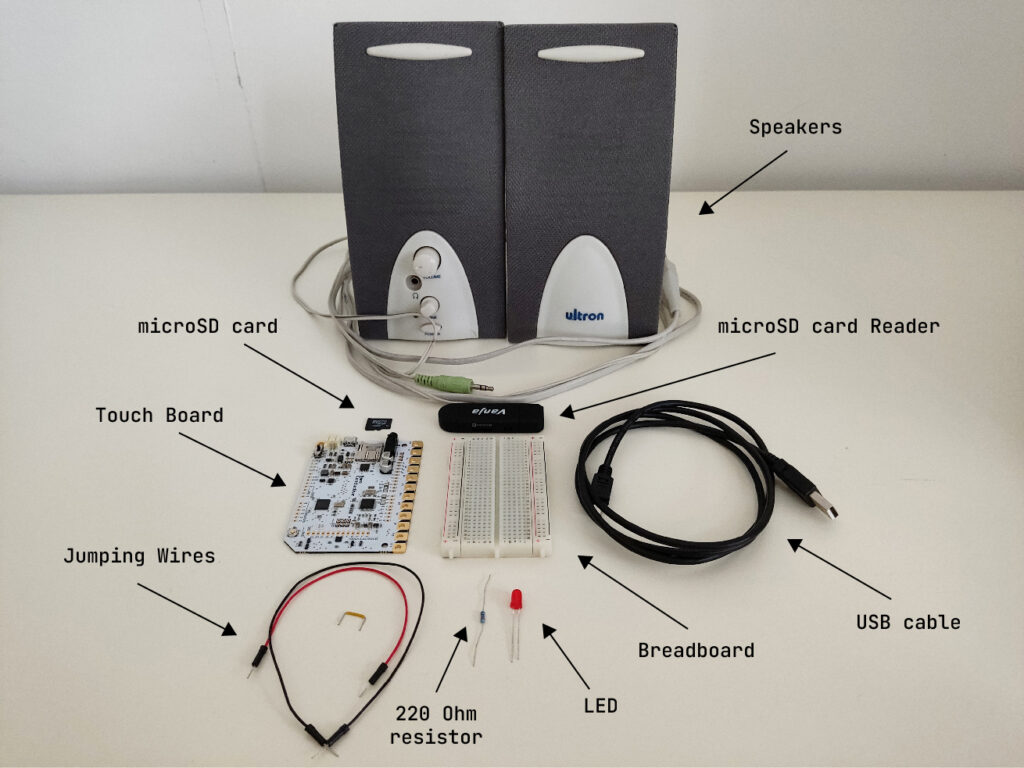
- 1x Touch Board
- 1x microSD card
- 1x microSD card reader
- 1x Speaker
- 1x USB cable (for power and code upload)
- 1x LED (for basic feedback)
- 1x 220 Ohm resistor
- 1x Breadboard
- 3x Jumping Wires
- Bare Conductive’s “Touch MP3 with LEDs” example code
Basic Wiring
The Touch Board’s default “Touch MP3” code links each of the 12 electrodes (E0-E11) to a corresponding MP3 file on the microSD card. When you touch an electrode, it plays the matching audio clip.
To make the interaction more multisensory and responsive, I added a simple LED feedback: when a sound plays, the LED lights up.
Here’s how I wired it:
- Connected Touch Board’s GND to the breadboard’s ground rail using a jumper wire.
- Placed a red LED on the breadboard.
- Connected the long leg (anode) of the LED to a 220Ω resistor.
- Connected the short leg (cathode) to the breadboard’s ground rail using a jumper wire.
- Connected the other end of the resistor to one of the Touch Board’s pins using a jumper wire.
For more detailed instructions, check out this helpful tutorial: https://www.instructables.com/Touch-Board-and-LEDs/

First Test
Touching one of the electrodes triggered a short sound from the speaker. At the same time, the LED lit up, confirming that the interaction was happening.
Here’s a short video testing this simple interaction.
Observations
- Responsiveness: Very fast, almost too sensitive. Occasionally triggered by nearby touches or objects.
- Satisfaction: The sound + light combo made the interaction feel clear and complete.
- Compactness: Everything fit neatly on one board. No need for additional modules at this stage.
Next Steps
For wrapping up this lo-fi prototype, I will:
- Add more electrodes and connect multiple LEDs
- Try using conductive ink or custom-designed graphics as touchpoints
- Test a portable setup powered by a USB power bank
- Design audio content that reflects unusual or hidden stories from Graz
Reflections
This first test confirmed that the Touch Board is a great fit for early-stage, lo-fi prototyping. It’s easy to set up, intuitive to work with, and lets me focus on designing interactions, not just solving hardware problems. More importantly, it opened up space for experimenting with storytelling, mapping emotion, sound, and place onto physical interaction. I’m excited to continue developing this idea and exploring how each touchpoint might reveal a different layer of the city.