When I look back at Vertigo, the project that took place as part of the Klanglicht Festival in Graz, I don’t just remember the long working days and tight deadlines, but I remember the feeling of being part of something real. Together with a Elisabeth Seiler, I had the opportunity to develop the corporate identity for Vertigo, the sound and visual project by Media, Sound and Interactiondesign realized inside the St. Antonius Church.
Real project – real deadlines
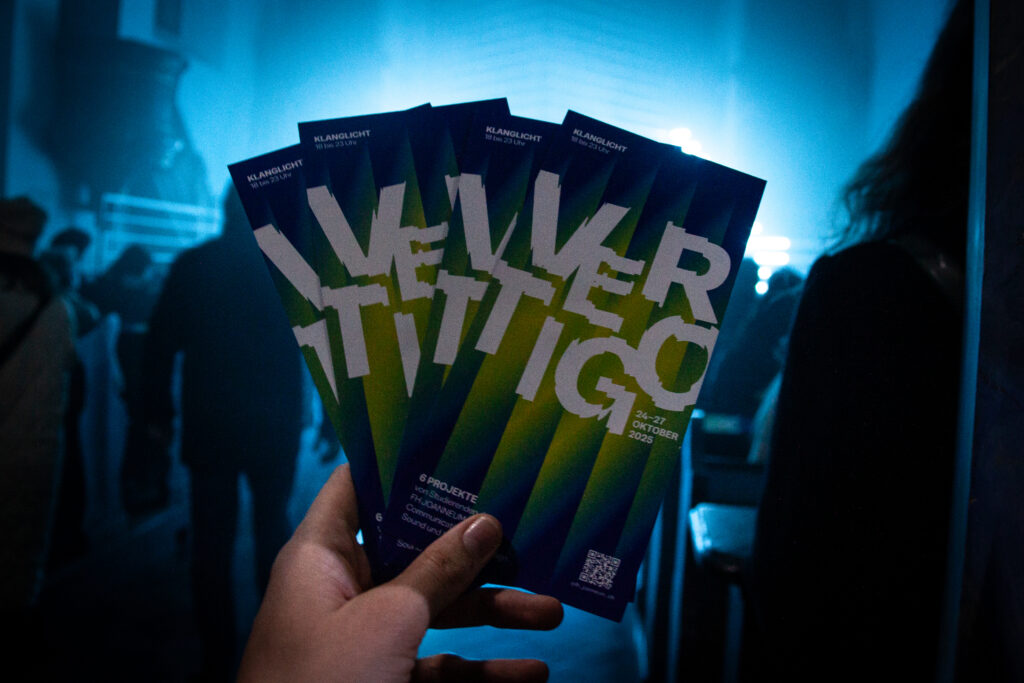
The special thing at this project was, that it wasn’t a classroom simulation. It was part of Klanglicht, a real festival with real deadlines and an actual audience. And perfectly suited as portfolio work. We were responsible for everything related to visual communication like:
- Branding and logo design
- Posters, flyers, and stickers
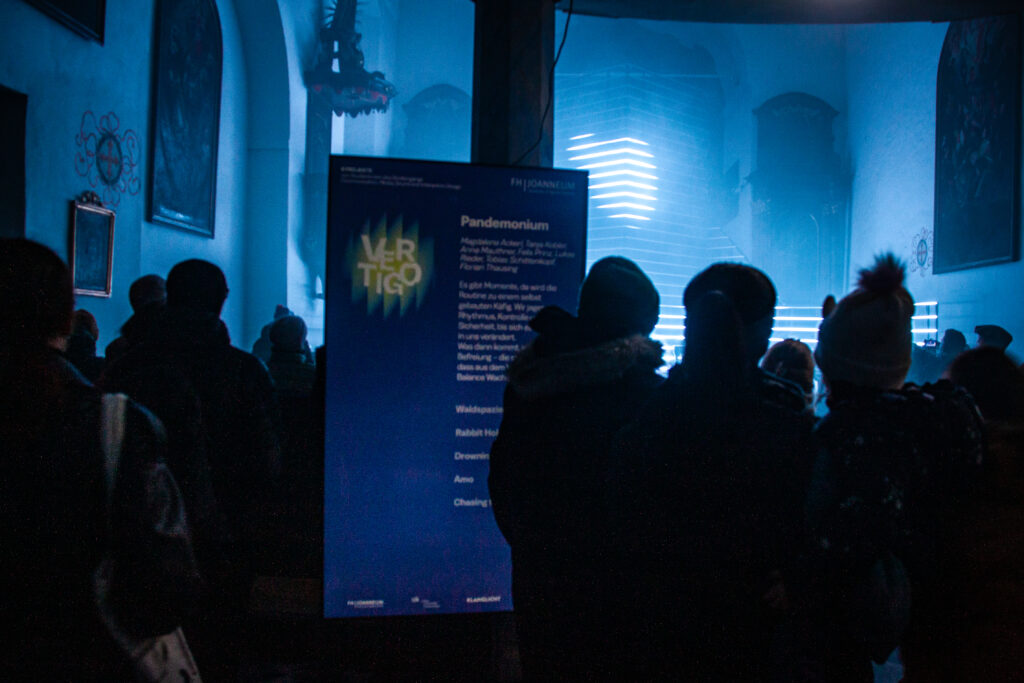
- Wayfinding banner for the exhibition space
- Screen animations for digital displays (in collaboration)
- and social media content to promote the event.
The scope was huge and challenging but also incredibly valuable. It was very imporant that the design not just look “good”, but also work: it had to be recognizable, consistent, and evoke the right atmosphere while fitting into the overall Klanglicht visual world.
Atmosphere and concept
The theme Vertigo – meaning dizziness, disorientation, the play with perception and space – was something we wanted to make tangible through our design. We tried to translate this feeling visually: through sharp forms, splinter effect, and imbalances in composition. The effect, as well as the bright colors used, should also visualize the students’ project.
When we finally saw the finished exhibition in the St. Antonius Church, it was fascinating to experience how sound, light, space, and design all came together. Each installation had its own language, yet everything was connected through the shared theme.

Our Work Phase
At the beginning, we actually started with a completely different concept than the one we eventually realized. Our first idea was to work with 3D particles, animate them, and use the resulting visuals as the basis for our posters. However, it quickly became clear that the time we had was far too short for that approach. Both technically and conceptually, we just weren’t making enough progress. Looking back, I’m actually glad we decided to let that idea go, because the concept that followed fit the project so much better and felt much more authentic to both of us.
We began experimenting with splinter effects in After Effects, testing out countless colors and shapes until we found a visual language that captured the feeling of Vertigo. From there, we created the brandmark using the same visual effect and animated it to form the foundation of our entire corporate design.
Once that core was established, we moved on to the layout for posters and flyers, which had top priority. In between, we had several feedback sessions, where we refined details and adjusted compositions. After receiving final approval, everything had to move fast – printing deadlines were approaching and we only had a few days left. At the same time, we worked on banners, wayfinding elements, and animated content for social media. Toward the end, we also designed the screen visuals, which were later animated by Roman.
Finally came the setup phase. We painted the poster stands ourselves, which turned out to be a lot more work than expected, and spent the day before the festival installing everything around the church. Seeing all the printed materials in place and how they transformed the space into an exhibition atmosphere was incredibly rewarding. It was the moment when all our work finally came to life.

What I took away from this project
Even though Vertigo isn’t directly related to my planned master’s thesis, this project was very important to me. Working on it showed me how crucial a well-thought-out concept is, one that is backed by a clear idea and attitude. Working on a real project was challenging, but also extremely educational. We had to react quickly, find solutions, and still remain consistent in our design. An experience that gave me a lot of confidence.
Since I probably want to use animations in my master’s thesis, Vertigo was particularly valuable in this regard. We worked intensively with After Effects, and I was able to learn a lot, technical know-how, but also a better understanding of how movement can enhance mood and meaning. This knowledge will be enormously helpful for my future project work.
This project was a step toward professional practice, and at the same time, a creative experience that helped me grow as a designer. The process was intense and sometimes stressful, as we had very little time and the communication channels were often quite spontaneous and unstructured. Nevertheless, it was an incredibly rewarding experience, and we’re genuinely proud of the final result.
