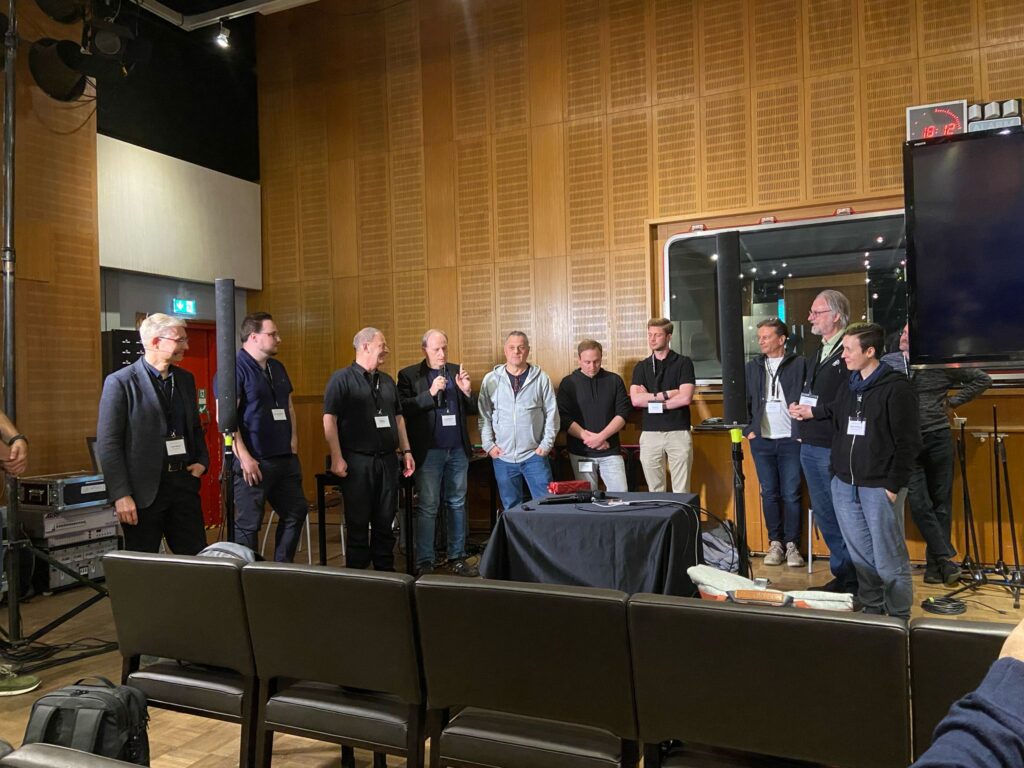
At the end of april, i had the opportunity to attend and participate in Lasse Nipkow’s 3D audio seminar. This seminar was held at the ORF Funkhaus in vienna and many important guests from the industry were invited. At the end of the last day of the seminar, all speakers were asked to talk briefly about the future of 3D audio. These were the most important findings of this discussion:
“Who’s Gonna Pay for This?” – Dietz Tinhof
Dietz Tinhof tackled the uncomfortable question of financing 3D audio head-on. He stressed that creators and innovators in the field rarely see financial returns for their work, while platforms and labels profit. “We’re at the forefront of a development where others will reap the rewards, not us,” he said, pointing out the lack of rights or credits for audio engineers compared to other creative roles like cinematographers. He called for collective action to demand recognition and fair compensation, arguing that immersive audio’s artistic and technical value should translate into tangible benefits for its creators. “Ton wächst nicht auf Bäumen—it’s our labor, our ideas. We can’t keep giving it away for free.”
Lasse Nipkow proposed in this context that we should focus on 3D audio in luxury settings (e.g., spas, luxury hotels).
Tom Ammermann continued by emphasizing the need for better binaural mixes, noting significant room for improvement. He highlighted the growing role of 3D audio in live installations and households, urging producers to prioritize quality to shift perceptions from “it wasn’t bad” to genuine enthusiasm. He envisioned 3D audio becoming “the new stereo” if the industry collectively pushes for higher standards.
Michael A. Bühlmann added that while technical formats like mono, stereo, or 3D are packaging, the artistic vision must remain uncompromised. Roger Baltensperger stressed the importance of mastering workflows and quality control, advocating for the same rigor applied to stereo to unlock 3D’s full potential.
Sebastian Oeynhausen (Pan Acoustics) thanked the community for its welcoming atmosphere and noted the divergence between home and industrial applications, urging manufacturers to develop specialized hardware. He also praised tools like Graves 3D for animating audio objects in DAWs.
Katharina Pollack, representing the scientific angle, underscored the importance of foundational research and artistic-technical synergy. She predicted a binaural-dominated future, citing widespread headphone use and innovative applications like Dreamwaves’ navigation systems for the visually impaired.
Karlheinz Brandenburg reflected on 25 years of binaural and speaker-based audio, celebrating its resurgence but cautioning that home-listening standards (e.g., proper headphones for spatial audio) are still evolving. He dismissed the idea that standard headphones or YouTube could deliver true spatial experiences.
“Good Content Survives Mono Underwater”
Florian Camerer blended humor and skepticism, toasting to “mono beer, stereo schnitzel, and immersive fever dreams.” But his real focus was broadcast’s inertia. While public broadcasters like ORF led the 5.1 revolution, immersive audio remains stuck in limbo. “Everyone’s waiting for someone else to jump first—the BBC, the French, the Germans.” He criticized recycled debates over basics like center channels and LFE, calling it “déjà vu from the 5.1 era.” Yet he ended on optimism: immersive audio, unlike 5.1, might survive because of its artistic potential.
Benedikt Ernst, the youngest in the room, brought a hopeful counterpoint. With “youthful recklessness,” he argued that engaging more creatives could unlock both artistic and economic potential. “If we get artists on board—not just as passive recipients but as active participants—the content will improve, and the money might follow.” He acknowledged the uphill battle but emphasized the need to bridge the gap between technical possibilities and creative buy-in.
Lenni Damann grounded the discussion in reality, citing Spotify’s influence as a make-or-break factor. “Labels ask: Why invest in 3D if our artists have 3 million monthly listeners on Spotify but only 95,000 on Apple Music?” He hinted at industry rumors about Spotify’s potential spatial-audio rollout, which could tip the scales. “If the biggest platform pushes it, suddenly the ‘why’ becomes obvious.”
Closing Words: “The Battle for Quality and Perception”
Dietz Tinhof circled back to dual challenges: production and perception. On one side, clients treat 3D as a marketing afterthought, demanding “stems-based pricing” that sacrifices quality. On the other, end-users hear compressed, downgraded versions of meticulously crafted mixes. “We’re stuck between clients who say we’re not making money and listeners who say we don’t hear the difference.” His rallying cry? Fight for immersive audio as its own art form—not just “stereo with extra steps.” Tom Ammermann and Michael Bühlmann echoed this, sharing stories of artists who dismissed 3D until they experienced it firsthand. The takeaway: Education, advocacy, and unflinching quality are the keys to 3D’s future.
Lasse Nipkow closed with a nod to collaboration, inviting attendees to the next Tonmeistertagung. The room’s consensus was clear: 3D audio’s potential is undeniable, but realizing it demands creativity, persistence, and a fair share for those building it.
