As designers we are usually taught to make things smooth and frictionless. We want the user experience to be easy. But in storytelling friction is everything. If everything makes sense and everyone is happy you have a boring movie. I have been researching a concept called Cognitive Dissonance to help structure my screenplay. It was developed by the psychologist Leon Festinger in the 1950s and it describes the mental discomfort we feel when we hold two conflicting beliefs or values at the same time. Festinger found that humans have a powerful inner drive to hold all our attitudes and beliefs in harmony. When there is inconsistency, or “dissonance,” we feel psychological stress and are motivated to reduce it, often by changing our beliefs or justifying our actions to make them fit.
Humans hate this feeling. We will do anything to get rid of it. If we smoke cigarettes but we know smoking kills we have dissonance. To fix it we either quit smoking or we convince ourselves that the science is wrong. We change our reality to stop the pain.
In film narrative this theory is incredibly potent. Dissonance creates a gap that the audience desperately wants to close. There is a related concept called the “Expectancy Violation Theory” by Judee Burgoon which says that when someone behaves in a way that violates our social expectations it triggers arousal and forces us to pay closer attention. We stop operating on autopilot and start analyzing the situation to understand why the norm was broken.
In my film I am creating a massive cognitive dissonance for the audience and for the main character. The premise itself is a contradiction. The protagonist is a teacher of “Political Education.” Her job is to explain the Austrian constitution and the importance of voting to teenagers. She is the voice of the state. She represents the system. But at the same time she is not a citizen. She cannot vote. The state that she represents does not represent her.
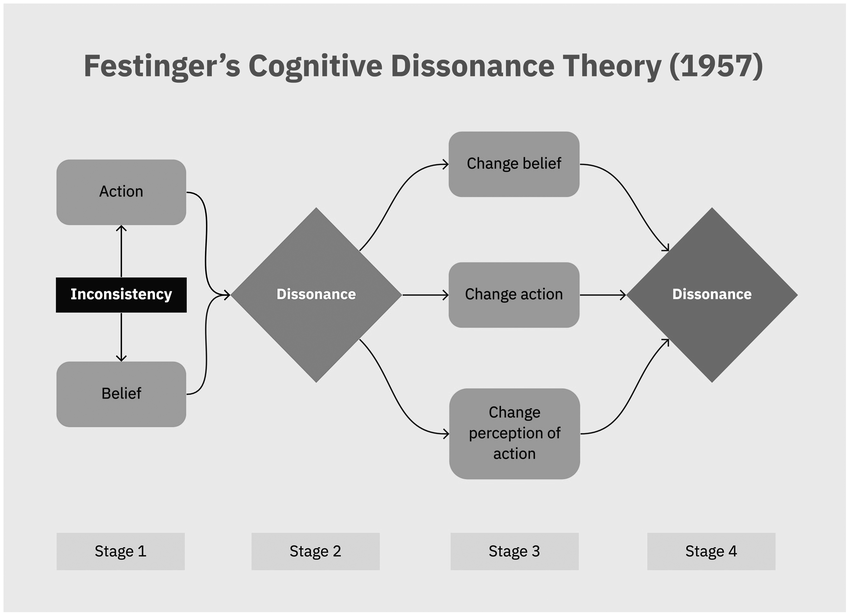
This creates a tension that vibrates through every scene. Imagine a scene where she is grading a student’s test about democracy. The student failed the test but can vote because he is 16 and Austrian. She aced the test because she is the teacher but she cannot vote. This is illogical. It hurts the brain to think about it. That mental pain is what keeps the viewer engaged. They want to resolve this glitch. They want the world to make sense again.
I am also using this to play with the character’s internal psychology. Festinger says we often reduce dissonance by lying to ourselves. My character is doing exactly that. She tells herself that if she just works hard enough and speaks German well enough she will belong. She is performing “Austrian-ness” perfectly to reduce the dissonance between her life here and her legal status. But the reality keeps hitting her in the face. This makes her an “unreliable narrator” not because she is malicious but because she is in denial. She is trying to protect her own sanity.
We can even see this dissonance in how audiences might react to her. Research on “Intersectional Invisibility” shows that Black women often don’t fit the standard prototypes for race or gender which makes them “invisible” or confusing to observers. By placing a Black woman in a position of high authority (a Gymnasium teacher) I am creating a visual dissonance for the audience. I am violating their expectations. According to the theory this should make them pay more attention to her but it might also make them uncomfortable. My goal is to lean into that discomfort rather than smooth it over. I want the audience to feel the same friction that she feels every day. It is not just a story about a sad situation, it is a psychological experiment in empathy through dissonance.
Festinger, L. (1957). A theory of cognitive dissonance. Stanford University Press.
Festinger, L., & Carlsmith, J. M. (1959). Cognitive consequences of forced compliance. The Journal of Abnormal and Social Psychology, 58(2), 203–210. https://doi.org/10.1037/h0041593
