When think about how often we interact with services it really is shocking how poorly designed a lot of them are. Good service design, a book by Lou Downe, the former Director of Design for the UK Government. She was involved with the design https://www.gov.uk/. In her book, Downe gives a guideline of 15 points of what to look out for when designing a service.
What is a service?
Short answer: A service helps us do something we want to do
A service can range from something as tiny as buying a bottle of water to something huge like registering to get married. What makes a service a service is that it combines multiple organizations into one (hopefully) seamless experience for the user to get to their desired goal.
The 15 principles for good service design
- They have to be easy to find
- Clearly explain its purpose
- Set a user’s expectations of the service
- Enable each user to complete the outcome they set out to do
- Work in a way thats familiar
- Require no prior knowledge to use
- Be agnostic of organizational structures
- Require the minimum possible steps to complete
- Be consistent throughout
- Have no dead ends
- Be usable by everyone, equally
- Encourage the right behaviours from users and service providers
- Quickly respond to chage
- Clearly explain why a descision is made
- Make it easy to get human assistance
I haven’t read the entire book yet but I would like to point out what really stuck with me and that I want to focus on in my thesis.
In chapter 7 Be agnostic of organizational structures, Downe mentions that it is vital to a service must not show the hidden structures of the organizations it’s combining. She uses the term “siloed” a lot, which basically means that parts of organistations are isolated so much and don’t share data efficiently between each other. It’s less collaboration and more work for the user. I think this is extremely true for health care in Austria because the transfer of data and knowledge relies on so many different tools that it’s confusing and overwhelming to deal with.
Downe believes that the sub-organizations need to agree on a common goal in order to work together seamlessly. Once this foundation is set it can help to create a permissive environment for collaboration.
I really enjoy how effectively this book conveys the most important aspects of service design and I’m sure it will provide lots of guidance when writing my thesis.
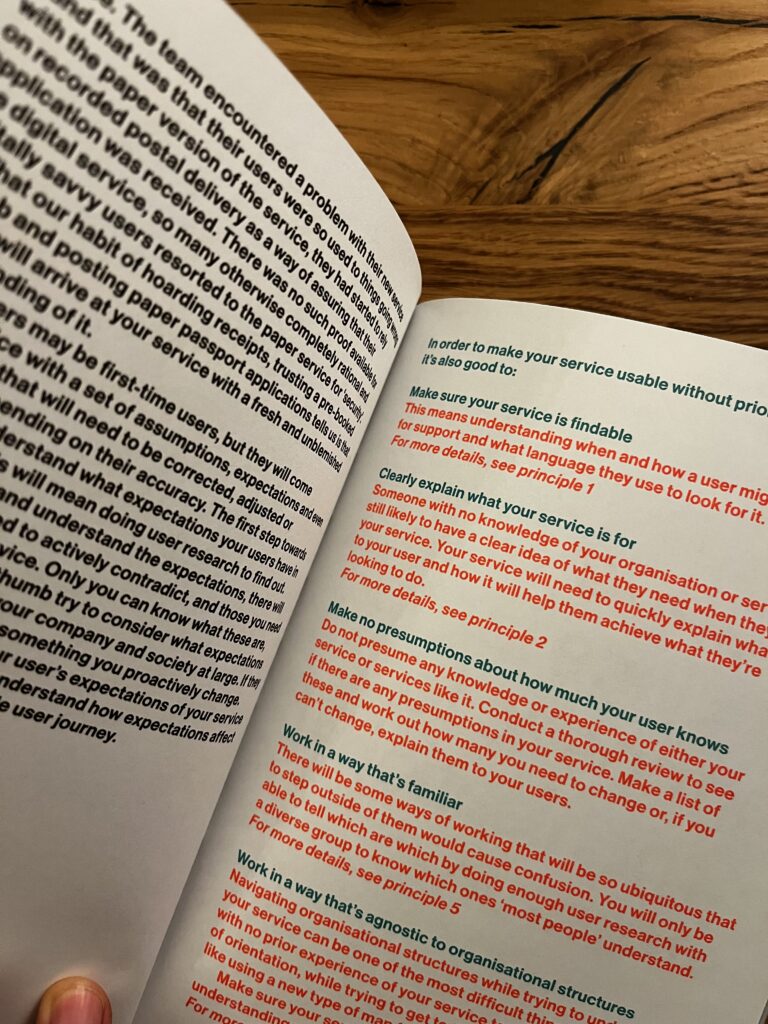
Random side note: Even though the overall design of this book is really pleasing I was extremely irritated by the bold font they used for the body text. This is not relevant to the content but it’s something that bothered and reminded me of the importance of visual hierarchy once again.
Link to the book: https://good.services/home
No AI was used to write this blog post
