For my third impulse, I watched the podcast episode “The Role of AI in Electric Vehicle Charging” with Diego Pareschi from ABB E-mobility. It was my first time listening to someone who actually designs global charging products, not just talking from theory. This felt very relevant for my Master thesis about the User Experience of EV charging, because he connected UX, AI and business in a very clear way.
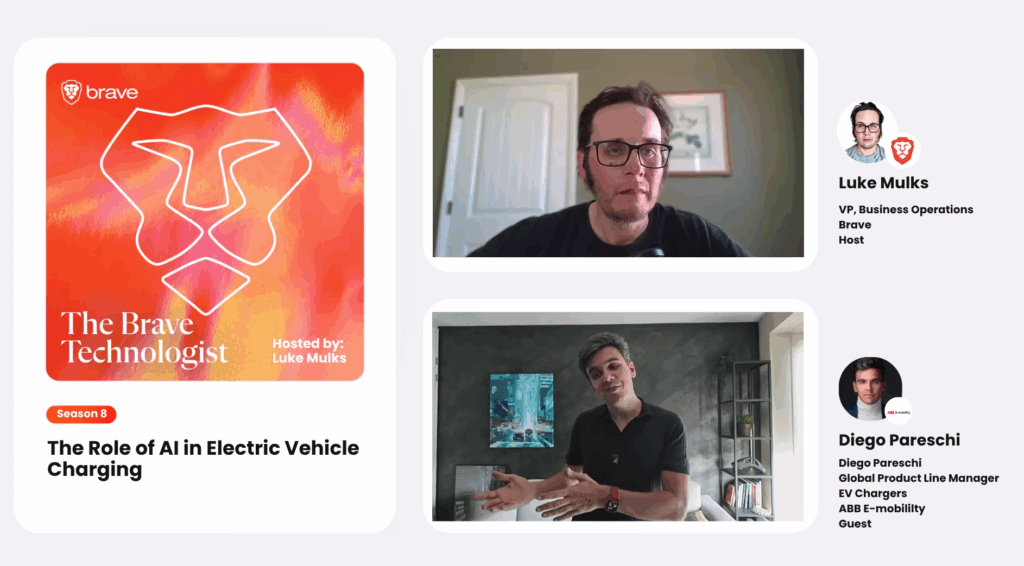
Diego started by saying that EV charging is still not easy and not frictionless. There is so much to optimize in user experience, energy efficiency and software. This confirmed something I already felt: the problems are not only technical, but also human. People are confused, frustrated or anxious when charging. For my research, this is an important starting point: I am not just designing a nicer interface, I am working in a system that still has a lot of friction.
He explained the key problems step by step. First, location: drivers often have trouble just finding where a charger is. Second, reliability: will the charger actually work when I arrive? Third, compatibility: does this station work with my specific car and plug? Then waiting times and payment: how long do I need to charge and how can I pay (app, subscription, credit card)? I realised that my own interviews and surveys must cover exactly these pain points. If I ignore one of them, my picture of the user experience will not be complete.
The discussion about standards was also interesting. There are different plugs and standards around the world (CCS1, CCS2, etc.), and then Tesla introduced NACS. Diego compared it to USB and USB-C. For users, this means less cognitive load if the plugs are more standardised. This connects directly to interaction design: the fewer decisions the user has to make before charging, the better. In my thesis I can link physical standardisation (plugs) with digital standardisation (more consistent interfaces across providers).
The most inspiring and also new knowledge gaining part for me was how AI is used. Diego described projects with universities where they analysed user behaviour and location together. They look at how long people charge, how much energy they take, what kind of errors happen (for example, payment failures because the user needs too long to find a credit card) and where the station is placed (near cinema, restaurant, supermarket, gas station). With clustering they created “profiles” of charging behaviour linked to points of interest. This shows that behaviour at a restaurant charger is very different from behaviour at a charger near a cinema or gas station.
For my research, this is a big insight: context matters a lot. A 30–40 minute charging session becomes acceptable or even pleasant if the location fits the user’s plans. So when I design my prototype or interview guide, I must always ask: “Where is the user? What are they doing while the car is charging?” Not only “What does the screen look like?”.
Diego also talked about inclusivity. He said EV charging is complex and new, but “simplicity is the real innovation”. That sentence stayed in my mind. There are standards like ADA for accessibility, but they had to be adapted to fit real charging situations. He mentioned design elements like lights: even if the screen is confusing, everybody understands green (available) and red (problem). This is a strong reminder for my thesis: good UX is not only about detailed menus, sometimes a clear light signal can support or even replace text for stressed users or people with limited tech skills.
Overall, this video gave me an important impulse: my research should not only focus on what happens on the screen, but also on the whole ecosystem around it like location, behaviour, inclusivity and even future AI-supported services. In my next steps, I want to use these ideas to refine my interview questions: I will ask users not just “How did you use the charger?”, but also “Where were you, what did you do while chargin, and what made the experience feel easy or hard?”. This will help me move closer to the real, messy, human experience of EV charging.
AI disclaimer: AI was used to help structure and formulate this blog post.