Importance of Diverse Source Footage
In the process of designing a show LUT, one cannot rely solely on a narrow selection of material. The end goal is to build a transform that behaves consistently, no matter the variations in camera sensor, lighting condition, or scene composition. A LUT tested on limited footage is unlikely to generalize well across the complexities of an actual production environment.
Footage must therefore be drawn from a wide array of scenarios: sunlit exteriors, dim interiors, high-contrast night scenes, and environments illuminated by mixed light sources. Moreover, it is necessary to incorporate material from multiple camera manufacturers—each bringing its own interpretation of color science and sensor response to the equation. Without such diversity, the LUT may perform well under certain conditions but break down unpredictably when the variables change.
This is not merely a technical requirement; it is a philosophical one. A LUT must serve the story without introducing artifacts that pull the viewer out of the experience. As Poynton (2012) points out, wide testing ensures that color transforms survive the real-world unpredictability that defines filmmaking.
The Role of Controlled References
Including color charts within the test material is equally critical. These references, such as the X-Rite ColorChecker or similar calibration tools, provide fixed targets against which LUT behavior can be measured. They offer a set of known quantities—neutral grays, primary colors—that allow the colorist to observe exactly how the LUT manipulates standard values.
This step moves the process from subjective taste toward empirical validation. Without color charts, evaluations become reliant on intuition alone, which may fail to detect subtle but cumulative errors over the course of a feature-length project.
The ICC (2022) highlights that such controlled references are essential to maintaining fidelity not just within a shot but across the complex interrelation of shots, scenes, and acts. When the same reference yields different results across multiple lighting conditions or cameras, one can be confident that the problem lies within the transform, not within the footage.
Necessity of a Neutral Evaluation Pipeline
A show LUT can only be meaningfully assessed if all other variables are controlled. This principle demands that the footage be stripped of in-camera looks, hidden LUTs, and uncontrolled image processing prior to evaluation. Only through this neutralization can the true effect of the show LUT be isolated.
Otherwise, as Arney (2021) warns, observed issues may stem not from the LUT but from a polluted pipeline, leading to incorrect conclusions and wasted revision cycles. It becomes impossible to know whether a magenta shift, for instance, is caused by the LUT itself or an unnoticed RAW processing setting.
Neutralization, therefore, is a prerequisite—not a preference. It guarantees that the feedback loop between observation and correction is valid, allowing genuine issues to be identified and addressed with confidence.
Designing Test Structures with Purpose
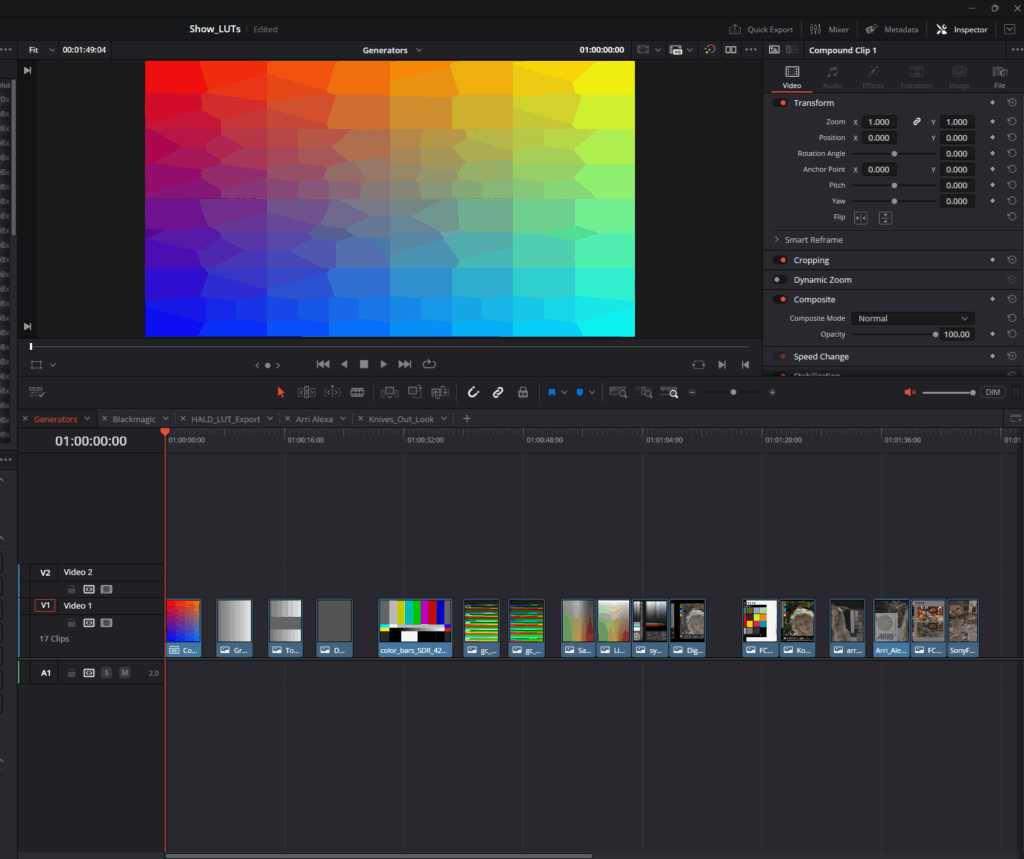
Simply gathering footage is not enough; it must be organized and sequenced thoughtfully. Test timelines must be constructed to reveal different failure modes: rapid shifts from bright exteriors to dim interiors, extreme saturation to near-monochrome, natural daylight to heavy artificial lighting. Each transition becomes a test of the LUT’s resilience.
Furthermore, footage should be juxtaposed to maximize stress on the transform. For instance, placing a RED clip next to an ARRI clip, or alternating between footage with and without deep shadows, forces the LUT to reveal its behavior under changing conditions.
In this way, the colorist is not waiting for issues to arise by accident but actively provoking them. As van Hurkman (2014) suggests, the integrity of a color transform is proven not in ideal conditions but when subjected to extremes.
Conclusion
The creation of a show LUT is ultimately a scientific inquiry wrapped in artistic purpose. By committing to footage diversity, employing objective reference points, maintaining pipeline neutrality, and designing tests that actively seek out failure, the colorist ensures that the final transform will not merely look good on a single shot but will endure the realities of production.
A show LUT, if built properly, becomes invisible—supporting story, mood, and emotion without drawing attention to itself. Achieving this level of reliability requires more than technical skill; it demands a methodological rigor rooted in the understanding that visual storytelling is at once a technical craft and an expressive art.
References
- Van Hurkman, A. (2014). Color Correction Handbook: Professional Techniques for Video and Cinema. 2nd ed., Peachpit Press.
- ICC (International Color Consortium). (2022). Introduction to the ICC Profile Format and Color Management Workflows. ICC White Paper Series.
- Poynton, C. (2012). Digital Video and HD: Algorithms and Interfaces. 2nd ed., Morgan Kaufmann.
Arney, D. (2021). Practical Color Management in Film and Video Postproduction. Postproduction Journal, Vol. 19
