When I arrived at the presentation of Plane of Emergence at IRCAM, the setup looked surprisingly simple at first. On the floor, inside a black marked rectangle, were two small cube-like devices, standing quietly next to each other. A big screen behind them showed a live camera view of the scene. I noticed a line connecting the two cubes on the projection, showing exactly how far they were apart. This was made possible by a motion-tracking camera mounted above, constantly measuring their positions.
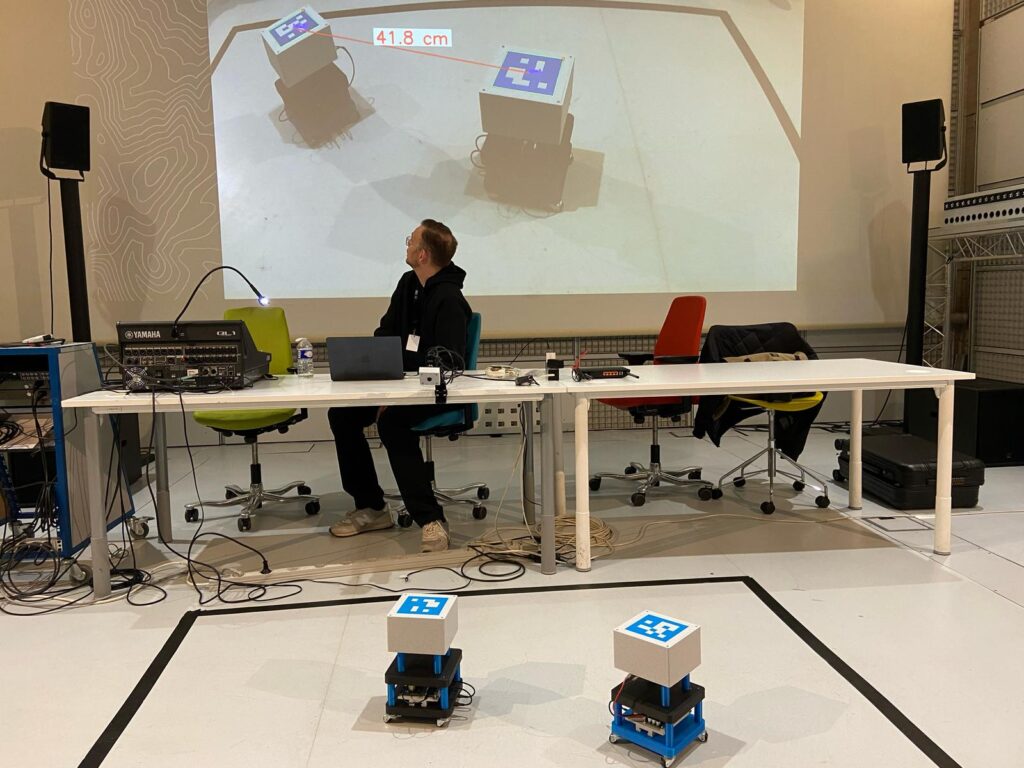
The artist explained that these devices were not normal speakers or instruments, but autonomous machines. They were able to listen, react, and transform musical patterns based on how close or far they were from each other. There was no conductor or composer telling them what to play — everything emerged from their interaction alone.
While listening, I could feel how the soundscape was always shifting. Sometimes you could recognize small repetitive patterns, like a rhythm or a melody fragment. But just when you thought something stable was forming, it suddenly dissolved into something new. The artist described this as a balance between “territorialization” — when the devices settle into stable patterns — and “deterritorialization” — when they break free and surprise you with unexpected variations. It felt like watching two creatures communicating and constantly changing their language.
The idea behind it is inspired by the philosopher Deleuze and his concept of the plane of immanence — a space where things don’t follow strict rules but constantly create themselves from within. I liked that you could really hear this concept, it wasn’t just theory.
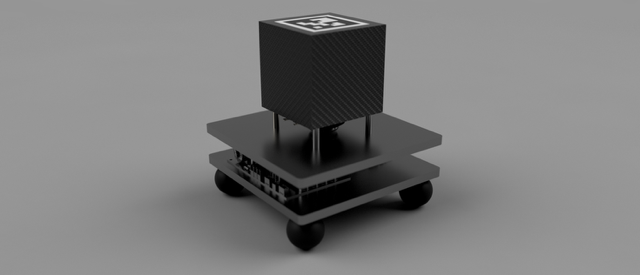
Technically, the system is based on a previous project called Spatially Distributed Instruments, where the machines not only send sounds but also “listen” to each other without noticeable delay. The sound you hear is not pre-composed, it is created in real-time from their relationship in space.
Unfortunately, as the artist mentioned, only two of the planned interaction methods were working that day. But even with these limitations, it was fascinating to see (and hear) how rich and alive the system already was.
For me, it was less like watching a performance and more like observing a small ecosystem made of sound and technology.
IRCAM Link: https://forum.ircam.fr/article/detail/plane-of-emergence/
