How do the users behave and respond to design interventions, such as carbon impact calculators or green streaming options? In the next paragraphs I would like to describe one scientific research from Germany made in January 2024 aimed to understand how feedback from the CFTA eco2log app affects consumer behavior and their carbon footprint.
The Study
This research involved 216 university students who used the CFTA eco2log app—a tool designed to calculate individual carbon emissions in four major consumption areas: mobility, food, heating, and household activities. Participants entered their current consumption habits into the app, which provided detailed feedback on their carbon footprint, both overall and in each domain.[1]
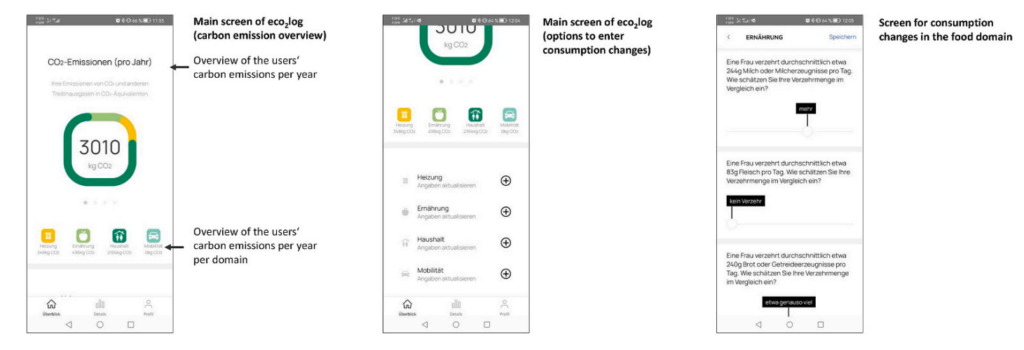
Screenshots of the App, https://www.sciencedirect.com/science/article/pii/S0959652623041392#dfig1
After receiving feedback, participants planned modifications to their consumption and entered these future plans into the app. The app then recalculated their estimated emissions based on these planned changes, giving participants an opportunity to reflect on their behaviors and make more sustainable choices.[1]
Key Findings
Awareness Sparks Action
The study revealed that awareness drives change. When participants were confronted with their actual carbon footprint, they were motivated to plan significant reductions in their emissions. On average, participants aimed to reduce their overall carbon emissions by 22.5%.However, the reductions varied by domain:
- Household activities saw the largest reduction (34.7%).
- Heating came next (26.9%), followed by food (16.4%).
- Mobility had the smallest reduction (12.0%), and this change was only marginally significant.
Feedback Drives Domain-Specific Changes
Interestingly, the app’s feedback was most effective in encouraging changes in the exact area where it highlighted high emissions. For example, feedback about high emissions from heating inspired participants to plan significant reductions in heating-related consumption. There were minimal cross-effects—feedback on one domain (e.g., mobility) didn’t strongly influence behavior in other areas (e.g., food).
Awareness Gaps
The study also showed that participants struggled to estimate their carbon footprint accurately, especially in specific domains. While they could gauge their overall footprint somewhat reliably, they often underestimated or overestimated emissions in individual areas like food or heating. This underscores the importance of tools like the CFTA app, which provide precise, data-driven feedback.[1]
What Does This Mean for Sustainability?
The study demonstrates that design interventions like the CFTA eco2log app can effectively encourage more sustainable behaviors by raising awareness and providing actionable feedback. However, it also highlights the need for tailored approaches. Not all users respond equally—some changes, like reducing food-related emissions, require different strategies than those for mobility or household activities.
Conclusion
Awareness alone is a powerful first step, but tools that provide specific, domain-focused insights are key to driving meaningful, lasting behavior changes. The principles tested in the study—awareness, actionable feedback, and domain-specific insights—are equally relevant and powerful in encouraging more sustainable behaviors in the digital world. Creating tools to measure and share the energy footprint of online activities could be the first step toward a greener digital future.
Resources:
[1] Stefan Hoffmann, Carbon footprint tracking apps. Does feedback help reduce carbon emissions?,
Journal of Cleaner Production, Volume 434, 2024, 139981, ISSN 0959-6526,https://www.sciencedirect.com/science/article/pii/S0959652623041392#dfig1
